

NR 509 Bates Midterm Exam Advanced
Physical Assessment Questions and Answers
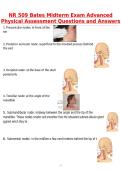
1. Preauricular nodes: in front of the
ear
2. Posterior auricular node: superficial to the mastoid process (behind
the ear)
3. Occipital node: at the base of the skull
posteriorly
4. Tonsillar node: at the angle of the
mandible
5. Submandibular node: midway between the angle and the tip of the are
mandible. These nodes smaller and smoother than the lobulated subman-dibular gland usually
against which they lie
6. Submental nodes: in the midline a few centi-meters behind the tip of the mandible
,7. Superficial cervical nodes: superficial to the sternocleidomastoid.
,8. Posterior cervical nodes: along the anterior edge of the
trapezius.
9. Deep cervical chain lymph nodes: deep to the ster-nocleidomastoid and inaccessible
often examination. Hook your thumb and fingers around either side of the to to find
sterno-cleidomastoid muscle them.
10. Supraclavicular nodes: deep in the angle formed by the clavicle and eidomastoi
the sterno-cl d.
11. shotty: Small, mobile, discrete, nontender nodes, are frequently found in normal people
12. physical assessment techniques: Inspection - visual examination; Palpation -
tactile examination; Percussion - tactile and auditory examination; Auscultation - auditory
examination
13. head and neck: Begin the physical assessment by inspecting
14. general appearance of head/neck: facial expression, contours, asymmetry
15. comprehensive assessment: Seeing patient for first time; Includes all the
elements of the health history and the complete physical examination; fundamental and
personalized knowledge about the patient that strengthens the clinician-patient relationship; provides
a complete basis for assessing these concerns and answering patient questions
16. focused assessment: chief complaint such as cough, abdominal pain, sore throat, etc.
or a follow-up for a chronic illness; Your history and physical will be much more focused on the chief
complaint as you begin diagnosis and management
17. basic: maximize patient's comfort, avoid unnecessary changes in position, enhance clinical
eflciency, move head to toe, examine the patient from their right side
, 18. active listening: closely attending to what the patient is communicating, connecting to
the patient's emo- tional state, and using verbal and nonverbal skills to encourage the patient to
expand on his or her feelings and concerns
19. Empathic responses: the capacity to identify with the patient and feel the patient's
pain as your own, then respond in a supportive manner
20. Guided questioning: show your sustained interest in the patient's feelings and
deepest disclosures and allows the interviewer to facilitate full communication, in the patient's own
words, without interruption.
21. Nonverbal communication: eye contact, facial expression, posture, head position
and movement such as shaking or nodding, interpersonal distance, and placement of the arms
or legs—crossed, neutral, or open
22. validation: helps to aflrm the legitimacy of the patient's emotional experience.
23. Partnering: When building rapport with patients, express your commitment to an
ongoing relationship
24. Summarization: Giving a capsule summary of the patient's story during the course
of the interview to communicate that you have been listening carefully.
25. Transitions: Inform your patient when you are changing directions during the interview
26. empowering the patient: encourage patients to ask questions, express their
concerns, and probe your recommendations in order to encourage them to adopt your advice,
make lifestyle changes, or take medications as prescribed.
27. subjective: apparent only to the person attected' perceptions, feelings, thoughts,
expectations. Cannot be observed and can be discovered only by asking questions
28. objective: detectable by an observer or can be tested against an acceptable standard;
tangible, observable facts; includes observation of the clients behavior, medical records, lab and
diagnostic tests, data collected by physical exam
29. chief complaint: Make every attempt to quote the patient's own words
30. 7 attributes of a symptom: Location, quality, quantity or severity, timing - including
onset duration and frequency, setting in which it occurs, alleviating/aggravating factors, associated
manifestations
31. Past medical history: Medications (prescription, OTC and herbs), allergies to drugs
foods seasonal envi- ronment (document reaction to each), childhood; illness/hospitalizations, adult
illnesses (diabetes, HTN, HIV, hispital- izations, gender of sexual partners, sexual practices), surgical
history (dates, indications, types), OBGYN (menstrual hx, methods of contraception, sexual function) ,
Physical Assessment Questions and Answers
1. Preauricular nodes: in front of the
ear
2. Posterior auricular node: superficial to the mastoid process (behind
the ear)
3. Occipital node: at the base of the skull
posteriorly
4. Tonsillar node: at the angle of the
mandible
5. Submandibular node: midway between the angle and the tip of the are
mandible. These nodes smaller and smoother than the lobulated subman-dibular gland usually
against which they lie
6. Submental nodes: in the midline a few centi-meters behind the tip of the mandible
,7. Superficial cervical nodes: superficial to the sternocleidomastoid.
,8. Posterior cervical nodes: along the anterior edge of the
trapezius.
9. Deep cervical chain lymph nodes: deep to the ster-nocleidomastoid and inaccessible
often examination. Hook your thumb and fingers around either side of the to to find
sterno-cleidomastoid muscle them.
10. Supraclavicular nodes: deep in the angle formed by the clavicle and eidomastoi
the sterno-cl d.
11. shotty: Small, mobile, discrete, nontender nodes, are frequently found in normal people
12. physical assessment techniques: Inspection - visual examination; Palpation -
tactile examination; Percussion - tactile and auditory examination; Auscultation - auditory
examination
13. head and neck: Begin the physical assessment by inspecting
14. general appearance of head/neck: facial expression, contours, asymmetry
15. comprehensive assessment: Seeing patient for first time; Includes all the
elements of the health history and the complete physical examination; fundamental and
personalized knowledge about the patient that strengthens the clinician-patient relationship; provides
a complete basis for assessing these concerns and answering patient questions
16. focused assessment: chief complaint such as cough, abdominal pain, sore throat, etc.
or a follow-up for a chronic illness; Your history and physical will be much more focused on the chief
complaint as you begin diagnosis and management
17. basic: maximize patient's comfort, avoid unnecessary changes in position, enhance clinical
eflciency, move head to toe, examine the patient from their right side
, 18. active listening: closely attending to what the patient is communicating, connecting to
the patient's emo- tional state, and using verbal and nonverbal skills to encourage the patient to
expand on his or her feelings and concerns
19. Empathic responses: the capacity to identify with the patient and feel the patient's
pain as your own, then respond in a supportive manner
20. Guided questioning: show your sustained interest in the patient's feelings and
deepest disclosures and allows the interviewer to facilitate full communication, in the patient's own
words, without interruption.
21. Nonverbal communication: eye contact, facial expression, posture, head position
and movement such as shaking or nodding, interpersonal distance, and placement of the arms
or legs—crossed, neutral, or open
22. validation: helps to aflrm the legitimacy of the patient's emotional experience.
23. Partnering: When building rapport with patients, express your commitment to an
ongoing relationship
24. Summarization: Giving a capsule summary of the patient's story during the course
of the interview to communicate that you have been listening carefully.
25. Transitions: Inform your patient when you are changing directions during the interview
26. empowering the patient: encourage patients to ask questions, express their
concerns, and probe your recommendations in order to encourage them to adopt your advice,
make lifestyle changes, or take medications as prescribed.
27. subjective: apparent only to the person attected' perceptions, feelings, thoughts,
expectations. Cannot be observed and can be discovered only by asking questions
28. objective: detectable by an observer or can be tested against an acceptable standard;
tangible, observable facts; includes observation of the clients behavior, medical records, lab and
diagnostic tests, data collected by physical exam
29. chief complaint: Make every attempt to quote the patient's own words
30. 7 attributes of a symptom: Location, quality, quantity or severity, timing - including
onset duration and frequency, setting in which it occurs, alleviating/aggravating factors, associated
manifestations
31. Past medical history: Medications (prescription, OTC and herbs), allergies to drugs
foods seasonal envi- ronment (document reaction to each), childhood; illness/hospitalizations, adult
illnesses (diabetes, HTN, HIV, hispital- izations, gender of sexual partners, sexual practices), surgical
history (dates, indications, types), OBGYN (menstrual hx, methods of contraception, sexual function) ,


