

BUSINESS ADMINISTRATION
Study online at https://quizlet.com/_92149k
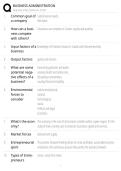
1. Common goal of Satisfy human needs;
a company Add value;
2. How can a busi- A business can compete on 2 levels: quality and quantity.
ness compete
with others?
3. Input factors of a Knowledge, HR, Natural resources; Capital and Entrepreneurship
business
4. Output factors goods and services
5. What are some Generating pollution and waste;
potential nega- creating health and safety risks;
tive effects of a disrupting communitites;
business? causing financial instability;
6. Environmental natural and physical;
forces to cultural;
consider Technological;
social;
Political and legal;
Economic;
7. What's the econ- The economy is the sum of all economic activities within a given region. It's the
omy? study of how a society uses its resouces to produce godds and services,
8. Market forces demand and supply
9. Entrepreneurial The positive, forward-thinking desire to create profitable, sustainable business
spirit enterprises. the continuous passion that pushes the business forward.
10. Types of Entre- classic, serial, first mover.
preneurs
, BUSINESS ADMINISTRATION
Study online at https://quizlet.com/_92149k
11. social entrepre- the pursuit of social goals while creating a profitable business
neurship
12. stages of Birth
an entrepreneur- breakthrough
ial firm maturity
13. small business an independently owned business that usually has the owner as its manager.
a small business has to: create jobs; introduce new products; meet the needs of
larger organizations; help the economy; take risks; provide specialized goods and
services;
14. Why small busi- Lack of experience, lack of commitment, lack of strategy, lack of expertise; growing
nesses fail too fast and insufficient financing;
15. Partnership a business owned by two or more people.
three types of partnership: General, Limited, Limited liability
16. Corporation A business that is owned by many investors.
S CORPORATION
LIMITES LIABILITY CORPORATION
BENEFIT CORPORATION
17. Main business Entrepreneurial spirit;
functions of a Production;
company Marketing;
R&D & Innovation;
Accounting and Finance;
Business services;
Organizatio & HR;
18. Information Sys- collects, create, process, store and distribute seful data;
tem
, BUSINESS ADMINISTRATION
Study online at https://quizlet.com/_92149k
19. artificial intelli- a subdiscipline of computer science that attempts to simulate human thinking.
gence Used for:
Transferring and cross-referencing data;
Understanding the consumers' behaviour;
Detecting fraud;
Personalizing ADV and marketing messaging;
20. Innovation vs In- Invention can be defined as the creation of a product or introduction of a process
vention for the first time. Innovation, on the other hand, occurs if someone improves on
or makes a significant contribution to an existing product, process or service.
21. Product Develop- 1. idea generation
ment Process 2. idea screening
3. business analysis
4. prototype development
5. test marketing
6. commercializing
22. circular view A series of related tasks are completed in succession, the results of the effort
are analyzed, and the insights from that analysis are used to improve quality and
efficiency of the next cycle of the process.
23. Production The process of creating goods and services.
From input to output.
24. production and Overseeing all the activities involved in producing goods and services.
operations man-
agement
25. supply chain it coordinates the flow of goods and materials from the supplier to the final
customer.
26.
Study online at https://quizlet.com/_92149k
1. Common goal of Satisfy human needs;
a company Add value;
2. How can a busi- A business can compete on 2 levels: quality and quantity.
ness compete
with others?
3. Input factors of a Knowledge, HR, Natural resources; Capital and Entrepreneurship
business
4. Output factors goods and services
5. What are some Generating pollution and waste;
potential nega- creating health and safety risks;
tive effects of a disrupting communitites;
business? causing financial instability;
6. Environmental natural and physical;
forces to cultural;
consider Technological;
social;
Political and legal;
Economic;
7. What's the econ- The economy is the sum of all economic activities within a given region. It's the
omy? study of how a society uses its resouces to produce godds and services,
8. Market forces demand and supply
9. Entrepreneurial The positive, forward-thinking desire to create profitable, sustainable business
spirit enterprises. the continuous passion that pushes the business forward.
10. Types of Entre- classic, serial, first mover.
preneurs
, BUSINESS ADMINISTRATION
Study online at https://quizlet.com/_92149k
11. social entrepre- the pursuit of social goals while creating a profitable business
neurship
12. stages of Birth
an entrepreneur- breakthrough
ial firm maturity
13. small business an independently owned business that usually has the owner as its manager.
a small business has to: create jobs; introduce new products; meet the needs of
larger organizations; help the economy; take risks; provide specialized goods and
services;
14. Why small busi- Lack of experience, lack of commitment, lack of strategy, lack of expertise; growing
nesses fail too fast and insufficient financing;
15. Partnership a business owned by two or more people.
three types of partnership: General, Limited, Limited liability
16. Corporation A business that is owned by many investors.
S CORPORATION
LIMITES LIABILITY CORPORATION
BENEFIT CORPORATION
17. Main business Entrepreneurial spirit;
functions of a Production;
company Marketing;
R&D & Innovation;
Accounting and Finance;
Business services;
Organizatio & HR;
18. Information Sys- collects, create, process, store and distribute seful data;
tem
, BUSINESS ADMINISTRATION
Study online at https://quizlet.com/_92149k
19. artificial intelli- a subdiscipline of computer science that attempts to simulate human thinking.
gence Used for:
Transferring and cross-referencing data;
Understanding the consumers' behaviour;
Detecting fraud;
Personalizing ADV and marketing messaging;
20. Innovation vs In- Invention can be defined as the creation of a product or introduction of a process
vention for the first time. Innovation, on the other hand, occurs if someone improves on
or makes a significant contribution to an existing product, process or service.
21. Product Develop- 1. idea generation
ment Process 2. idea screening
3. business analysis
4. prototype development
5. test marketing
6. commercializing
22. circular view A series of related tasks are completed in succession, the results of the effort
are analyzed, and the insights from that analysis are used to improve quality and
efficiency of the next cycle of the process.
23. Production The process of creating goods and services.
From input to output.
24. production and Overseeing all the activities involved in producing goods and services.
operations man-
agement
25. supply chain it coordinates the flow of goods and materials from the supplier to the final
customer.
26.


