

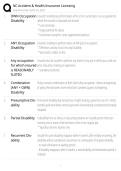
NC Accident & Health Insurance Licensing
Study online at https://quizlet.com/_6qst9t
1. OWN Occupation Insured's inability to perform duties of his or her current job or an occupation for
Disability which the insured is educated and trained
**Least restrictive
**Huge potential for abuse
**Uncommon except for some supplemental policies
2. ANY Occupation Insured's inability to perform duties of ANY job or occupation
Disability **Definition used by Social Security Disability
**Very hard to collect on this
3. Any occupation Insured must be unable to perform any duties of any job in which you could use
for which insured prior education, training or experience.
is REASONABLY **somewhat restrictive
SUITED
4. Combination Policy contains combination of both Own & Any occupation. Liberal at beginning
(ANY + OWN) of policy then becomes more restrictive to prevent against malingering.
Disability
5. Presumptive Dis- Permanent disability due to total loss of sight, hearing, speech or use of 2 + limbs;
ability benefits paid even while continuing to work. Automatically considered to be totally
disabled.
6. Partial Disability A disability from an illness or injury that prevents an insured person from per-
forming one or more of the functions of his or her regular job.
**Typically concerns injuries only
7. Recurrent Dis- should the same disability reappear within 6 months after initially recovering, the
ability disability will be considered a recurrence or continuation of original disability
- no new elimination or waiting period
- if disability reappears after 6 months, a new disability and elimination period is
initiated
, NC Accident & Health Insurance Licensing
Study online at https://quizlet.com/_6qst9t
8. Residual Disabili- Type of disability income policy that provides benefits for loss of income when a
ty person returns to work after a total disability, but is still not able to perform at the
same level as before becoming disabled.
**Benefits are pro rata & reduced as income increases
9. Non-Occupation- Insurance that excludes coverage from work related illness or injury. Injuries/
al Disability illnesses while on-the-job is usually covered under Worker's Comp
Coverage
10. Occupational Benefits covered both on & off the job.
(Full) Disability **Generally reserved for those who don't have Worker's Comp
Coverage
11. Probationary Pe- The period of time between the effective date of a health insurance policy and the
riod date coverage for all or certain conditions begins. During this time, losses from
sickness will NOT be covered but losses from accidents MAY be covered.
**eliminates coverage for pre-existing conditions
**protects against adverse selection
12. Elimination Peri- A period of days (time) that must pass after the onset of an illness or occurrence
od (Waiting Peri- of an accident before benefits will be payable.
od) **aka "time deductible"
13. Short Term Dis- Benefit period is up to 2 years; May cover accident, illness or both
ability
14. Long Term Dis- Helps replace portion of lost income for over 2 years or until the disabled individ-
ability ual turns 65.
15. Common Exclu- war, military service, intentionally self-inflicted injuries, aviation, overseas resi-
sions from Dis- dence, disabilities arising from committing a felony
ability Coverage **coverage can also be denied if insured was intoxicated or under the influence
of non prescribed narcotic when the loss occurred.
, NC Accident & Health Insurance Licensing
Study online at https://quizlet.com/_6qst9t
16. Social Security For those who have a minimum of 40 quarters/ work credits of FICA contributions
Disability -Disability MUST be permanent & total (in existence for > 5 months and anticipated
to last at least 1 year or end in death
-Complete inability to do ANY productive work
-Benefits are based upon am't of FICA contributions & # of dependents
17. COLA rider Provides a cost of living adjustment to benefit payments based on increases in
inflation
**Insured must have been receiving disability benefits for at least 12 months
before COLA is activated.
18. Guaranteed Pur- Insured is allowed to buy additional amounts of benefits at predetermined,
chase (Insurabili- selected intervals without needing to provide proof of insurability.
ty) Option
19. Basic Medical In- Pays hospital confinement on a reimbursement basis (benefits paid to insured)
surance or on service basis (paid directly to provider)
-combines hosptial polic, basic medical & surgical coverage
-First Dollar Coverage - no deductive or coinsurance.
20. Hospital Expens- Basic room and board charges are taken care of
es **Cover hospital "extras" or miscellaneous charges as well
**Drugs, x-rays, anesthesia, lab fees, dressings, supplied as an inpatient and the
use of the operation room and supplies
**Does not cover physician services
- All the information will be labeled out in how much they cover and on what
21. Surgical Expense Covers a surgeon's fee for inpatient procedures in accordance to scheduled
benefits for each procedure type
Absolute value - schedule of benefits with flat rate reimbursement
Relative value - reimbursement calculated via a conversion factor
UCR (Usual, Customary, Reasonable) - Pay rate is based on geographical average
Study online at https://quizlet.com/_6qst9t
1. OWN Occupation Insured's inability to perform duties of his or her current job or an occupation for
Disability which the insured is educated and trained
**Least restrictive
**Huge potential for abuse
**Uncommon except for some supplemental policies
2. ANY Occupation Insured's inability to perform duties of ANY job or occupation
Disability **Definition used by Social Security Disability
**Very hard to collect on this
3. Any occupation Insured must be unable to perform any duties of any job in which you could use
for which insured prior education, training or experience.
is REASONABLY **somewhat restrictive
SUITED
4. Combination Policy contains combination of both Own & Any occupation. Liberal at beginning
(ANY + OWN) of policy then becomes more restrictive to prevent against malingering.
Disability
5. Presumptive Dis- Permanent disability due to total loss of sight, hearing, speech or use of 2 + limbs;
ability benefits paid even while continuing to work. Automatically considered to be totally
disabled.
6. Partial Disability A disability from an illness or injury that prevents an insured person from per-
forming one or more of the functions of his or her regular job.
**Typically concerns injuries only
7. Recurrent Dis- should the same disability reappear within 6 months after initially recovering, the
ability disability will be considered a recurrence or continuation of original disability
- no new elimination or waiting period
- if disability reappears after 6 months, a new disability and elimination period is
initiated
, NC Accident & Health Insurance Licensing
Study online at https://quizlet.com/_6qst9t
8. Residual Disabili- Type of disability income policy that provides benefits for loss of income when a
ty person returns to work after a total disability, but is still not able to perform at the
same level as before becoming disabled.
**Benefits are pro rata & reduced as income increases
9. Non-Occupation- Insurance that excludes coverage from work related illness or injury. Injuries/
al Disability illnesses while on-the-job is usually covered under Worker's Comp
Coverage
10. Occupational Benefits covered both on & off the job.
(Full) Disability **Generally reserved for those who don't have Worker's Comp
Coverage
11. Probationary Pe- The period of time between the effective date of a health insurance policy and the
riod date coverage for all or certain conditions begins. During this time, losses from
sickness will NOT be covered but losses from accidents MAY be covered.
**eliminates coverage for pre-existing conditions
**protects against adverse selection
12. Elimination Peri- A period of days (time) that must pass after the onset of an illness or occurrence
od (Waiting Peri- of an accident before benefits will be payable.
od) **aka "time deductible"
13. Short Term Dis- Benefit period is up to 2 years; May cover accident, illness or both
ability
14. Long Term Dis- Helps replace portion of lost income for over 2 years or until the disabled individ-
ability ual turns 65.
15. Common Exclu- war, military service, intentionally self-inflicted injuries, aviation, overseas resi-
sions from Dis- dence, disabilities arising from committing a felony
ability Coverage **coverage can also be denied if insured was intoxicated or under the influence
of non prescribed narcotic when the loss occurred.
, NC Accident & Health Insurance Licensing
Study online at https://quizlet.com/_6qst9t
16. Social Security For those who have a minimum of 40 quarters/ work credits of FICA contributions
Disability -Disability MUST be permanent & total (in existence for > 5 months and anticipated
to last at least 1 year or end in death
-Complete inability to do ANY productive work
-Benefits are based upon am't of FICA contributions & # of dependents
17. COLA rider Provides a cost of living adjustment to benefit payments based on increases in
inflation
**Insured must have been receiving disability benefits for at least 12 months
before COLA is activated.
18. Guaranteed Pur- Insured is allowed to buy additional amounts of benefits at predetermined,
chase (Insurabili- selected intervals without needing to provide proof of insurability.
ty) Option
19. Basic Medical In- Pays hospital confinement on a reimbursement basis (benefits paid to insured)
surance or on service basis (paid directly to provider)
-combines hosptial polic, basic medical & surgical coverage
-First Dollar Coverage - no deductive or coinsurance.
20. Hospital Expens- Basic room and board charges are taken care of
es **Cover hospital "extras" or miscellaneous charges as well
**Drugs, x-rays, anesthesia, lab fees, dressings, supplied as an inpatient and the
use of the operation room and supplies
**Does not cover physician services
- All the information will be labeled out in how much they cover and on what
21. Surgical Expense Covers a surgeon's fee for inpatient procedures in accordance to scheduled
benefits for each procedure type
Absolute value - schedule of benefits with flat rate reimbursement
Relative value - reimbursement calculated via a conversion factor
UCR (Usual, Customary, Reasonable) - Pay rate is based on geographical average


