

ANATOMY (1st year nursing)
Study online at https://quizlet.com/_3oo0e2
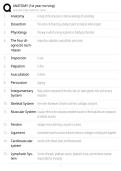
1. Anatomy A study of the structure or internal workings of something
2. Dissection The action of dissecting a body or plant to study its internal parts
3. Physiology The way in which a living organism or bodily part function
4. The four di- inspection, palpation, auscultation, percussion
agnostic tech-
niques
5. Inspection to see
6. Palpation to feel
7. Auscultation to listen
8. Percussion tapping
9. Integumentary Body system composed of the skin, hair, oil, sweat glands, nails and sensory
System receptors
10. Skeletal System The entire framework of bones and their cartilages and joints
11. Muscular System Usually refers to the voluntary contolled muscles of the body that are composed
of skeletal muscles
12. Tendon collagen tissue attaching a muscle to a bone
13. Ligament Connective tissue that connects bone to bone or cartilages or holds joints together
14. Cardiovascular consist of the blood, heart and blood vessels
system
15. Lymphatic Sys- Consist of lymph, lymphatic vessels, lymphatic tissue, and red bone marrow
tem responsible for immunity
1/8
, ANATOMY (1st year nursing)
Study online at https://quizlet.com/_3oo0e2
16. Immunity The state of being resistant to injury, particularly by poison, proteins, or invading
pathogens
17. Nervous system composed of a network of a billion neurons and neuroglia, divided into two main
divisions: The central and peripheral
18. Endocrine Sys- composed of all endocrine glands and hormone- secreting cells
tem
19. Digestive System study of the functions: consist of the gastrointestinal tract (mouth, pharynx,
esophagus, stomach, small intestines, and large intestines) and accessory diges-
tive organs (teeth, tongue, salivary glands, liver, gallbladder, and pancreas)
20. Respiratory Sys- study of the functions, consist of the nose, nasal cavity, pharynx, larynx, trachea,
tem bronchi and lungs
21. Urinary System Consist of the kidneys, ureters, urinary bladder, and urethra
22. Anatomical posi- The subject stands erect facing the observer, with the head level and the eyes
tion facing directly forward. Lower limbs are parallel and the feet flat on the floor
looking forward. The upper limbs are at the side with the palm facing forward.
23. Prone the body is lying face down
24. Supine the body is lying face up
25. Skull protects the brain
26. Face front portion with eyes, nose, mouth, forehead, cheeks and chin
27. Neck modified portion of the trunk, supports the head and attaches it to the remainder
of the trunk
28. Trunk Consist of the neck, thorax, abdomen, and pelvis
2/8
Study online at https://quizlet.com/_3oo0e2
1. Anatomy A study of the structure or internal workings of something
2. Dissection The action of dissecting a body or plant to study its internal parts
3. Physiology The way in which a living organism or bodily part function
4. The four di- inspection, palpation, auscultation, percussion
agnostic tech-
niques
5. Inspection to see
6. Palpation to feel
7. Auscultation to listen
8. Percussion tapping
9. Integumentary Body system composed of the skin, hair, oil, sweat glands, nails and sensory
System receptors
10. Skeletal System The entire framework of bones and their cartilages and joints
11. Muscular System Usually refers to the voluntary contolled muscles of the body that are composed
of skeletal muscles
12. Tendon collagen tissue attaching a muscle to a bone
13. Ligament Connective tissue that connects bone to bone or cartilages or holds joints together
14. Cardiovascular consist of the blood, heart and blood vessels
system
15. Lymphatic Sys- Consist of lymph, lymphatic vessels, lymphatic tissue, and red bone marrow
tem responsible for immunity
1/8
, ANATOMY (1st year nursing)
Study online at https://quizlet.com/_3oo0e2
16. Immunity The state of being resistant to injury, particularly by poison, proteins, or invading
pathogens
17. Nervous system composed of a network of a billion neurons and neuroglia, divided into two main
divisions: The central and peripheral
18. Endocrine Sys- composed of all endocrine glands and hormone- secreting cells
tem
19. Digestive System study of the functions: consist of the gastrointestinal tract (mouth, pharynx,
esophagus, stomach, small intestines, and large intestines) and accessory diges-
tive organs (teeth, tongue, salivary glands, liver, gallbladder, and pancreas)
20. Respiratory Sys- study of the functions, consist of the nose, nasal cavity, pharynx, larynx, trachea,
tem bronchi and lungs
21. Urinary System Consist of the kidneys, ureters, urinary bladder, and urethra
22. Anatomical posi- The subject stands erect facing the observer, with the head level and the eyes
tion facing directly forward. Lower limbs are parallel and the feet flat on the floor
looking forward. The upper limbs are at the side with the palm facing forward.
23. Prone the body is lying face down
24. Supine the body is lying face up
25. Skull protects the brain
26. Face front portion with eyes, nose, mouth, forehead, cheeks and chin
27. Neck modified portion of the trunk, supports the head and attaches it to the remainder
of the trunk
28. Trunk Consist of the neck, thorax, abdomen, and pelvis
2/8


