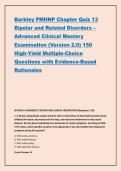
Barkley PMHNP Chapter Quiz 13
Bipolar and Related Disorders –
Advanced Clinical Mastery
Examination (Version 2.0) 150
High-Yield Multiple-Choice
Questions with Evidence-Based
Rationales
SECTION A: DIAGNOSTIC CRITERIA AND CLINICAL PRESENTATION (Questions 1-30)
1. A 26-year-old graduate student presents with a 9-day history of abnormally elevated mood,
inflated self-esteem, decreased need for sleep, and excessive involvement in risky sexual
behavior. She has been hospitalized once previously for similar symptoms. According to DSM-
5-TR criteria, which specifier would be most appropriate if she also exhibits three depressive
symptoms during this episode?
A. With anxious distress
B. With mixed features
C. With rapid cycling
D. With psychotic features
Correct Answer: B
,Rationale: The mixed features specifier is applied when an individual meets full criteria for a
manic or hypomanic episode and has at least three depressive symptoms (depressed mood,
diminished interest, psychomotor retardation, fatigue, guilt, sleep disturbance, appetite change,
or suicidal ideation) during the episode. This specifier is clinically significant because mixed
episodes are associated with increased suicide risk, poorer treatment outcomes, and higher
rates of psychiatric comorbidity.
2. A 34-year-old male presents with a 6-month history of fluctuating mood with periods of
hypomanic symptoms lasting 2-3 days alternating with depressive symptoms lasting 1-2
weeks. He has never met full criteria for a major depressive episode or hypomanic episode.
Which of the following is the most likely diagnosis?
A. Bipolar II disorder
B. Cyclothymic disorder
C. Unspecified bipolar and related disorder
D. Major depressive disorder with atypical features
Correct Answer: B
Rationale: Cyclothymic disorder is characterized by at least 2 years (1 year in
children/adolescents) of numerous periods with hypomanic symptoms that do not meet criteria
for a hypomanic episode and numerous periods with depressive symptoms that do not meet
criteria for a major depressive episode. Symptoms must be present for at least half the time,
and the individual must not have been without symptoms for more than 2 months at a time.
The patient's symptoms of 6 months duration do not yet meet the 2-year requirement, so a
diagnosis of "Other Specified Bipolar and Related Disorder" would be more appropriate.
However, cyclothymic disorder is the closest match among the options, though the duration is
insufficient.
3. A 29-year-old female presents with a 5-day history of elevated mood, increased energy, and
decreased need for sleep. She has no history of major depressive episodes. Her symptoms
have not caused marked impairment in social or occupational functioning. Which of the
following is the most appropriate diagnosis?
A. Bipolar I disorder, current episode manic
B. Bipolar II disorder, current episode hypomanic
C. Cyclothymic disorder
D. Bipolar II disorder with mixed features
,Correct Answer: B
Rationale: The patient meets criteria for a hypomanic episode (duration of 4 or more days, no
marked impairment, no psychotic features). A diagnosis of bipolar II disorder requires at least
one hypomanic episode and at least one major depressive episode. Since the patient has no
history of major depressive episodes, a diagnosis of "Other Specified Bipolar and Related
Disorder" would be more appropriate. However, among the options, bipolar II disorder is the
closest match for the current presentation.
4. A 48-year-old male with a 25-year history of bipolar I disorder presents with a manic
episode characterized by irritability, grandiosity, and decreased need for sleep. Which of the
following is the minimum number of associated symptoms required to meet DSM-5-TR
criteria for a manic episode when the mood is irritable?
A. Two symptoms
B. Three symptoms
C. Four symptoms
D. Five symptoms
Correct Answer: C
Rationale: For a manic episode, three or more of the associated symptoms must be present
(four if the mood is only irritable). This requirement reflects the clinical observation that
irritable mood alone may be less specific for mania, necessitating a higher threshold of
associated symptoms to confirm the diagnosis. The associated symptoms include inflated self-
esteem, decreased need for sleep, pressured speech, flight of ideas, distractibility, increased
goal-directed activity, and excessive involvement in risky activities.
5. A 31-year-old female presents with a 3-week history of depressed mood, anhedonia,
hypersomnia, hyperphagia, and leaden paralysis. She has a history of one prior episode of
elevated mood lasting 6 days with decreased need for sleep and grandiosity. Which of the
following is the most likely diagnosis?
A. Major depressive disorder, recurrent
B. Bipolar II disorder, current episode depressed
C. Bipolar I disorder, current episode depressed
D. Persistent depressive disorder with major depressive episode
Correct Answer: B
, Rationale: The patient has a history of a hypomanic episode (duration of 6 days, elevated mood,
decreased need for sleep, grandiosity) and is currently experiencing a major depressive episode
with atypical features. This meets criteria for bipolar II disorder (at least one hypomanic episode
and at least one major depressive episode, with no history of a manic episode). Atypical
features (hypersomnia, hyperphagia, leaden paralysis) are more commonly associated with
bipolar depression than unipolar depression.
6. A 52-year-old male with bipolar I disorder presents with a manic episode. He reports that
he has been "hearing God's voice" telling him to save the world. Which of the following is the
most appropriate specifier for this patient's diagnosis?
A. With anxious distress
B. With mixed features
C. With psychotic features
D. With rapid cycling
Correct Answer: C
Rationale: The presence of psychotic symptoms (auditory hallucinations with religious content)
during a manic episode warrants the specifier "with psychotic features." Psychotic features in
bipolar disorder are mood-congruent (the content is consistent with the mood, such as
grandiose delusions during mania) or mood-incongruent. This specifier has clinical implications
for treatment selection and prognosis.
7. A 22-year-old college student presents with a 2-week history of decreased need for sleep,
pressured speech, and flight of ideas. He has been engaging in excessive spending and has
accumulated significant credit card debt. His symptoms have caused marked impairment in
his academic performance. Which of the following is the most appropriate diagnosis?
A. Bipolar I disorder, current episode manic
B. Bipolar II disorder, current episode hypomanic
C. Cyclothymic disorder
D. Substance-induced bipolar disorder
Correct Answer: A
Rationale: The patient meets criteria for a manic episode (duration of at least 1 week, three or
more associated symptoms, and marked impairment). A diagnosis of bipolar I disorder requires
at least one lifetime manic episode. The presence of marked impairment and the duration of
Bipolar and Related Disorders –
Advanced Clinical Mastery
Examination (Version 2.0) 150
High-Yield Multiple-Choice
Questions with Evidence-Based
Rationales
SECTION A: DIAGNOSTIC CRITERIA AND CLINICAL PRESENTATION (Questions 1-30)
1. A 26-year-old graduate student presents with a 9-day history of abnormally elevated mood,
inflated self-esteem, decreased need for sleep, and excessive involvement in risky sexual
behavior. She has been hospitalized once previously for similar symptoms. According to DSM-
5-TR criteria, which specifier would be most appropriate if she also exhibits three depressive
symptoms during this episode?
A. With anxious distress
B. With mixed features
C. With rapid cycling
D. With psychotic features
Correct Answer: B
,Rationale: The mixed features specifier is applied when an individual meets full criteria for a
manic or hypomanic episode and has at least three depressive symptoms (depressed mood,
diminished interest, psychomotor retardation, fatigue, guilt, sleep disturbance, appetite change,
or suicidal ideation) during the episode. This specifier is clinically significant because mixed
episodes are associated with increased suicide risk, poorer treatment outcomes, and higher
rates of psychiatric comorbidity.
2. A 34-year-old male presents with a 6-month history of fluctuating mood with periods of
hypomanic symptoms lasting 2-3 days alternating with depressive symptoms lasting 1-2
weeks. He has never met full criteria for a major depressive episode or hypomanic episode.
Which of the following is the most likely diagnosis?
A. Bipolar II disorder
B. Cyclothymic disorder
C. Unspecified bipolar and related disorder
D. Major depressive disorder with atypical features
Correct Answer: B
Rationale: Cyclothymic disorder is characterized by at least 2 years (1 year in
children/adolescents) of numerous periods with hypomanic symptoms that do not meet criteria
for a hypomanic episode and numerous periods with depressive symptoms that do not meet
criteria for a major depressive episode. Symptoms must be present for at least half the time,
and the individual must not have been without symptoms for more than 2 months at a time.
The patient's symptoms of 6 months duration do not yet meet the 2-year requirement, so a
diagnosis of "Other Specified Bipolar and Related Disorder" would be more appropriate.
However, cyclothymic disorder is the closest match among the options, though the duration is
insufficient.
3. A 29-year-old female presents with a 5-day history of elevated mood, increased energy, and
decreased need for sleep. She has no history of major depressive episodes. Her symptoms
have not caused marked impairment in social or occupational functioning. Which of the
following is the most appropriate diagnosis?
A. Bipolar I disorder, current episode manic
B. Bipolar II disorder, current episode hypomanic
C. Cyclothymic disorder
D. Bipolar II disorder with mixed features
,Correct Answer: B
Rationale: The patient meets criteria for a hypomanic episode (duration of 4 or more days, no
marked impairment, no psychotic features). A diagnosis of bipolar II disorder requires at least
one hypomanic episode and at least one major depressive episode. Since the patient has no
history of major depressive episodes, a diagnosis of "Other Specified Bipolar and Related
Disorder" would be more appropriate. However, among the options, bipolar II disorder is the
closest match for the current presentation.
4. A 48-year-old male with a 25-year history of bipolar I disorder presents with a manic
episode characterized by irritability, grandiosity, and decreased need for sleep. Which of the
following is the minimum number of associated symptoms required to meet DSM-5-TR
criteria for a manic episode when the mood is irritable?
A. Two symptoms
B. Three symptoms
C. Four symptoms
D. Five symptoms
Correct Answer: C
Rationale: For a manic episode, three or more of the associated symptoms must be present
(four if the mood is only irritable). This requirement reflects the clinical observation that
irritable mood alone may be less specific for mania, necessitating a higher threshold of
associated symptoms to confirm the diagnosis. The associated symptoms include inflated self-
esteem, decreased need for sleep, pressured speech, flight of ideas, distractibility, increased
goal-directed activity, and excessive involvement in risky activities.
5. A 31-year-old female presents with a 3-week history of depressed mood, anhedonia,
hypersomnia, hyperphagia, and leaden paralysis. She has a history of one prior episode of
elevated mood lasting 6 days with decreased need for sleep and grandiosity. Which of the
following is the most likely diagnosis?
A. Major depressive disorder, recurrent
B. Bipolar II disorder, current episode depressed
C. Bipolar I disorder, current episode depressed
D. Persistent depressive disorder with major depressive episode
Correct Answer: B
, Rationale: The patient has a history of a hypomanic episode (duration of 6 days, elevated mood,
decreased need for sleep, grandiosity) and is currently experiencing a major depressive episode
with atypical features. This meets criteria for bipolar II disorder (at least one hypomanic episode
and at least one major depressive episode, with no history of a manic episode). Atypical
features (hypersomnia, hyperphagia, leaden paralysis) are more commonly associated with
bipolar depression than unipolar depression.
6. A 52-year-old male with bipolar I disorder presents with a manic episode. He reports that
he has been "hearing God's voice" telling him to save the world. Which of the following is the
most appropriate specifier for this patient's diagnosis?
A. With anxious distress
B. With mixed features
C. With psychotic features
D. With rapid cycling
Correct Answer: C
Rationale: The presence of psychotic symptoms (auditory hallucinations with religious content)
during a manic episode warrants the specifier "with psychotic features." Psychotic features in
bipolar disorder are mood-congruent (the content is consistent with the mood, such as
grandiose delusions during mania) or mood-incongruent. This specifier has clinical implications
for treatment selection and prognosis.
7. A 22-year-old college student presents with a 2-week history of decreased need for sleep,
pressured speech, and flight of ideas. He has been engaging in excessive spending and has
accumulated significant credit card debt. His symptoms have caused marked impairment in
his academic performance. Which of the following is the most appropriate diagnosis?
A. Bipolar I disorder, current episode manic
B. Bipolar II disorder, current episode hypomanic
C. Cyclothymic disorder
D. Substance-induced bipolar disorder
Correct Answer: A
Rationale: The patient meets criteria for a manic episode (duration of at least 1 week, three or
more associated symptoms, and marked impairment). A diagnosis of bipolar I disorder requires
at least one lifetime manic episode. The presence of marked impairment and the duration of