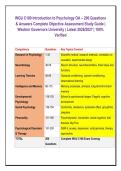
WGU C180 Introduction to Psychology OA – 200 Questions
& Answers Complete Objective Assessment Study Guide |
Western Governors University | Latest 2026/2027 | 100%
Verified
Competency Questions Key Topics Covered
Research in Psychology 1-35 Scientific method, research methods, correlation vs
causation, experimental design
Neurobiology 36-55 Neuron structure, neurotransmitters, brain lobes and
functions
Learning Theories 56-85 Classical conditioning, operant conditioning,
observational learning
Intelligence and Memory 86-115 Memory processes, amnesia, long-term/short-term
memory
Developmental 116-135 Erikson's psychosocial stages, Piaget's cognitive
Psychology development
Social Psychology 136-150 Conformity, obedience, bystander effect, groupthink,
prejudice
Personality 151-180 Psychodynamic, humanistic, social-cognitive, trait
theories; Big Five
Psychological Disorders 181-200 DSM-5, anxiety, depression, schizophrenia, therapy
& Therapy approaches
TOTAL 200 Complete WGU C180 Exam Coverag
Questions
,This comprehensive document contains 200 practice questions and verified answers for the WGU C180
Introduction to Psychology Objective Assessment. The questions cover all 8 competencies: Research in
Psychology, Neurobiology, Stages of Development, Social Cognition, Behaviorism and Learning Theories,
Intelligence and Memory, Emotion/Motivation/Personality, and Psychological Disorders . Each answer
includes the correct option in bold with a detailed rationale.
SECTION 1: FOUNDATIONS OF PSYCHOLOGY & RESEARCH METHODS (Questions
1–35)
1. What is the formal definition of psychology?
A) The study of human evolution and cultural development
B) The scientific study of the mind and behavior
C) The analysis of social structures and group dynamics
D) The examination of brain structure and function only
Answer: B
Psychology is formally defined as the scientific discipline that studies mental processes
(thoughts, emotions, perceptions) and observable behaviors. The key elements are that it is
"scientific" (based on empirical evidence) and covers both internal mental life and external
actions .
2. Which of the following do psychologists study? (Select all that apply)
A) Biological foundations (brain, hormones, genetics)
B) Mental life (thought processes, problem-solving)
,C) Change (development across the lifespan)
D) Self and others (self-judgment, relationships)
E) Potential and dysfunction (normal vs. abnormal behavior)
Answer: A, B, C, D, E
Psychology encompasses all these areas: biological underpinnings of behavior, internal
mental processes, developmental changes across the lifespan, social interactions and self-
perception, and the continuum from normal to dysfunctional behavior .
3. Who is considered the "father of psychology"?
A) Sigmund Freud
B) William James
C) Wilhelm Wundt
D) John Watson
Answer: C
Wilhelm Wundt established the first psychology laboratory in 1879 at the University of
Leipzig, Germany, marking the beginning of modern psychology as an independent
scientific discipline .
4. Who is considered the founder of structuralism?
A) William James
B) Sigmund Freud
C) Wilhelm Wundt
D) John Watson
, Answer: C
Wilhelm Wundt focused on breaking down mental processes into their most basic
components, an approach known as structuralism. He used introspection to examine the
structure of conscious experience .
5. Which early psychologist founded the school of functionalism?
A) Wilhelm Wundt
B) William James
C) Sigmund Freud
D) B.F. Skinner
Answer: B
William James was a prominent American psychologist who developed functionalism. This
school of thought emphasized the purpose of consciousness and behavior, focusing on how
mental processes help individuals adapt to their environment .
6. The psychodynamic perspective, founded by Sigmund Freud, emphasizes:
A) Observable behavior and environmental conditioning
B) Unconscious drives, repressed memories, and early childhood experiences
C) Free will and the innate drive toward self-actualization
D) Mental processes such as memory and problem-solving
Answer: B
& Answers Complete Objective Assessment Study Guide |
Western Governors University | Latest 2026/2027 | 100%
Verified
Competency Questions Key Topics Covered
Research in Psychology 1-35 Scientific method, research methods, correlation vs
causation, experimental design
Neurobiology 36-55 Neuron structure, neurotransmitters, brain lobes and
functions
Learning Theories 56-85 Classical conditioning, operant conditioning,
observational learning
Intelligence and Memory 86-115 Memory processes, amnesia, long-term/short-term
memory
Developmental 116-135 Erikson's psychosocial stages, Piaget's cognitive
Psychology development
Social Psychology 136-150 Conformity, obedience, bystander effect, groupthink,
prejudice
Personality 151-180 Psychodynamic, humanistic, social-cognitive, trait
theories; Big Five
Psychological Disorders 181-200 DSM-5, anxiety, depression, schizophrenia, therapy
& Therapy approaches
TOTAL 200 Complete WGU C180 Exam Coverag
Questions
,This comprehensive document contains 200 practice questions and verified answers for the WGU C180
Introduction to Psychology Objective Assessment. The questions cover all 8 competencies: Research in
Psychology, Neurobiology, Stages of Development, Social Cognition, Behaviorism and Learning Theories,
Intelligence and Memory, Emotion/Motivation/Personality, and Psychological Disorders . Each answer
includes the correct option in bold with a detailed rationale.
SECTION 1: FOUNDATIONS OF PSYCHOLOGY & RESEARCH METHODS (Questions
1–35)
1. What is the formal definition of psychology?
A) The study of human evolution and cultural development
B) The scientific study of the mind and behavior
C) The analysis of social structures and group dynamics
D) The examination of brain structure and function only
Answer: B
Psychology is formally defined as the scientific discipline that studies mental processes
(thoughts, emotions, perceptions) and observable behaviors. The key elements are that it is
"scientific" (based on empirical evidence) and covers both internal mental life and external
actions .
2. Which of the following do psychologists study? (Select all that apply)
A) Biological foundations (brain, hormones, genetics)
B) Mental life (thought processes, problem-solving)
,C) Change (development across the lifespan)
D) Self and others (self-judgment, relationships)
E) Potential and dysfunction (normal vs. abnormal behavior)
Answer: A, B, C, D, E
Psychology encompasses all these areas: biological underpinnings of behavior, internal
mental processes, developmental changes across the lifespan, social interactions and self-
perception, and the continuum from normal to dysfunctional behavior .
3. Who is considered the "father of psychology"?
A) Sigmund Freud
B) William James
C) Wilhelm Wundt
D) John Watson
Answer: C
Wilhelm Wundt established the first psychology laboratory in 1879 at the University of
Leipzig, Germany, marking the beginning of modern psychology as an independent
scientific discipline .
4. Who is considered the founder of structuralism?
A) William James
B) Sigmund Freud
C) Wilhelm Wundt
D) John Watson
, Answer: C
Wilhelm Wundt focused on breaking down mental processes into their most basic
components, an approach known as structuralism. He used introspection to examine the
structure of conscious experience .
5. Which early psychologist founded the school of functionalism?
A) Wilhelm Wundt
B) William James
C) Sigmund Freud
D) B.F. Skinner
Answer: B
William James was a prominent American psychologist who developed functionalism. This
school of thought emphasized the purpose of consciousness and behavior, focusing on how
mental processes help individuals adapt to their environment .
6. The psychodynamic perspective, founded by Sigmund Freud, emphasizes:
A) Observable behavior and environmental conditioning
B) Unconscious drives, repressed memories, and early childhood experiences
C) Free will and the innate drive toward self-actualization
D) Mental processes such as memory and problem-solving
Answer: B