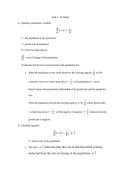
Task 1 – B. Bailey
A. Equation, parameters, variables
df f
f =rf (1− )
dt K
f = fish population at any given time
r = growth rate of population
K = fixed carrying capacity
df
= rate of change of fish population
dt
rf indicates that the rate is proportional to the population size
f
a. When the population is very small relative to the carrying capacity, will be
K
f
extremely close to 0, which means that (1− ) will essentially be 1, which
k
doesn’t impact the proportional relationship of the growth rate and the population
size.
f
When the population exceeds the carrying capacity, f > K , will be greater than
K
f f
1, which means that (1− ) will be negative. A negative (1− ) indicates that the
k k
growth rate is negative.
B. Modified equation
df
dt ( f
)
f =rf 1− −h √ f
K
h = harvest rate of the population
a. The term −h √ f indicates that the rate of fish harvested is being
deducted from the rate of change of the population. h √ f
, indicates the rate of harvest is proportional to the square of the
population size.
A. Equation, parameters, variables
df f
f =rf (1− )
dt K
f = fish population at any given time
r = growth rate of population
K = fixed carrying capacity
df
= rate of change of fish population
dt
rf indicates that the rate is proportional to the population size
f
a. When the population is very small relative to the carrying capacity, will be
K
f
extremely close to 0, which means that (1− ) will essentially be 1, which
k
doesn’t impact the proportional relationship of the growth rate and the population
size.
f
When the population exceeds the carrying capacity, f > K , will be greater than
K
f f
1, which means that (1− ) will be negative. A negative (1− ) indicates that the
k k
growth rate is negative.
B. Modified equation
df
dt ( f
)
f =rf 1− −h √ f
K
h = harvest rate of the population
a. The term −h √ f indicates that the rate of fish harvested is being
deducted from the rate of change of the population. h √ f
, indicates the rate of harvest is proportional to the square of the
population size.