
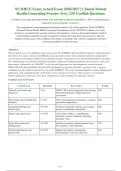
NCMHCE Exam Actual Exam 2026/2027 | Clinical Mental
Health Counseling Practice Test | 250 Verified Questions
NCMHCE Exam 2026-2027 QUESTIONS AND ANSWERS ALREADY GRADED A+. 100% Verified Solutions |
Updated Per Latest Guidelines | Graded A+
This comprehensive exam preparation document contains 250 verified questions for the NCMHCE
(National Clinical Mental Health Counseling Examination) for the 2026/2027 academic year. Each
question is accompanied by accurate solutions and rationales to ensure a deep understanding of clinical
mental health counseling concepts. Designed to simulate the actual exam, this resource is ideal for
students seeking to pass with confidence and achieve a top grade. The content is updated per the latest
counseling guidelines and best practices.
Abstract:
This document serves as a definitive study resource for the NCMHCE, offering 250 meticulously crafted questions
that mirror the exam's structure and difficulty. Each question is paired with a detailed rationale explaining the
correct answer and common distractors, facilitating a deeper comprehension of clinical mental health counseling.
The content spans core domains including assessment, diagnosis, treatment planning, ethical practice, and crisis
intervention. Updated for the 2026/2027 cycle, this guide integrates the latest diagnostic criteria from the
DSM-5-TR and ethical guidelines from the ACA. Designed for rigorous self-study or group review, it ensures
candidates are thoroughly prepared to excel on the NCMHCE. The answer format emphasizes critical thinking and
application, with explanations that clarify both correct and incorrect choices. This resource is essential for
students aiming for a high pass rate and a comprehensive understanding of counseling concepts.
Content Area Overview:
Content Area Questions Key Topics Weight
Clinical Assessment and 1-50 DSM-5-TR criteria, diagnostic interviewing, 20%
Diagnosis differential diagnosis, biopsychosocial
assessment
Counseling and Psychotherapy 51-100 CBT, psychodynamic, humanistic, systemic, 20%
Theories postmodern approaches
Treatment Planning and 101-150 Evidence-based interventions, goal setting, 20%
Intervention progress monitoring, termination
Ethical and Legal Issues 151-190 ACA Code of Ethics, confidentiality, 16%
informed consent, mandatory reporting,
boundary issues
Crisis Intervention and 191-220 Suicide assessment, trauma-informed care, 12%
Management de-escalation, safety planning
Professional Practice and 221-250 Supervision models, consultation, 12%
Supervision documentation, self-care, advocacy
Page 1
,Q1. A client with a history of childhood emotional neglect presents with chronic feelings of
emptiness, fears of abandonment, and a pattern of unstable relationships. The client reports
recurrent suicidal ideation without plan. Which diagnosis best captures the core pathology, and
what is the first-line pharmacological augmentation strategy if depressive symptoms persist after
adequate SSRI trial?
A. Borderline Personality Disorder with major depressive disorder; add aripiprazole
B. Persistent Depressive Disorder with anxious distress; add bupropion
C. Borderline Personality Disorder; add lamotrigine
D. Complex PTSD; add prazosin
Correct Answer: A. Borderline Personality Disorder with major depressive disorder; add
aripiprazole
Rationale: The symptoms (emptiness, abandonment fears, unstable relationships, suicidal ideation) are
classic for Borderline Personality Disorder. Comorbid major depressive disorder is common. For
treatment-resistant depression, aripiprazole is FDA-approved as augmentation. Bupropion may worsen
anxiety; lamotrigine is not first-line for depression; prazosin targets nightmares in PTSD.
Why Wrong:
B - Persistent Depressive Disorder lacks the interpersonal instability and abandonment fears central
to this case.
C - While BPD is correct, lamotrigine is not first-line for depressive augmentation; aripiprazole is.
D - Complex PTSD requires a history of prolonged trauma; this case focuses on emotional neglect,
not trauma per se. Prazosin is for nightmares.
Reference: DSM-5-TR; APA Practice Guideline for Major Depressive Disorder, 3rd Ed.
Q2. A counselor uses a manualized CBT protocol for generalized anxiety disorder. A client shows
minimal progress after 8 sessions, reporting that cognitive restructuring feels invalidating. The
counselor considers integrating a third-wave approach. Which integration is most theoretically
consistent and evidence-supported?
A. Switching to pure mindfulness-based stress reduction
B. Adding acceptance and commitment therapy techniques focusing on cognitive defusion and valued
action
C. Incorporating psychodynamic exploration of early attachment patterns
D. Using dialectical behavior therapy skills training for emotional regulation
Correct Answer: B. Adding acceptance and commitment therapy techniques focusing on cognitive
defusion and valued action
Rationale: ACT is a third-wave CBT that addresses the struggle with thoughts (cognitive defusion) and
promotes value-driven behavior, directly addressing the client's feeling of invalidation. MBSR is less
structured for GAD; psychodynamic and DBT are less directly aligned with CBT for GAD and have less
evidence for this specific integration.
Why Wrong:
A - MBSR lacks the explicit focus on values and action that targets avoidance in GAD.
C - Psychodynamic integration is not a third-wave CBT approach and has weaker evidence for
augmenting CBT in GAD.
D - DBT is designed for BPD and emotional dysregulation, not primarily for GAD.
Reference: Hofmann, S.G., & Asmundson, G.J.G. (2008). Acceptance and mindfulness-based therapy:
New wave or old hat? Clinical Psychology Review.
Page 2
,Q3. A licensed counselor discovers that a former client, now terminated for 6 months, is the CEO of
a company where the counselor's spouse is applying for a job. The counselor is asked by the spouse's
potential employer (the former client) for a character reference. According to the ACA Code of
Ethics, which action best upholds ethical standards?
A. Provide a reference focusing only on the client's professional competence, avoiding any therapeuti
c
information.
B. Decline the request, citing the dual relationship prohibition and confidentiality.
C. Obtain the former client's signed release and provide a balanced reference.
D. Refer the spouse to another counselor to avoid any appearance of impropriety.
Correct Answer: B. Decline the request, citing the dual relationship prohibition and confidentiality.
Rationale: ACA Code of Ethics (A.6.d.) prohibits using a former client relationship for personal gain or
advantage. Providing a reference, even with consent, creates a dual relationship that could exploit the
former client. The counselor must decline to avoid conflict of interest. Option A still uses the relationship;
C still creates a dual relationship; D does not address the counselor's own conflict.
Why Wrong:
A - Using the former client relationship for a reference, even limited, is a prohibited dual
relationship.
C - Consent does not negate the ethical prohibition against using former clients for personal benefit.
D - This does not resolve the counselor's own ethical duty to avoid the dual relationship.
Reference: ACA Code of Ethics (2014), Section A.6.d. Former Clients.
Q4. A counselor is working with a client who endorses auditory hallucinations commenting on their
actions, paranoia that coworkers are plotting harm, and disorganized speech. The client has been
stable on olanzapine for 2 years but now reports weight gain of 30 lbs and refuses medication. What
is the most appropriate initial step in treatment planning?
A. Refer to a psychiatrist for consideration of a switch to aripiprazole or lurasidone.
B. Validate the client's concerns and explore the meaning of the medication refusal using motivational
interviewing.
C. Implement a behavioral weight loss program while continuing olanzapine.
D. Discuss the risks of relapse versus side effects and recommend continuing olanzapine given its
efficacy.
Correct Answer: B. Validate the client's concerns and explore the meaning of the medication refusal
using motivational interviewing.
Rationale: The counselor must first understand the client's perspective and build alliance before any
medication change. Motivational interviewing helps explore ambivalence and increases adherence. A
direct referral (A) bypasses the client's autonomy; weight loss (C) may not address the core refusal;
recommending continuation (D) dismisses the client's distress.
Why Wrong:
A - This disregards the client's autonomy and the therapeutic relationship; the counselor should first
engage the client.
C - Weight loss alone does not address the client's refusal; the underlying reasons must be explored.
D - This dismisses the client's legitimate concerns and may damage rapport.
Reference: Miller, W.R., & Rollnick, S. (2013). Motivational Interviewing, 3rd Ed.
Page 3
, Q5. A counselor administers the Beck Depression Inventory-II (BDI-II) to a client who endorses '2'
on item 9 (suicidal thoughts). The total score is 28. Which combination of follow-up actions is most
consistent with current suicide risk assessment guidelines?
A. Immediately hospitalize the client because a score of 2 on item 9 indicates high risk.
B. Conduct a structured clinical interview to assess suicide risk, including intent, plan, means, and
protective factors.
C. Reassure the client that the BDI-II score indicates moderate depression and schedule a follow-up in
2 weeks.
D. Administer the Columbia-Suicide Severity Rating Scale (C-SSRS) and if the score is low, continue
outpatient therapy.
Correct Answer: B. Conduct a structured clinical interview to assess suicide risk, including intent,
plan, means, and protective factors.
Rationale: Suicide risk assessment requires clinical interview, not reliance on a single item score. The
BDI-II item 9 indicates suicidal ideation but not severity; a comprehensive assessment (intent, plan,
means, protective factors) is essential. Hospitalization (A) may be premature; reassurance (C) ignores
risk; C-SSRS is a tool but should be part of a clinical interview, not a replacement.
Why Wrong:
A - A score of 2 on item 9 indicates ideation but not necessarily imminent risk; hospitalization
requires clinical judgment.
C - This minimizes the reported ideation and delays appropriate assessment.
D - The C-SSRS is a structured assessment, but clinical interview is still the gold standard; low score
does not rule out risk.
Reference: American Psychiatric Association. (2003). Practice Guideline for the Assessment and
Treatment of Patients with Suicidal Behaviors.
Q6. A client from a collectivist culture presents with somatic complaints (headaches, fatigue) and
avoids discussing emotions. The counselor, trained in Western CBT, wants to address underlying
anxiety. Which adaptation is most culturally responsive while maintaining fidelity to CBT
principles?
A. Replace cognitive restructuring with behavioral activation only, focusing on pleasant activities.
B. Introduce the cognitive model using somatic metaphors (e.g., 'tension in the body is like a warning
signal') and incorporate culturally acceptable coping strategies.
C. Refer the client to a traditional healer while continuing CBT separately.
D. Explain that somatic symptoms are caused by unexpressed emotions and encourage direct
emotional expression.
Correct Answer: B. Introduce the cognitive model using somatic metaphors (e.g., 'tension in the
body is like a warning signal') and incorporate culturally acceptable coping strategies.
Rationale: Using somatic metaphors aligns CBT with the client's cultural framework, making it
acceptable. Behavioral activation alone (A) may miss cognitive components; referral (C) may fragment
care; direct emotional expression (D) may violate cultural norms and cause distress.
Why Wrong:
A - Behavioral activation is helpful but may not fully address the cognitive aspects of anxiety.
C - This may create a split treatment without integration; the counselor should adapt their approach
first.
D - Direct emotional expression may be culturally inappropriate and increase resistance.
Page 4


