

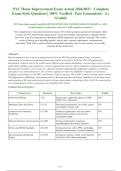
NYC Home Improvement Exam Actual 2026/2027 - Complete
Exam-Style Questions | 100% Verified - Pass Guaranteed - A+
Graded
NYC Home Improvement Exam 2026-2027 QUESTIONS AND ANSWERS ALREADY GRADED A+. 100%
Verified Solutions | Updated Per Latest NYC DOB Guidelines | Graded A+
This comprehensive exam prep document contains 250 verified questions and answers designed to help
you pass the NYC Home Improvement Exam on your first attempt. Each question is aligned with the
latest New York City Department of Buildings (DOB) regulations and industry standards. The content
covers all critical areas including permits, safety codes, contract requirements, and inspection
procedures. With 100% verified solutions and detailed rationales, this resource ensures you are fully
prepared for the actual exam.
Abstract:
This document provides a rigorous preparation tool for the NYC Home Improvement Exam, a licensure
requirement for contractors performing home improvement work in New York City. The 250 questions are
meticulously crafted to mirror the actual exam's difficulty and content distribution, covering topics such as permit
applications, building code compliance, contract requirements, lien law, safety regulations, and business practices.
Each question includes a correct answer, a detailed rationale explaining the underlying regulation or principle,
and analysis of common distractors. The content is updated to reflect the 2026/2027 regulatory environment,
including recent changes to the NYC Construction Codes, Local Law 196 of 2021 (carbon emission limits), and the
NYC Department of Buildings' enforcement policies. By mastering these questions, candidates will develop a deep
understanding of the legal and practical aspects of home improvement contracting in New York City, ensuring they
are well-prepared to achieve a passing score and obtain their license.
Content Area Overview:
Content Area Questions Key Topics Weight
Permits and Filings 1-50 Permit types, application process, DOB 20%
NOW, fees, inspections
Building Codes and Safety 51-110 Structural requirements, fire safety, egress, 24%
accessibility, energy code
Contracts and Consumer 111-160 Contract requirements, lien law, home 20%
Protection improvement contracts, disclosures,
cancellation rights
Business Practices and Licensing 161-200 License requirements, insurance, 16%
recordkeeping, advertising, penalties
Safety and OSHA Standards 201-230 Construction site safety, PPE, scaffolding, 12%
hazard communication, accident reporting
Environmental and Special 231-250 Lead paint, asbestos, mold, waste disposal, 8%
Topics Local Law 196 (carbon emissions)
Page 1
,Q1. A contractor is performing a gut renovation of a pre-war apartment in Manhattan. The
building has an active certificate of occupancy for residential use. Which of the following alterations
would require a full-demolition permit rather than an alteration permit?
A. Removal of all interior partitions and finishes down to the structural frame, while retaining the
exterior walls and roof.
B. Removal of all non-load-bearing walls and replacement of all plumbing and electrical systems
within the same footprint.
C. Removal of all interior finishes, including plaster and lath, down to the masonry walls, without
altering the structural frame.
D. Removal of the entire interior, including all structural elements, leaving only the facade and party
walls.
Correct Answer: D. Removal of the entire interior, including all structural elements, leaving only
the facade and party walls.
Rationale: Under NYC Building Code Section 28-101.5, a full-demolition permit is required when the
scope of work removes all structural elements and reduces the building to only the facade and party
walls. Options A, B, and C involve less extensive work that qualifies for alteration permits.
Why Wrong:
A - Retaining the structural frame and exterior walls qualifies as an alteration, not a full demolition.
B - Replacing systems within the same footprint without structural changes is an alteration.
C - Removing finishes only, without altering structure, is an alteration.
Reference: NYC Building Code, Chapter 28, Section 28-101.5; NYC DOB Technical Policy and
Procedure Notice #5/2006.
Q2. A contractor plans to install a new gas-fired boiler in a residential basement. The boiler room
must be separated from the rest of the building by fire-resistance-rated construction. According to
the NYC Mechanical Code, what is the minimum fire-resistance rating required for the walls and
door of the boiler room?
A. 1-hour fire-resistance rating for walls and a 1-hour fire-rated door assembly.
B. 2-hour fire-resistance rating for walls and a 1-hour fire-rated door assembly.
C. 1-hour fire-resistance rating for walls and a 3-hour fire-rated door assembly.
D. 2-hour fire-resistance rating for walls and a 2-hour fire-rated door assembly.
Correct Answer: B. 2-hour fire-resistance rating for walls and a 1-hour fire-rated door assembly.
Rationale: NYC Mechanical Code Section 304.1 requires boiler rooms to be separated by 2-hour
fire-resistance-rated walls and a 1-hour fire-rated door assembly. This provides sufficient containment
for potential boiler fires while allowing egress.
Why Wrong:
A - 1-hour walls are insufficient for boiler rooms per code.
C - A 3-hour door is not required and would be excessive.
D - A 2-hour door is not required; 1-hour is sufficient.
Reference: NYC Mechanical Code, Section 304.1; NFPA 54/ANSI Z223.1 (National Fuel Gas Code).
Page 2
,Q3. A homeowner hires a contractor to replace all windows in a brownstone. The contractor is a
licensed home improvement contractor but does not hold a special license for window installation.
Which of the following statements is correct regarding the legal requirements for this work?
A. The contractor may perform the work under the home improvement license because window
replacement is a standard home improvement activity.
B. The contractor must subcontract the work to a licensed window installer or obtain a separate
window installation license.
C. The contractor may perform the work only if the homeowner signs a waiver acknowledging the
contractor lacks the specific license.
D. The contractor may perform the work if he registers with the NYC Department of Buildings as a
window installer for that specific project.
Correct Answer: B. The contractor must subcontract the work to a licensed window installer or
obtain a separate window installation license.
Rationale: NYC Administrative Code Title 20, Chapter 2 requires a separate license for window
installation (including replacement) under the jurisdiction of the Department of Consumer and Worker
Protection. A general home improvement license does not cover window installation; subcontracting to a
licensed window installer is required.
Why Wrong:
A - Window replacement is not covered under a general home improvement license; a separate
license is needed.
C - Waivers cannot override licensing requirements; the contractor would still be unlicensed.
D - Registration for a single project is not a valid substitute for a license.
Reference: NYC Administrative Code, Title 20, Chapter 2, §20-387; DCWP Licensing Requirements.
Q4. During a kitchen renovation, a contractor discovers that the existing electrical panel is a
Federal Pacific Stab-Lok type. The homeowner asks the contractor to simply replace a few
breakers. What is the best course of action?
A. Replace the breakers as requested, as the panel is still functional.
B. Advise the homeowner that the panel is a known fire hazard and recommend immediate
replacement of the entire panel.
C. Replace the breakers but install an arc-fault circuit interrupter (AFCI) for additional safety.
D. Leave the panel untouched and perform only non-electrical work to avoid liability.
Correct Answer: B. Advise the homeowner that the panel is a known fire hazard and recommend
immediate replacement of the entire panel.
Rationale: Federal Pacific Stab-Lok panels have a history of failing to trip during overcurrent conditions,
posing a significant fire risk. The Consumer Product Safety Commission has identified them as
hazardous. The contractor should recommend full replacement to ensure safety and code compliance.
Simply replacing breakers does not address the inherent defect.
Why Wrong:
A - Using a known defective panel is unsafe and may violate code.
C - AFCI breakers do not fix the fundamental failure of the panel to trip.
D - Ignoring the issue does not satisfy the contractor's duty to advise of safety hazards.
Reference: CPSC Recall of Federal Pacific Electric Stab-Lok Panels; NFPA 70 (NEC) Article 110; NYC
Electrical Code.
Page 3
, Q5. A contractor is hired to replace a 1,200 sq ft flat roof on a row house. The existing roof has two
layers of built-up roofing. The new roof will be a single-ply membrane. Which of the following is
true regarding the removal of existing roofing?
A. The contractor may install the new membrane directly over the existing two layers if the roof slope
is at least 1/4:12.
B. The contractor must remove all existing roofing down to the deck because more than two layers are
present.
C. The contractor must remove only the top layer, leaving the bottom layer as a base, because the
building is in a historic district.
D. The contractor may leave both layers if a structural analysis shows the deck can support the
additional weight.
Correct Answer: B. The contractor must remove all existing roofing down to the deck because more
than two layers are present.
Rationale: NYC Building Code Section 1507.1 and the International Building Code limit the number of
roof covering layers to two. Since two layers already exist, the contractor must remove all existing
roofing down to the deck before installing the new membrane. Option D is incorrect because the code
does not permit exceeding two layers regardless of structural capacity.
Why Wrong:
A - Installing over two existing layers would create a third layer, exceeding the code limit.
C - Historic district rules do not exempt from roofing layer limits.
D - Structural capacity does not override the two-layer maximum.
Reference: NYC Building Code, Section 1507.1; International Building Code 2014, Section 1507.1.
Q6. A contractor enters into a home improvement contract for $8,000 with a homeowner. The
contractor requests a down payment of $2,500 before starting work. According to NYC Home
Improvement Contractor regulations, which of the following is correct?
A. The contractor may request any amount as a down payment, but must place it in an escrow
account.
B. The down payment may not exceed $1,500, and the contractor must provide a written contract with
specific disclosures.
C. The down payment may be up to 25% of the contract price, but only if the contractor posts a bond.
D. The down payment is limited to $1,500 or 10% of the contract price, whichever is less, and must
be deposited into a separate escrow account.
Correct Answer: D. The down payment is limited to $1,500 or 10% of the contract price, whichever
is less, and must be deposited into a separate escrow account.
Rationale: Under NYC Administrative Code §20-712, for home improvement contracts over $500, the
down payment is limited to the lesser of $1,500 or 10% of the contract price. The contractor must deposit
the funds into an escrow account. Since $8,000 × 10% = $800, which is less than $1,500, the maximum
down payment is $800, not $2,500.
Why Wrong:
A - The amount is capped; not any amount is allowed.
B - The limit is the lesser of $1,500 or 10%, not a flat $1,500.
C - Bonding does not increase the down payment limit.
Reference: NYC Administrative Code, Title 20, Chapter 2, §20-712; DCWP Home Improvement
Contractor Regulations.
Page 4
Exam-Style Questions | 100% Verified - Pass Guaranteed - A+
Graded
NYC Home Improvement Exam 2026-2027 QUESTIONS AND ANSWERS ALREADY GRADED A+. 100%
Verified Solutions | Updated Per Latest NYC DOB Guidelines | Graded A+
This comprehensive exam prep document contains 250 verified questions and answers designed to help
you pass the NYC Home Improvement Exam on your first attempt. Each question is aligned with the
latest New York City Department of Buildings (DOB) regulations and industry standards. The content
covers all critical areas including permits, safety codes, contract requirements, and inspection
procedures. With 100% verified solutions and detailed rationales, this resource ensures you are fully
prepared for the actual exam.
Abstract:
This document provides a rigorous preparation tool for the NYC Home Improvement Exam, a licensure
requirement for contractors performing home improvement work in New York City. The 250 questions are
meticulously crafted to mirror the actual exam's difficulty and content distribution, covering topics such as permit
applications, building code compliance, contract requirements, lien law, safety regulations, and business practices.
Each question includes a correct answer, a detailed rationale explaining the underlying regulation or principle,
and analysis of common distractors. The content is updated to reflect the 2026/2027 regulatory environment,
including recent changes to the NYC Construction Codes, Local Law 196 of 2021 (carbon emission limits), and the
NYC Department of Buildings' enforcement policies. By mastering these questions, candidates will develop a deep
understanding of the legal and practical aspects of home improvement contracting in New York City, ensuring they
are well-prepared to achieve a passing score and obtain their license.
Content Area Overview:
Content Area Questions Key Topics Weight
Permits and Filings 1-50 Permit types, application process, DOB 20%
NOW, fees, inspections
Building Codes and Safety 51-110 Structural requirements, fire safety, egress, 24%
accessibility, energy code
Contracts and Consumer 111-160 Contract requirements, lien law, home 20%
Protection improvement contracts, disclosures,
cancellation rights
Business Practices and Licensing 161-200 License requirements, insurance, 16%
recordkeeping, advertising, penalties
Safety and OSHA Standards 201-230 Construction site safety, PPE, scaffolding, 12%
hazard communication, accident reporting
Environmental and Special 231-250 Lead paint, asbestos, mold, waste disposal, 8%
Topics Local Law 196 (carbon emissions)
Page 1
,Q1. A contractor is performing a gut renovation of a pre-war apartment in Manhattan. The
building has an active certificate of occupancy for residential use. Which of the following alterations
would require a full-demolition permit rather than an alteration permit?
A. Removal of all interior partitions and finishes down to the structural frame, while retaining the
exterior walls and roof.
B. Removal of all non-load-bearing walls and replacement of all plumbing and electrical systems
within the same footprint.
C. Removal of all interior finishes, including plaster and lath, down to the masonry walls, without
altering the structural frame.
D. Removal of the entire interior, including all structural elements, leaving only the facade and party
walls.
Correct Answer: D. Removal of the entire interior, including all structural elements, leaving only
the facade and party walls.
Rationale: Under NYC Building Code Section 28-101.5, a full-demolition permit is required when the
scope of work removes all structural elements and reduces the building to only the facade and party
walls. Options A, B, and C involve less extensive work that qualifies for alteration permits.
Why Wrong:
A - Retaining the structural frame and exterior walls qualifies as an alteration, not a full demolition.
B - Replacing systems within the same footprint without structural changes is an alteration.
C - Removing finishes only, without altering structure, is an alteration.
Reference: NYC Building Code, Chapter 28, Section 28-101.5; NYC DOB Technical Policy and
Procedure Notice #5/2006.
Q2. A contractor plans to install a new gas-fired boiler in a residential basement. The boiler room
must be separated from the rest of the building by fire-resistance-rated construction. According to
the NYC Mechanical Code, what is the minimum fire-resistance rating required for the walls and
door of the boiler room?
A. 1-hour fire-resistance rating for walls and a 1-hour fire-rated door assembly.
B. 2-hour fire-resistance rating for walls and a 1-hour fire-rated door assembly.
C. 1-hour fire-resistance rating for walls and a 3-hour fire-rated door assembly.
D. 2-hour fire-resistance rating for walls and a 2-hour fire-rated door assembly.
Correct Answer: B. 2-hour fire-resistance rating for walls and a 1-hour fire-rated door assembly.
Rationale: NYC Mechanical Code Section 304.1 requires boiler rooms to be separated by 2-hour
fire-resistance-rated walls and a 1-hour fire-rated door assembly. This provides sufficient containment
for potential boiler fires while allowing egress.
Why Wrong:
A - 1-hour walls are insufficient for boiler rooms per code.
C - A 3-hour door is not required and would be excessive.
D - A 2-hour door is not required; 1-hour is sufficient.
Reference: NYC Mechanical Code, Section 304.1; NFPA 54/ANSI Z223.1 (National Fuel Gas Code).
Page 2
,Q3. A homeowner hires a contractor to replace all windows in a brownstone. The contractor is a
licensed home improvement contractor but does not hold a special license for window installation.
Which of the following statements is correct regarding the legal requirements for this work?
A. The contractor may perform the work under the home improvement license because window
replacement is a standard home improvement activity.
B. The contractor must subcontract the work to a licensed window installer or obtain a separate
window installation license.
C. The contractor may perform the work only if the homeowner signs a waiver acknowledging the
contractor lacks the specific license.
D. The contractor may perform the work if he registers with the NYC Department of Buildings as a
window installer for that specific project.
Correct Answer: B. The contractor must subcontract the work to a licensed window installer or
obtain a separate window installation license.
Rationale: NYC Administrative Code Title 20, Chapter 2 requires a separate license for window
installation (including replacement) under the jurisdiction of the Department of Consumer and Worker
Protection. A general home improvement license does not cover window installation; subcontracting to a
licensed window installer is required.
Why Wrong:
A - Window replacement is not covered under a general home improvement license; a separate
license is needed.
C - Waivers cannot override licensing requirements; the contractor would still be unlicensed.
D - Registration for a single project is not a valid substitute for a license.
Reference: NYC Administrative Code, Title 20, Chapter 2, §20-387; DCWP Licensing Requirements.
Q4. During a kitchen renovation, a contractor discovers that the existing electrical panel is a
Federal Pacific Stab-Lok type. The homeowner asks the contractor to simply replace a few
breakers. What is the best course of action?
A. Replace the breakers as requested, as the panel is still functional.
B. Advise the homeowner that the panel is a known fire hazard and recommend immediate
replacement of the entire panel.
C. Replace the breakers but install an arc-fault circuit interrupter (AFCI) for additional safety.
D. Leave the panel untouched and perform only non-electrical work to avoid liability.
Correct Answer: B. Advise the homeowner that the panel is a known fire hazard and recommend
immediate replacement of the entire panel.
Rationale: Federal Pacific Stab-Lok panels have a history of failing to trip during overcurrent conditions,
posing a significant fire risk. The Consumer Product Safety Commission has identified them as
hazardous. The contractor should recommend full replacement to ensure safety and code compliance.
Simply replacing breakers does not address the inherent defect.
Why Wrong:
A - Using a known defective panel is unsafe and may violate code.
C - AFCI breakers do not fix the fundamental failure of the panel to trip.
D - Ignoring the issue does not satisfy the contractor's duty to advise of safety hazards.
Reference: CPSC Recall of Federal Pacific Electric Stab-Lok Panels; NFPA 70 (NEC) Article 110; NYC
Electrical Code.
Page 3
, Q5. A contractor is hired to replace a 1,200 sq ft flat roof on a row house. The existing roof has two
layers of built-up roofing. The new roof will be a single-ply membrane. Which of the following is
true regarding the removal of existing roofing?
A. The contractor may install the new membrane directly over the existing two layers if the roof slope
is at least 1/4:12.
B. The contractor must remove all existing roofing down to the deck because more than two layers are
present.
C. The contractor must remove only the top layer, leaving the bottom layer as a base, because the
building is in a historic district.
D. The contractor may leave both layers if a structural analysis shows the deck can support the
additional weight.
Correct Answer: B. The contractor must remove all existing roofing down to the deck because more
than two layers are present.
Rationale: NYC Building Code Section 1507.1 and the International Building Code limit the number of
roof covering layers to two. Since two layers already exist, the contractor must remove all existing
roofing down to the deck before installing the new membrane. Option D is incorrect because the code
does not permit exceeding two layers regardless of structural capacity.
Why Wrong:
A - Installing over two existing layers would create a third layer, exceeding the code limit.
C - Historic district rules do not exempt from roofing layer limits.
D - Structural capacity does not override the two-layer maximum.
Reference: NYC Building Code, Section 1507.1; International Building Code 2014, Section 1507.1.
Q6. A contractor enters into a home improvement contract for $8,000 with a homeowner. The
contractor requests a down payment of $2,500 before starting work. According to NYC Home
Improvement Contractor regulations, which of the following is correct?
A. The contractor may request any amount as a down payment, but must place it in an escrow
account.
B. The down payment may not exceed $1,500, and the contractor must provide a written contract with
specific disclosures.
C. The down payment may be up to 25% of the contract price, but only if the contractor posts a bond.
D. The down payment is limited to $1,500 or 10% of the contract price, whichever is less, and must
be deposited into a separate escrow account.
Correct Answer: D. The down payment is limited to $1,500 or 10% of the contract price, whichever
is less, and must be deposited into a separate escrow account.
Rationale: Under NYC Administrative Code §20-712, for home improvement contracts over $500, the
down payment is limited to the lesser of $1,500 or 10% of the contract price. The contractor must deposit
the funds into an escrow account. Since $8,000 × 10% = $800, which is less than $1,500, the maximum
down payment is $800, not $2,500.
Why Wrong:
A - The amount is capped; not any amount is allowed.
B - The limit is the lesser of $1,500 or 10%, not a flat $1,500.
C - Bonding does not increase the down payment limit.
Reference: NYC Administrative Code, Title 20, Chapter 2, §20-712; DCWP Home Improvement
Contractor Regulations.
Page 4


