
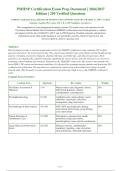
PMHNP Certification Exam Prep Document | 2026/2027
Edition | 250 Verified Questions
PMHNP Certification Exam 2026-2027 QUESTIONS AND ANSWERS ALREADY GRADED A+. 100% Verified
Solutions | Updated Per Latest ANCC & AANP Guidelines | Graded A+
This comprehensive exam preparation document contains 250 actual exam-style questions for the
Psychiatric-Mental Health Nurse Practitioner (PMHNP) certification exam. Each question is verified
and aligned with the latest 2026/2027 ANCC and AANP blueprints. Detailed rationales and distractor
explanations ensure deep understanding of core psychiatric concepts. Ideal for final review and
self-assessment to achieve a passing score.
Abstract:
This document provides a rigorous preparation tool for the PMHNP certification exam, featuring 250 verified
questions that mirror the actual exam format. The content spans the full scope of psychiatric-mental health nursing
practice, including assessment, diagnosis, pharmacotherapy, psychotherapy, and ethical-legal issues. Each
question is accompanied by a detailed rationale explaining the correct answer and why distractors are incorrect,
promoting critical thinking and retention. Updated for the 2026/2027 exam cycle, this resource incorporates the
latest DSM-5-TR criteria and treatment guidelines. It is designed for graduate nursing students and practicing NPs
seeking board certification. The questions are organized by content area with weighted percentages to guide
focused study. This document is a pass-guaranteed tool for achieving a high score on the PMHNP certification
exam.
Content Area Overview:
Content Area Questions Key Topics Weight
Psychiatric Assessment & 1-50 Mental status exam, diagnostic criteria, 20%
Diagnosis differential diagnosis, cultural
considerations, screening tools
Psychopharmacology 51-100 Antidepressants, antipsychotics, mood 20%
stabilizers, anxiolytics, side effect
management, drug interactions
Psychotherapy & Interventions 101-150 CBT, DBT, psychodynamic therapy, 20%
motivational interviewing, group therapy,
crisis intervention
Patient Education & 151-200 Therapeutic communication, health 20%
Collaborative Care promotion, relapse prevention,
interdisciplinary team, referral coordination
Legal, Ethical & Professional 201-250 Informed consent, confidentiality, 20%
Issues mandatory reporting, scope of practice,
ethical dilemmas, telehealth regulations
Page 1
,Q1. A patient with major depressive disorder (MDD) has failed adequate trials of two SSRIs and
one SNRI. Which pharmacogenetic finding most strongly supports the selection of a tricyclic
antidepressant (TCA) over a monoamine oxidase inhibitor (MAOI)?
A. CYP2D6 ultrarapid metabolizer phenotype
B. CYP2C19 poor metabolizer phenotype
C. CYP2D6 poor metabolizer phenotype
D. CYP2C19 ultrarapid metabolizer phenotype
Correct Answer: C. CYP2D6 poor metabolizer phenotype
Rationale: TCAs are metabolized primarily by CYP2D6. A poor metabolizer phenotype leads to higher
TCA plasma levels, increasing efficacy and toxicity risk. However, with careful dosing, TCAs can be
effective in treatment-resistant depression. MAOIs require dietary restrictions and have significant drug
interactions; they are not first-line after SSRIs/SNRIs unless other options fail. CYP2D6 poor
metabolizers are at risk for TCA toxicity but also for lack of efficacy of prodrugs like codeine; but for
TCAs, the increased levels can be therapeutic.
Why Wrong:
A - Ultrarapid metabolizers of CYP2D6 rapidly clear TCAs, leading to subtherapeutic levels, not
supporting TCA use.
B - CYP2C19 poor metabolizer status affects drugs like citalopram, not TCAs; it does not directly
support TCA selection.
D - CYP2C19 ultrarapid metabolizers clear drugs like escitalopram quickly, but this does not favor
TCAs over MAOIs.
Reference: Lehne, R.A. (2026). Pharmacology for Nursing Care, 12th Ed., Ch. 32, 34; Stahl, S.M. (2025).
Stahl's Essential Psychopharmacology, 5th Ed.
Q2. Which of the following best explains why bupropion is less likely than SSRIs to cause sexual
dysfunction?
A. Bupropion is a selective serotonin reuptake inhibitor with minimal effect on dopamine.
B. Bupropion primarily inhibits norepinephrine and dopamine reuptake without significant
serotonergic activity.
C. Bupropion acts as a serotonin receptor antagonist, blocking sexual side effects.
D. Bupropion increases prolactin levels, which counteracts sexual dysfunction.
Correct Answer: B. Bupropion primarily inhibits norepinephrine and dopamine reuptake without
significant serotonergic activity.
Rationale: Bupropion is a norepinephrine-dopamine reuptake inhibitor (NDRI). It does not significantly
affect serotonin reuptake or receptors, thus avoiding the serotonergically mediated sexual dysfunction
common with SSRIs. Increased prolactin from serotonergic drugs contributes to sexual side effects;
bupropion does not raise prolactin.
Why Wrong:
A - Bupropion is not an SSRI; it has negligible effects on serotonin reuptake.
C - Bupropion does not block serotonin receptors; it inhibits reuptake of norepinephrine and
dopamine.
D - Bupropion does not increase prolactin; in fact, it may lower prolactin.
Reference: Lehne, R.A. (2026). Pharmacology for Nursing Care, 12th Ed., Ch. 33; Stahl, S.M. (2025).
Stahl's Essential Psychopharmacology, 5th Ed.
Page 2
,Q3. A patient with bipolar I disorder is currently manic and has severe agitation. Which
combination of medications is most appropriate for rapid stabilization in an inpatient setting?
A. Lithium monotherapy 900 mg/day
B. Valproate 20 mg/kg/day plus haloperidol 5 mg IM
C. Lamotrigine 25 mg/day plus quetiapine 300 mg/day
D. Carbamazepine 400 mg/day alone
Correct Answer: B. Valproate 20 mg/kg/day plus haloperidol 5 mg IM
Rationale: For acute mania with agitation, a combination of a mood stabilizer (valproate) and an
antipsychotic (haloperidol) provides rapid symptom control. Valproate is effective for acute mania, and
haloperidol IM quickly reduces agitation. Lithium has a slow onset (5-7 days) and is not ideal for
immediate control. Lamotrigine is ineffective for acute mania and is used for maintenance.
Carbamazepine alone has slower onset and significant drug interactions.
Why Wrong:
A - Lithium monotherapy takes days to achieve therapeutic levels and is not appropriate for severe
agitation.
C - Lamotrigine is not indicated for acute mania; it may worsen agitation. Quetiapine alone is
insufficient.
D - Carbamazepine has a slow onset and multiple drug interactions; it is not first-line for acute
agitation.
Reference: American Psychiatric Association (2025). Practice Guideline for the Treatment of Patients
With Bipolar Disorder, 3rd Ed.
Q4. A patient with generalized anxiety disorder (GAD) has not responded to first-line treatments.
Which augmentation strategy is supported by the strongest evidence?
A. Adding buspirone to an SSRI
B. Adding pregabalin to an SNRI
C. Adding aripiprazole to an SSRI
D. Adding propranolol to a benzodiazepine
Correct Answer: B. Adding pregabalin to an SNRI
Rationale: Pregabalin is a gabapentinoid that has demonstrated efficacy as augmentation for GAD in
multiple RCTs, especially when first-line SSRIs/SNRIs are inadequate. Buspirone augmentation has mixed
evidence. Aripiprazole is used for depression but not GAD. Propranolol is used for performance anxiety,
not GAD, and benzodiazepines are not first-line.
Why Wrong:
A - Buspirone augmentation for GAD has limited and inconsistent evidence.
C - Aripiprazole is not FDA-approved for GAD; evidence for augmentation is weak.
D - Propranolol is not effective for generalized anxiety; benzodiazepines are not recommended for
long-term use.
Reference: Bandelow, B., et al. (2025). World Federation of Societies of Biological Psychiatry Guidelines
for Anxiety Disorders.
Page 3
, Q5. Which of the following is the most critical reason to avoid combining a monoamine oxidase
inhibitor (MAOI) with an SSRI?
A. Increased risk of hypertensive crisis
B. Increased risk of serotonin syndrome
C. Increased risk of neuroleptic malignant syndrome
D. Increased risk of cardiac arrhythmias
Correct Answer: B. Increased risk of serotonin syndrome
Rationale: Combining MAOIs (which prevent breakdown of serotonin) with SSRIs (which block serotonin
reuptake) leads to excessive serotonergic activity, potentially causing life-threatening serotonin
syndrome. Hypertensive crisis is a risk with MAOIs and tyramine, not SSRIs. Neuroleptic malignant
syndrome is associated with antipsychotics. Cardiac arrhythmias are not the primary risk.
Why Wrong:
A - Hypertensive crisis occurs with MAOIs and tyramine-containing foods, not with SSRIs.
C - NMS is associated with antipsychotics, not MAOIs or SSRIs.
D - Cardiac arrhythmias are not a typical risk of MAOI-SSRI combination; serotonin syndrome is
the main concern.
Reference: Lehne, R.A. (2026). Pharmacology for Nursing Care, 12th Ed., Ch. 34, 32.
Q6. A patient with schizophrenia has been stable on haloperidol decanoate 100 mg IM every 4
weeks. He now presents with acute dystonia. Which intervention should be prioritized?
A. Increase the haloperidol decanoate dose to 150 mg
B. Add benztropine 2 mg PO twice daily
C. Switch to clozapine 25 mg PO daily
D. Administer diphenhydramine 50 mg IM immediately
Correct Answer: D. Administer diphenhydramine 50 mg IM immediately
Rationale: Acute dystonia is a medical emergency requiring immediate treatment with an anticholinergic
agent such as diphenhydramine IM or benztropine IM. The priority is symptom relief. Increasing the
antipsychotic dose would worsen dystonia. Benztropine PO is slower. Clozapine is not used for acute
dystonia; it is reserved for treatment-resistant schizophrenia.
Why Wrong:
A - Increasing haloperidol dose will likely worsen dystonia, not treat it.
B - Oral benztropine has slower onset; IM diphenhydramine is preferred for acute dystonia.
C - Clozapine is not indicated for acute dystonia and requires slow titration.
Reference: Lehne, R.A. (2026). Pharmacology for Nursing Care, 12th Ed., Ch. 36.
Page 4
Edition | 250 Verified Questions
PMHNP Certification Exam 2026-2027 QUESTIONS AND ANSWERS ALREADY GRADED A+. 100% Verified
Solutions | Updated Per Latest ANCC & AANP Guidelines | Graded A+
This comprehensive exam preparation document contains 250 actual exam-style questions for the
Psychiatric-Mental Health Nurse Practitioner (PMHNP) certification exam. Each question is verified
and aligned with the latest 2026/2027 ANCC and AANP blueprints. Detailed rationales and distractor
explanations ensure deep understanding of core psychiatric concepts. Ideal for final review and
self-assessment to achieve a passing score.
Abstract:
This document provides a rigorous preparation tool for the PMHNP certification exam, featuring 250 verified
questions that mirror the actual exam format. The content spans the full scope of psychiatric-mental health nursing
practice, including assessment, diagnosis, pharmacotherapy, psychotherapy, and ethical-legal issues. Each
question is accompanied by a detailed rationale explaining the correct answer and why distractors are incorrect,
promoting critical thinking and retention. Updated for the 2026/2027 exam cycle, this resource incorporates the
latest DSM-5-TR criteria and treatment guidelines. It is designed for graduate nursing students and practicing NPs
seeking board certification. The questions are organized by content area with weighted percentages to guide
focused study. This document is a pass-guaranteed tool for achieving a high score on the PMHNP certification
exam.
Content Area Overview:
Content Area Questions Key Topics Weight
Psychiatric Assessment & 1-50 Mental status exam, diagnostic criteria, 20%
Diagnosis differential diagnosis, cultural
considerations, screening tools
Psychopharmacology 51-100 Antidepressants, antipsychotics, mood 20%
stabilizers, anxiolytics, side effect
management, drug interactions
Psychotherapy & Interventions 101-150 CBT, DBT, psychodynamic therapy, 20%
motivational interviewing, group therapy,
crisis intervention
Patient Education & 151-200 Therapeutic communication, health 20%
Collaborative Care promotion, relapse prevention,
interdisciplinary team, referral coordination
Legal, Ethical & Professional 201-250 Informed consent, confidentiality, 20%
Issues mandatory reporting, scope of practice,
ethical dilemmas, telehealth regulations
Page 1
,Q1. A patient with major depressive disorder (MDD) has failed adequate trials of two SSRIs and
one SNRI. Which pharmacogenetic finding most strongly supports the selection of a tricyclic
antidepressant (TCA) over a monoamine oxidase inhibitor (MAOI)?
A. CYP2D6 ultrarapid metabolizer phenotype
B. CYP2C19 poor metabolizer phenotype
C. CYP2D6 poor metabolizer phenotype
D. CYP2C19 ultrarapid metabolizer phenotype
Correct Answer: C. CYP2D6 poor metabolizer phenotype
Rationale: TCAs are metabolized primarily by CYP2D6. A poor metabolizer phenotype leads to higher
TCA plasma levels, increasing efficacy and toxicity risk. However, with careful dosing, TCAs can be
effective in treatment-resistant depression. MAOIs require dietary restrictions and have significant drug
interactions; they are not first-line after SSRIs/SNRIs unless other options fail. CYP2D6 poor
metabolizers are at risk for TCA toxicity but also for lack of efficacy of prodrugs like codeine; but for
TCAs, the increased levels can be therapeutic.
Why Wrong:
A - Ultrarapid metabolizers of CYP2D6 rapidly clear TCAs, leading to subtherapeutic levels, not
supporting TCA use.
B - CYP2C19 poor metabolizer status affects drugs like citalopram, not TCAs; it does not directly
support TCA selection.
D - CYP2C19 ultrarapid metabolizers clear drugs like escitalopram quickly, but this does not favor
TCAs over MAOIs.
Reference: Lehne, R.A. (2026). Pharmacology for Nursing Care, 12th Ed., Ch. 32, 34; Stahl, S.M. (2025).
Stahl's Essential Psychopharmacology, 5th Ed.
Q2. Which of the following best explains why bupropion is less likely than SSRIs to cause sexual
dysfunction?
A. Bupropion is a selective serotonin reuptake inhibitor with minimal effect on dopamine.
B. Bupropion primarily inhibits norepinephrine and dopamine reuptake without significant
serotonergic activity.
C. Bupropion acts as a serotonin receptor antagonist, blocking sexual side effects.
D. Bupropion increases prolactin levels, which counteracts sexual dysfunction.
Correct Answer: B. Bupropion primarily inhibits norepinephrine and dopamine reuptake without
significant serotonergic activity.
Rationale: Bupropion is a norepinephrine-dopamine reuptake inhibitor (NDRI). It does not significantly
affect serotonin reuptake or receptors, thus avoiding the serotonergically mediated sexual dysfunction
common with SSRIs. Increased prolactin from serotonergic drugs contributes to sexual side effects;
bupropion does not raise prolactin.
Why Wrong:
A - Bupropion is not an SSRI; it has negligible effects on serotonin reuptake.
C - Bupropion does not block serotonin receptors; it inhibits reuptake of norepinephrine and
dopamine.
D - Bupropion does not increase prolactin; in fact, it may lower prolactin.
Reference: Lehne, R.A. (2026). Pharmacology for Nursing Care, 12th Ed., Ch. 33; Stahl, S.M. (2025).
Stahl's Essential Psychopharmacology, 5th Ed.
Page 2
,Q3. A patient with bipolar I disorder is currently manic and has severe agitation. Which
combination of medications is most appropriate for rapid stabilization in an inpatient setting?
A. Lithium monotherapy 900 mg/day
B. Valproate 20 mg/kg/day plus haloperidol 5 mg IM
C. Lamotrigine 25 mg/day plus quetiapine 300 mg/day
D. Carbamazepine 400 mg/day alone
Correct Answer: B. Valproate 20 mg/kg/day plus haloperidol 5 mg IM
Rationale: For acute mania with agitation, a combination of a mood stabilizer (valproate) and an
antipsychotic (haloperidol) provides rapid symptom control. Valproate is effective for acute mania, and
haloperidol IM quickly reduces agitation. Lithium has a slow onset (5-7 days) and is not ideal for
immediate control. Lamotrigine is ineffective for acute mania and is used for maintenance.
Carbamazepine alone has slower onset and significant drug interactions.
Why Wrong:
A - Lithium monotherapy takes days to achieve therapeutic levels and is not appropriate for severe
agitation.
C - Lamotrigine is not indicated for acute mania; it may worsen agitation. Quetiapine alone is
insufficient.
D - Carbamazepine has a slow onset and multiple drug interactions; it is not first-line for acute
agitation.
Reference: American Psychiatric Association (2025). Practice Guideline for the Treatment of Patients
With Bipolar Disorder, 3rd Ed.
Q4. A patient with generalized anxiety disorder (GAD) has not responded to first-line treatments.
Which augmentation strategy is supported by the strongest evidence?
A. Adding buspirone to an SSRI
B. Adding pregabalin to an SNRI
C. Adding aripiprazole to an SSRI
D. Adding propranolol to a benzodiazepine
Correct Answer: B. Adding pregabalin to an SNRI
Rationale: Pregabalin is a gabapentinoid that has demonstrated efficacy as augmentation for GAD in
multiple RCTs, especially when first-line SSRIs/SNRIs are inadequate. Buspirone augmentation has mixed
evidence. Aripiprazole is used for depression but not GAD. Propranolol is used for performance anxiety,
not GAD, and benzodiazepines are not first-line.
Why Wrong:
A - Buspirone augmentation for GAD has limited and inconsistent evidence.
C - Aripiprazole is not FDA-approved for GAD; evidence for augmentation is weak.
D - Propranolol is not effective for generalized anxiety; benzodiazepines are not recommended for
long-term use.
Reference: Bandelow, B., et al. (2025). World Federation of Societies of Biological Psychiatry Guidelines
for Anxiety Disorders.
Page 3
, Q5. Which of the following is the most critical reason to avoid combining a monoamine oxidase
inhibitor (MAOI) with an SSRI?
A. Increased risk of hypertensive crisis
B. Increased risk of serotonin syndrome
C. Increased risk of neuroleptic malignant syndrome
D. Increased risk of cardiac arrhythmias
Correct Answer: B. Increased risk of serotonin syndrome
Rationale: Combining MAOIs (which prevent breakdown of serotonin) with SSRIs (which block serotonin
reuptake) leads to excessive serotonergic activity, potentially causing life-threatening serotonin
syndrome. Hypertensive crisis is a risk with MAOIs and tyramine, not SSRIs. Neuroleptic malignant
syndrome is associated with antipsychotics. Cardiac arrhythmias are not the primary risk.
Why Wrong:
A - Hypertensive crisis occurs with MAOIs and tyramine-containing foods, not with SSRIs.
C - NMS is associated with antipsychotics, not MAOIs or SSRIs.
D - Cardiac arrhythmias are not a typical risk of MAOI-SSRI combination; serotonin syndrome is
the main concern.
Reference: Lehne, R.A. (2026). Pharmacology for Nursing Care, 12th Ed., Ch. 34, 32.
Q6. A patient with schizophrenia has been stable on haloperidol decanoate 100 mg IM every 4
weeks. He now presents with acute dystonia. Which intervention should be prioritized?
A. Increase the haloperidol decanoate dose to 150 mg
B. Add benztropine 2 mg PO twice daily
C. Switch to clozapine 25 mg PO daily
D. Administer diphenhydramine 50 mg IM immediately
Correct Answer: D. Administer diphenhydramine 50 mg IM immediately
Rationale: Acute dystonia is a medical emergency requiring immediate treatment with an anticholinergic
agent such as diphenhydramine IM or benztropine IM. The priority is symptom relief. Increasing the
antipsychotic dose would worsen dystonia. Benztropine PO is slower. Clozapine is not used for acute
dystonia; it is reserved for treatment-resistant schizophrenia.
Why Wrong:
A - Increasing haloperidol dose will likely worsen dystonia, not treat it.
B - Oral benztropine has slower onset; IM diphenhydramine is preferred for acute dystonia.
C - Clozapine is not indicated for acute dystonia and requires slow titration.
Reference: Lehne, R.A. (2026). Pharmacology for Nursing Care, 12th Ed., Ch. 36.
Page 4


