1 | Page
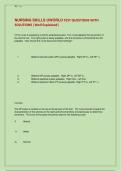
NURSING SKILLS UWORLD TEST QUESTIONS WITH
SOLUTIONS |Well Explained|
1.The nurse is assessing a client's peripheral pulses. The nurse palpates the top portion of
the client's foot. The right pulse is easily palpable, and the left pulse is diminished but still
palpable. How should the nurse document these findings?
1. Bilateral dorsalis pedis (DP) pulses palpable. Right DP 2+, left DP 1+.
2. Bilateral DP pulses palpable. Right DP 3+, left DP 2+.
3. Bilateral popliteal pulses palpable. Right foot > left foot.
4. Bilateral posterior tibial (PT) pulses palpable. Right PT 2+, left PT 1+.
1correct
The DP pulse is located on the top or dorsal part of the foot. The nurse should compare the
characteristics of the arteries on the right and left extremities simultaneously to determine
symmetry. The force of the pulse should be rated on the following scale.
0 Absent
1+ Weak
2+ Normal
,2 | Page
3+ Increased, full, bounding
(Option 2) DP is the correct artery being assessed, but 3+ would indicate a full, bounding
pulse and 2+ would indicate a normal pulse.
(Option 3) The popliteal pulse is assessed just behind the knee area, not on the foot. The
description of the right foot being greater than the left foot does not indicate the force of the
individual pulse.
(Option 4) Posterior tibial pulses are palpated just behind the medial malleolus bone on the
foot. The description of 2+ and 1+ is accurate.
Educational objective:
The nurse should palpate and compare the characteristic and quality of the pulses on the
right and left extremities simultaneously to determine symmetry. The force of the pulse
should be rated as 0, absent; 1+, weak; 2+, normal; and 3+, increased, full, bounding. These
descriptions should be documented in the client's record.
,3 | Page
4.While preparing to insert a peripheral IV line, the nurse notices scarring near the
client's left axilla. The client confirms a history of left breast cancer and modified
radical mastectomy. Which actions should the nurse take? Select all that apply.
1. Advance the entire stylet into the vein upon
venipuncture
2. Insert the IV line into the most distal site of the right
arm
, 4 | Page
3. Place an appropriate precaution sign above the bed
4. Review the medical record for history of
mastectomy
5. Teach the client to keep the left arm in a dependent
position
Correct 234
A modified radical mastectomy includes removal of axillary lymph nodes that are involved in
lymphatic drainage of the arm. Any trauma (eg, IV extravasation) to the arm on the
operative side can result in lymphedema, characterized by painful and lengthy swelling, as
normal lymphatic circulation is impaired by scarring. Therefore, starting an IV line in this arm
is contraindicated.
The nurse should insert the IV line into the most distal site of the unaffected side (Option
2). For client safety, it is also important to ensure documentation of the mastectomy
history, place a restricted extremity armband on the affected arm, and place a sign above
the client's bed notifying hospital staff of necessary mastectomy precautions (eg, no blood
pressure measurements, venipuncture, or IV lines) (Options 3 and 4).
In general, venipuncture is contraindicated in upper extremities affected by:
● Weakness
● Paralysis
● Infection
● Arteriovenous fistula or graft (used for hemodialysis)
● Impaired lymphatic drainage (prior mastectomy)
NURSING SKILLS UWORLD TEST QUESTIONS WITH
SOLUTIONS |Well Explained|
1.The nurse is assessing a client's peripheral pulses. The nurse palpates the top portion of
the client's foot. The right pulse is easily palpable, and the left pulse is diminished but still
palpable. How should the nurse document these findings?
1. Bilateral dorsalis pedis (DP) pulses palpable. Right DP 2+, left DP 1+.
2. Bilateral DP pulses palpable. Right DP 3+, left DP 2+.
3. Bilateral popliteal pulses palpable. Right foot > left foot.
4. Bilateral posterior tibial (PT) pulses palpable. Right PT 2+, left PT 1+.
1correct
The DP pulse is located on the top or dorsal part of the foot. The nurse should compare the
characteristics of the arteries on the right and left extremities simultaneously to determine
symmetry. The force of the pulse should be rated on the following scale.
0 Absent
1+ Weak
2+ Normal
,2 | Page
3+ Increased, full, bounding
(Option 2) DP is the correct artery being assessed, but 3+ would indicate a full, bounding
pulse and 2+ would indicate a normal pulse.
(Option 3) The popliteal pulse is assessed just behind the knee area, not on the foot. The
description of the right foot being greater than the left foot does not indicate the force of the
individual pulse.
(Option 4) Posterior tibial pulses are palpated just behind the medial malleolus bone on the
foot. The description of 2+ and 1+ is accurate.
Educational objective:
The nurse should palpate and compare the characteristic and quality of the pulses on the
right and left extremities simultaneously to determine symmetry. The force of the pulse
should be rated as 0, absent; 1+, weak; 2+, normal; and 3+, increased, full, bounding. These
descriptions should be documented in the client's record.
,3 | Page
4.While preparing to insert a peripheral IV line, the nurse notices scarring near the
client's left axilla. The client confirms a history of left breast cancer and modified
radical mastectomy. Which actions should the nurse take? Select all that apply.
1. Advance the entire stylet into the vein upon
venipuncture
2. Insert the IV line into the most distal site of the right
arm
, 4 | Page
3. Place an appropriate precaution sign above the bed
4. Review the medical record for history of
mastectomy
5. Teach the client to keep the left arm in a dependent
position
Correct 234
A modified radical mastectomy includes removal of axillary lymph nodes that are involved in
lymphatic drainage of the arm. Any trauma (eg, IV extravasation) to the arm on the
operative side can result in lymphedema, characterized by painful and lengthy swelling, as
normal lymphatic circulation is impaired by scarring. Therefore, starting an IV line in this arm
is contraindicated.
The nurse should insert the IV line into the most distal site of the unaffected side (Option
2). For client safety, it is also important to ensure documentation of the mastectomy
history, place a restricted extremity armband on the affected arm, and place a sign above
the client's bed notifying hospital staff of necessary mastectomy precautions (eg, no blood
pressure measurements, venipuncture, or IV lines) (Options 3 and 4).
In general, venipuncture is contraindicated in upper extremities affected by:
● Weakness
● Paralysis
● Infection
● Arteriovenous fistula or graft (used for hemodialysis)
● Impaired lymphatic drainage (prior mastectomy)