
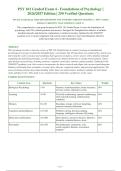
PSY 101 Graded Exam 4 - Foundations of Psychology |
2026/2027 Edition | 250 Verified Questions
PSY 101 Graded Exam 4 2026-2027 QUESTIONS AND ANSWERS ALREADY GRADED A+. 100% Verified
Solutions | Updated Per Latest Guidelines | Graded A+
This comprehensive exam prep document for PSY 101 Graded Exam 4 covers the foundations of
psychology with 250 verified questions and answers. Designed for StraighterLine students, it includes
detailed rationales and distractor explanations to reinforce learning. Updated for the 2026/2027
academic year, it ensures alignment with current course objectives and exam blueprints. Ideal for
achieving a high score on the final graded exam.
Abstract:
This document provides a rigorous review of PSY 101 Graded Exam 4 content, focusing on foundational
psychological concepts essential for StraighterLine's curriculum. The 250 questions are organized by content area,
mirroring the exam's structure and weighting. Each question includes a correct answer with a detailed rationale
explaining the underlying principle, as well as analysis of common distractors to clarify misconceptions. Topics
span biological psychology, learning, memory, cognition, motivation, emotion, and personality. Updated for the
2026/2027 academic year, this resource incorporates the latest research and aligns with current exam blueprints.
Students will benefit from systematic coverage of key theories, empirical studies, and practical applications. The
answer format promotes deep understanding rather than rote memorization, making it suitable for both initial
study and final review. This guide is an essential tool for achieving a graded A+ on the exam.
Content Area Overview:
Content Area Questions Key Topics Weight
Biological Psychology 1-40 Neurons, neurotransmitters, brain structures, 16%
nervous system, endocrine system
Learning 41-80 Classical conditioning, operant conditioning, 16%
observational learning, reinforcement
schedules
Memory 81-120 Encoding, storage, retrieval, forgetting, 16%
amnesia, memory distortions
Cognition and Intelligence 121-160 Problem-solving, decision-making, 16%
language, intelligence theories, IQ testing
Motivation and Emotion 161-200 Drive theories, incentive theories, Maslow's 16%
hierarchy, emotion theories, stress
Personality 201-250 Psychodynamic, humanistic, trait, 20%
social-cognitive theories, assessment
methods
Page 1
,Q1. In a classic experiment, participants who were asked to watch a video of a person being shocked
and then were given a choice to either continue watching or stop the shock showed less arousal when
they believed the shock was part of a learning experiment and they had no choice. Which concept
best explains this reduction in arousal?
A. Cognitive dissonance
B. Diffusion of responsibility
C. Learned helplessness
D. Justification of effort
Correct Answer: A. Cognitive dissonance
Rationale: The reduction in arousal when participants believed they had no choice reflects cognitive
dissonance: they rationalized their continued watching by downplaying the victim's suffering, thereby
reducing discomfort. Diffusion of responsibility involves sharing blame among group members, not
relevant here. Learned helplessness is a passive resignation after repeated aversive events. Justification
of effort is about valuing goals more after hard work.
Why Wrong:
B - Diffusion of responsibility applies when multiple people are present, not when an individual
makes a personal choice.
C - Learned helplessness involves a history of uncontrollable events; here the participant's choice is
key.
D - Justification of effort relates to valuing outcomes more after expending effort, not to reducing
arousal from watching harm.
Reference: Aronson, E., Wilson, T.D., & Akert, R.M. (2015). Social Psychology, 9th Ed., Ch. 6
Q2. A researcher finds a strong positive correlation between scores on a new personality test and
supervisor ratings of job performance. However, the test items appear to measure conscientiousness,
not overall job performance. Which type of validity is primarily supported by this finding?
A. Content validity
B. Criterion-related validity
C. Construct validity
D. Face validity
Correct Answer: B. Criterion-related validity
Rationale: Criterion-related validity is demonstrated when a test predicts an outcome (supervisor
ratings). The correlation with job performance shows predictive validity. Content validity would require
items sampling all facets of job performance. Construct validity would require evidence that the test
measures conscientiousness. Face validity is superficial appearance of relevance.
Why Wrong:
A - Content validity concerns whether the test covers all aspects of the construct; here it only
correlates with an external criterion.
C - Construct validity requires multiple lines of evidence (convergent/discriminant), not just a single
correlation.
D - Face validity is about whether the test looks valid to test-takers, not predictive power.
Reference: Nunnally, J.C., & Bernstein, I.H. (1994). Psychometric Theory, 3rd Ed., Ch. 3
Page 2
,Q3. A patient reports persistent, intrusive thoughts about contamination and engages in repetitive
hand-washing rituals lasting hours daily. The patient recognizes the thoughts are excessive but feels
compelled to perform the rituals to prevent anxiety. Which neurotransmitter system is most directly
implicated in this condition?
A. Dopaminergic pathways
B. Serotonergic pathways
C. GABAergic pathways
D. Noradrenergic pathways
Correct Answer: B. Serotonergic pathways
Rationale: Obsessive-compulsive disorder (OCD) is strongly linked to dysfunction in serotonergic
pathways, as evidenced by the efficacy of SSRIs. Dopamine is more involved in schizophrenia and
addiction. GABA is inhibitory and implicated in anxiety disorders generally, but OCD specifically
responds to serotonin modulation. Norepinephrine is involved in stress response and panic.
Why Wrong:
A - Dopamine is primarily associated with reward, movement, and psychosis, not OCD symptoms.
C - GABA is the main inhibitory neurotransmitter; while anxiety involves GABA, OCD's specific
response to SSRIs points to serotonin.
D - Noradrenaline is linked to fight-or-flight; panic disorder and PTSD, not primarily OCD.
Reference: American Psychiatric Association. (2022). DSM-5-TR. Obsessive-Compulsive and Related
Disorders.
Q4. In a study on bystander intervention, participants were placed in a room with smoke filling
through a vent. Those alone reported the smoke within seconds, but those in groups of three often
did not. Which psychological mechanism best accounts for the failure to act in groups?
A. Pluralistic ignorance
B. Social loafing
C. Groupthink
D. Deindividuation
Correct Answer: A. Pluralistic ignorance
Rationale: Pluralistic ignorance occurs when individuals in a group misinterpret others' inaction as
indicating that no emergency exists, leading them to not act themselves. Social loafing is reduced effort in
groups. Groupthink is flawed decision-making due to conformity. Deindividuation is loss of
self-awareness in crowds, not applicable to a small group in a lab.
Why Wrong:
B - Social loafing involves exerting less effort, not misinterpreting an emergency.
C - Groupthink relates to consensus-seeking in decision-making, not emergency response.
D - Deindividuation requires anonymity and arousal; lab participants were identifiable.
Reference: Latane, B., & Darley, J.M. (1970). The Unresponsive Bystander: Why Doesn't He Help?
Page 3
, Q5. A therapist helps a client identify and challenge automatic thoughts such as 'I am worthless' by
examining evidence for and against them. The therapist also assigns behavioral experiments to test
these beliefs. Which therapeutic approach is being used?
A. Rational emotive behavior therapy (REBT)
B. Cognitive behavioral therapy (CBT)
C. Acceptance and commitment therapy (ACT)
D. Dialectical behavior therapy (DBT)
Correct Answer: B. Cognitive behavioral therapy (CBT)
Rationale: CBT focuses on identifying and restructuring maladaptive automatic thoughts and uses
behavioral experiments. REBT emphasizes disputing irrational beliefs but uses more direct confrontation.
ACT encourages acceptance rather than challenging thoughts. DBT combines CBT with mindfulness and
is designed for borderline personality disorder.
Why Wrong:
A - REBT also challenges irrational beliefs but uses a more confrontational style and does not
typically include behavioral experiments as a core component.
C - ACT promotes acceptance and commitment to values, not cognitive restructuring.
D - DBT includes mindfulness and distress tolerance skills, not primarily cognitive restructuring of
automatic thoughts.
Reference: Beck, J.S. (2021). Cognitive Behavior Therapy: Basics and Beyond, 3rd Ed., Ch. 1
Q6. A patient with a history of trauma reports flashbacks, nightmares, and avoidance of places that
remind them of the event. They also have negative beliefs about themselves and are easily startled.
Which diagnosis is most appropriate?
A. Acute stress disorder
B. Posttraumatic stress disorder (PTSD)
C. Adjustment disorder
D. Panic disorder
Correct Answer: B. Posttraumatic stress disorder (PTSD)
Rationale: PTSD is characterized by re-experiencing (flashbacks, nightmares), avoidance, negative
cognitions, and hyperarousal for more than one month. Acute stress disorder is similar but lasts 3 days to
1 month. Adjustment disorder involves a reaction to a stressor without the full symptom profile of PTSD.
Panic disorder involves recurrent unexpected panic attacks.
Why Wrong:
A - Acute stress disorder requires symptoms within 1 month; the patient's symptoms are likely
chronic given the description.
C - Adjustment disorder does not include flashbacks or hyperarousal to this degree.
D - Panic disorder involves panic attacks, not trauma-related re-experiencing.
Reference: American Psychiatric Association. (2022). DSM-5-TR. Trauma- and Stressor-Related
Disorders.
Page 4
2026/2027 Edition | 250 Verified Questions
PSY 101 Graded Exam 4 2026-2027 QUESTIONS AND ANSWERS ALREADY GRADED A+. 100% Verified
Solutions | Updated Per Latest Guidelines | Graded A+
This comprehensive exam prep document for PSY 101 Graded Exam 4 covers the foundations of
psychology with 250 verified questions and answers. Designed for StraighterLine students, it includes
detailed rationales and distractor explanations to reinforce learning. Updated for the 2026/2027
academic year, it ensures alignment with current course objectives and exam blueprints. Ideal for
achieving a high score on the final graded exam.
Abstract:
This document provides a rigorous review of PSY 101 Graded Exam 4 content, focusing on foundational
psychological concepts essential for StraighterLine's curriculum. The 250 questions are organized by content area,
mirroring the exam's structure and weighting. Each question includes a correct answer with a detailed rationale
explaining the underlying principle, as well as analysis of common distractors to clarify misconceptions. Topics
span biological psychology, learning, memory, cognition, motivation, emotion, and personality. Updated for the
2026/2027 academic year, this resource incorporates the latest research and aligns with current exam blueprints.
Students will benefit from systematic coverage of key theories, empirical studies, and practical applications. The
answer format promotes deep understanding rather than rote memorization, making it suitable for both initial
study and final review. This guide is an essential tool for achieving a graded A+ on the exam.
Content Area Overview:
Content Area Questions Key Topics Weight
Biological Psychology 1-40 Neurons, neurotransmitters, brain structures, 16%
nervous system, endocrine system
Learning 41-80 Classical conditioning, operant conditioning, 16%
observational learning, reinforcement
schedules
Memory 81-120 Encoding, storage, retrieval, forgetting, 16%
amnesia, memory distortions
Cognition and Intelligence 121-160 Problem-solving, decision-making, 16%
language, intelligence theories, IQ testing
Motivation and Emotion 161-200 Drive theories, incentive theories, Maslow's 16%
hierarchy, emotion theories, stress
Personality 201-250 Psychodynamic, humanistic, trait, 20%
social-cognitive theories, assessment
methods
Page 1
,Q1. In a classic experiment, participants who were asked to watch a video of a person being shocked
and then were given a choice to either continue watching or stop the shock showed less arousal when
they believed the shock was part of a learning experiment and they had no choice. Which concept
best explains this reduction in arousal?
A. Cognitive dissonance
B. Diffusion of responsibility
C. Learned helplessness
D. Justification of effort
Correct Answer: A. Cognitive dissonance
Rationale: The reduction in arousal when participants believed they had no choice reflects cognitive
dissonance: they rationalized their continued watching by downplaying the victim's suffering, thereby
reducing discomfort. Diffusion of responsibility involves sharing blame among group members, not
relevant here. Learned helplessness is a passive resignation after repeated aversive events. Justification
of effort is about valuing goals more after hard work.
Why Wrong:
B - Diffusion of responsibility applies when multiple people are present, not when an individual
makes a personal choice.
C - Learned helplessness involves a history of uncontrollable events; here the participant's choice is
key.
D - Justification of effort relates to valuing outcomes more after expending effort, not to reducing
arousal from watching harm.
Reference: Aronson, E., Wilson, T.D., & Akert, R.M. (2015). Social Psychology, 9th Ed., Ch. 6
Q2. A researcher finds a strong positive correlation between scores on a new personality test and
supervisor ratings of job performance. However, the test items appear to measure conscientiousness,
not overall job performance. Which type of validity is primarily supported by this finding?
A. Content validity
B. Criterion-related validity
C. Construct validity
D. Face validity
Correct Answer: B. Criterion-related validity
Rationale: Criterion-related validity is demonstrated when a test predicts an outcome (supervisor
ratings). The correlation with job performance shows predictive validity. Content validity would require
items sampling all facets of job performance. Construct validity would require evidence that the test
measures conscientiousness. Face validity is superficial appearance of relevance.
Why Wrong:
A - Content validity concerns whether the test covers all aspects of the construct; here it only
correlates with an external criterion.
C - Construct validity requires multiple lines of evidence (convergent/discriminant), not just a single
correlation.
D - Face validity is about whether the test looks valid to test-takers, not predictive power.
Reference: Nunnally, J.C., & Bernstein, I.H. (1994). Psychometric Theory, 3rd Ed., Ch. 3
Page 2
,Q3. A patient reports persistent, intrusive thoughts about contamination and engages in repetitive
hand-washing rituals lasting hours daily. The patient recognizes the thoughts are excessive but feels
compelled to perform the rituals to prevent anxiety. Which neurotransmitter system is most directly
implicated in this condition?
A. Dopaminergic pathways
B. Serotonergic pathways
C. GABAergic pathways
D. Noradrenergic pathways
Correct Answer: B. Serotonergic pathways
Rationale: Obsessive-compulsive disorder (OCD) is strongly linked to dysfunction in serotonergic
pathways, as evidenced by the efficacy of SSRIs. Dopamine is more involved in schizophrenia and
addiction. GABA is inhibitory and implicated in anxiety disorders generally, but OCD specifically
responds to serotonin modulation. Norepinephrine is involved in stress response and panic.
Why Wrong:
A - Dopamine is primarily associated with reward, movement, and psychosis, not OCD symptoms.
C - GABA is the main inhibitory neurotransmitter; while anxiety involves GABA, OCD's specific
response to SSRIs points to serotonin.
D - Noradrenaline is linked to fight-or-flight; panic disorder and PTSD, not primarily OCD.
Reference: American Psychiatric Association. (2022). DSM-5-TR. Obsessive-Compulsive and Related
Disorders.
Q4. In a study on bystander intervention, participants were placed in a room with smoke filling
through a vent. Those alone reported the smoke within seconds, but those in groups of three often
did not. Which psychological mechanism best accounts for the failure to act in groups?
A. Pluralistic ignorance
B. Social loafing
C. Groupthink
D. Deindividuation
Correct Answer: A. Pluralistic ignorance
Rationale: Pluralistic ignorance occurs when individuals in a group misinterpret others' inaction as
indicating that no emergency exists, leading them to not act themselves. Social loafing is reduced effort in
groups. Groupthink is flawed decision-making due to conformity. Deindividuation is loss of
self-awareness in crowds, not applicable to a small group in a lab.
Why Wrong:
B - Social loafing involves exerting less effort, not misinterpreting an emergency.
C - Groupthink relates to consensus-seeking in decision-making, not emergency response.
D - Deindividuation requires anonymity and arousal; lab participants were identifiable.
Reference: Latane, B., & Darley, J.M. (1970). The Unresponsive Bystander: Why Doesn't He Help?
Page 3
, Q5. A therapist helps a client identify and challenge automatic thoughts such as 'I am worthless' by
examining evidence for and against them. The therapist also assigns behavioral experiments to test
these beliefs. Which therapeutic approach is being used?
A. Rational emotive behavior therapy (REBT)
B. Cognitive behavioral therapy (CBT)
C. Acceptance and commitment therapy (ACT)
D. Dialectical behavior therapy (DBT)
Correct Answer: B. Cognitive behavioral therapy (CBT)
Rationale: CBT focuses on identifying and restructuring maladaptive automatic thoughts and uses
behavioral experiments. REBT emphasizes disputing irrational beliefs but uses more direct confrontation.
ACT encourages acceptance rather than challenging thoughts. DBT combines CBT with mindfulness and
is designed for borderline personality disorder.
Why Wrong:
A - REBT also challenges irrational beliefs but uses a more confrontational style and does not
typically include behavioral experiments as a core component.
C - ACT promotes acceptance and commitment to values, not cognitive restructuring.
D - DBT includes mindfulness and distress tolerance skills, not primarily cognitive restructuring of
automatic thoughts.
Reference: Beck, J.S. (2021). Cognitive Behavior Therapy: Basics and Beyond, 3rd Ed., Ch. 1
Q6. A patient with a history of trauma reports flashbacks, nightmares, and avoidance of places that
remind them of the event. They also have negative beliefs about themselves and are easily startled.
Which diagnosis is most appropriate?
A. Acute stress disorder
B. Posttraumatic stress disorder (PTSD)
C. Adjustment disorder
D. Panic disorder
Correct Answer: B. Posttraumatic stress disorder (PTSD)
Rationale: PTSD is characterized by re-experiencing (flashbacks, nightmares), avoidance, negative
cognitions, and hyperarousal for more than one month. Acute stress disorder is similar but lasts 3 days to
1 month. Adjustment disorder involves a reaction to a stressor without the full symptom profile of PTSD.
Panic disorder involves recurrent unexpected panic attacks.
Why Wrong:
A - Acute stress disorder requires symptoms within 1 month; the patient's symptoms are likely
chronic given the description.
C - Adjustment disorder does not include flashbacks or hyperarousal to this degree.
D - Panic disorder involves panic attacks, not trauma-related re-experiencing.
Reference: American Psychiatric Association. (2022). DSM-5-TR. Trauma- and Stressor-Related
Disorders.
Page 4


