
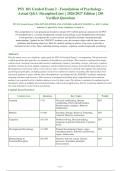
PSY 101 Graded Exam 2 - Foundations of Psychology -
Actual Q&A (StraighterLine) | 2026/2027 Edition | 250
Verified Questions
PSY 101 Graded Exam 2 2026-2027 QUESTIONS AND ANSWERS ALREADY GRADED A+. 100% Verified
Solutions | Updated Per Latest Guidelines | Graded A+
This comprehensive exam preparation document contains 250 verified questions and answers for PSY
101 Graded Exam 2, covering foundational concepts in psychology as per StraighterLine curriculum.
Each question is accompanied by a correct answer and detailed rationale, ensuring thorough
understanding. Updated for the 2026/2027 academic year, this resource aligns with the latest course
guidelines and learning objectives. Ideal for students seeking to achieve a top score, it provides a
structured review of key topics including learning, memory, cognition, and developmental psychology.
Abstract:
This document serves as a definitive study guide for PSY 101 Graded Exam 2, encompassing 250 meticulously
verified questions that span the core domains of introductory psychology. The content is organized into major
content areas: learning (classical and operant conditioning), memory (encoding, storage, retrieval), cognition
(problem-solving, decision-making, language), and developmental psychology (prenatal through adolescence).
Each question is presented with a correct answer and a comprehensive rationale that explains the underlying
psychological principles, including analysis of incorrect options to reinforce learning. The material has been
rigorously updated to align with the latest StraighterLine curriculum and the 2026/2027 academic standards,
ensuring relevance and accuracy. This resource is designed to facilitate deep comprehension and retention,
making it an essential tool for students aiming to excel in their exam. The abstract concludes by emphasizing the
document's utility in bridging theoretical knowledge with practical application, thereby preparing students for both
the exam and future coursework in psychology.
Content Area Overview:
Content Area Questions Key Topics Weight
Learning 1-50 Classical conditioning, Operant 20%
conditioning, Observational learning,
Reinforcement schedules, Behavior
modification
Memory 51-100 Encoding, Storage, Retrieval, Forgetting, 20%
Amnesia, Memory construction
Cognition 101-150 Problem-solving, Decision-making, 20%
Language acquisition, Heuristics, Cognitive
biases
Developmental Psychology 151-200 Prenatal development, Piaget's stages, 20%
Attachment theory, Erikson's psychosocial
stages, Adolescence
Biopsychology & 201-250 Neurons, Nervous system, Sensory 20%
Sensation/Perception processes, Perception principles,
Consciousness
Page 1
,Q1. In a study examining the effect of sleep deprivation on cognitive performance, participants are
randomly assigned to either 4 hours or 8 hours of sleep. Which type of validity is most threatened if
participants in the 4-hour group are also required to complete a demanding task before testing?
A. Internal validity
B. External validity
C. Construct validity
D. Statistical conclusion validity
Correct Answer: A. Internal validity
Rationale: Internal validity is threatened because the additional task confounds the effect of sleep
deprivation; the groups differ on more than just the independent variable. External validity concerns
generalizability, construct validity concerns operational definitions, and statistical conclusion validity
concerns appropriate statistical inference.
Why Wrong:
B - External validity refers to generalizability to other populations or settings, not to confounding
variables within the study.
C - Construct validity involves whether the measures accurately represent the theoretical constructs;
the threat here is to causal inference, not measurement.
D - Statistical conclusion validity concerns whether the statistical conclusions are reasonable; the
issue is a confound, not a statistical error.
Reference: Cozby, P. C., & Bates, S. C. (2018). Methods in Behavioral Research, 13th Ed., Ch. 6
Q2. Which neurotransmitter system is most directly implicated in the reinforcing effects of both
natural rewards (e.g., food) and addictive drugs?
A. Serotonergic projections from the raphe nuclei
B. Dopaminergic projections from the ventral tegmental area to the nucleus accumbens
C. Noradrenergic projections from the locus coeruleus
D. Cholinergic projections from the basal forebrain
Correct Answer: B. Dopaminergic projections from the ventral tegmental area to the nucleus
accumbens
Rationale: The mesolimbic dopamine pathway, originating in the ventral tegmental area and projecting
to the nucleus accumbens, is the core circuit for reward and reinforcement. Serotonin is more involved in
mood and appetite; norepinephrine in arousal; acetylcholine in attention and memory.
Why Wrong:
A - Serotonergic pathways primarily regulate mood, appetite, and sleep, not the primary
reinforcement of rewards.
C - Noradrenergic pathways modulate arousal and stress responses, not direct reward processing.
D - Cholinergic pathways are crucial for attention and memory, not the reinforcing effects of
rewards.
Reference: Carlson, N. R., & Birkett, M. A. (2017). Physiology of Behavior, 12th Ed., Ch. 4
Page 2
,Q3. A researcher trains a rat to press a lever for a food pellet on a variable-ratio 20 schedule. After
extinction, the rat shows a brief resurgence of lever pressing when a different response (chain
pulling) is also extinguished. This phenomenon best illustrates:
A. Spontaneous recovery
B. Renewal effect
C. Resurgence
D. Reinstatement
Correct Answer: C. Resurgence
Rationale: Resurgence is the reappearance of an extinguished behavior when an alternative behavior that
was reinforced during extinction is also extinguished. Spontaneous recovery is the return of a conditioned
response after a delay; renewal occurs when the context changes; reinstatement occurs when the
unconditioned stimulus is presented again.
Why Wrong:
A - Spontaneous recovery occurs after a time delay, not following extinction of an alternative
response.
B - Renewal involves a change in context, not extinction of an alternative behavior.
D - Reinstatement requires re-exposure to the original reinforcer, not extinction of another response.
Reference: Pierce, W. D., & Cheney, C. D. (2017). Behavior Analysis and Learning, 6th Ed., Ch. 8
Q4. Which of the following memory phenomena is most consistent with the encoding specificity
principle?
A. Better recall of a list of words when tested in the same room where learning occurred
B. Improved memory for emotional events compared to neutral events
C. The serial position effect in free recall
D. The tendency to recall the first items in a list more accurately than middle items
Correct Answer: A. Better recall of a list of words when tested in the same room where learning
occurred
Rationale: The encoding specificity principle states that memory is enhanced when the context at retrieval
matches the context at encoding; the same room provides contextual cues. Emotional memory
enhancement involves the amygdala; serial position effects reflect primacy and recency; primacy is due to
rehearsal.
Why Wrong:
B - Emotional memory enhancement is mediated by the amygdala and stress hormones, not by
encoding-retrieval match.
C - The serial position effect is explained by rehearsal and short-term memory, not by
context-dependent cues.
D - Primacy effect is due to greater rehearsal of early items, not encoding specificity.
Reference: Tulving, E., & Thomson, D. M. (1973). Encoding specificity and retrieval processes in
episodic memory. Psychological Review, 80(5), 352-373.
Page 3
, Q5. According to Piaget's theory, which cognitive acquisition is characteristic of the formal
operational stage that is NOT present in concrete operational thinking?
A. Conservation of liquid volume
B. Hypothetico-deductive reasoning
C. Object permanence
D. Egocentric speech
Correct Answer: B. Hypothetico-deductive reasoning
Rationale: Hypothetico-deductive reasoning, the ability to systematically test hypotheses, emerges in
formal operations. Conservation is achieved in concrete operations; object permanence in sensorimotor
stage; egocentric speech declines in concrete operations.
Why Wrong:
A - Conservation of liquid volume is mastered in the concrete operational stage, not formal
operations.
C - Object permanence develops during the sensorimotor stage, well before formal operations.
D - Egocentric speech decreases during concrete operations; formal operations involve more abstract
thought.
Reference: Piaget, J. (1972). Intellectual evolution from adolescence to adulthood. Human Development,
15(1), 1-12.
Q6. A client with obsessive-compulsive disorder experiences intrusive thoughts about contamination
and engages in excessive hand washing. From a cognitive-behavioral perspective, which factor most
directly maintains the hand-washing behavior?
A. Negative reinforcement through temporary reduction of anxiety
B. Positive reinforcement from the feeling of cleanliness
C. Classical conditioning pairing contamination thoughts with fear
D. Observational learning from family members
Correct Answer: A. Negative reinforcement through temporary reduction of anxiety
Rationale: The hand washing reduces anxiety, which negatively reinforces the behavior, making it more
likely to recur. Positive reinforcement is less central because the primary motive is anxiety reduction;
classical conditioning explains initial fear, not maintenance; observational learning is not the primary
mechanism.
Why Wrong:
B - While cleanliness may feel good, the primary driver is relief from anxiety, not the positive
sensation.
C - Classical conditioning accounts for the initial fear, but the compulsion is maintained by negative
reinforcement.
D - Observational learning may contribute to acquisition but is not the main maintaining factor.
Reference: Abramowitz, J. S., & Jacoby, R. J. (2015). Obsessive-compulsive disorder in adults. In P. H.
Blaney & T. Millon (Eds.), Oxford Textbook of Psychopathology, 3rd Ed., Ch. 7.
Page 4
Actual Q&A (StraighterLine) | 2026/2027 Edition | 250
Verified Questions
PSY 101 Graded Exam 2 2026-2027 QUESTIONS AND ANSWERS ALREADY GRADED A+. 100% Verified
Solutions | Updated Per Latest Guidelines | Graded A+
This comprehensive exam preparation document contains 250 verified questions and answers for PSY
101 Graded Exam 2, covering foundational concepts in psychology as per StraighterLine curriculum.
Each question is accompanied by a correct answer and detailed rationale, ensuring thorough
understanding. Updated for the 2026/2027 academic year, this resource aligns with the latest course
guidelines and learning objectives. Ideal for students seeking to achieve a top score, it provides a
structured review of key topics including learning, memory, cognition, and developmental psychology.
Abstract:
This document serves as a definitive study guide for PSY 101 Graded Exam 2, encompassing 250 meticulously
verified questions that span the core domains of introductory psychology. The content is organized into major
content areas: learning (classical and operant conditioning), memory (encoding, storage, retrieval), cognition
(problem-solving, decision-making, language), and developmental psychology (prenatal through adolescence).
Each question is presented with a correct answer and a comprehensive rationale that explains the underlying
psychological principles, including analysis of incorrect options to reinforce learning. The material has been
rigorously updated to align with the latest StraighterLine curriculum and the 2026/2027 academic standards,
ensuring relevance and accuracy. This resource is designed to facilitate deep comprehension and retention,
making it an essential tool for students aiming to excel in their exam. The abstract concludes by emphasizing the
document's utility in bridging theoretical knowledge with practical application, thereby preparing students for both
the exam and future coursework in psychology.
Content Area Overview:
Content Area Questions Key Topics Weight
Learning 1-50 Classical conditioning, Operant 20%
conditioning, Observational learning,
Reinforcement schedules, Behavior
modification
Memory 51-100 Encoding, Storage, Retrieval, Forgetting, 20%
Amnesia, Memory construction
Cognition 101-150 Problem-solving, Decision-making, 20%
Language acquisition, Heuristics, Cognitive
biases
Developmental Psychology 151-200 Prenatal development, Piaget's stages, 20%
Attachment theory, Erikson's psychosocial
stages, Adolescence
Biopsychology & 201-250 Neurons, Nervous system, Sensory 20%
Sensation/Perception processes, Perception principles,
Consciousness
Page 1
,Q1. In a study examining the effect of sleep deprivation on cognitive performance, participants are
randomly assigned to either 4 hours or 8 hours of sleep. Which type of validity is most threatened if
participants in the 4-hour group are also required to complete a demanding task before testing?
A. Internal validity
B. External validity
C. Construct validity
D. Statistical conclusion validity
Correct Answer: A. Internal validity
Rationale: Internal validity is threatened because the additional task confounds the effect of sleep
deprivation; the groups differ on more than just the independent variable. External validity concerns
generalizability, construct validity concerns operational definitions, and statistical conclusion validity
concerns appropriate statistical inference.
Why Wrong:
B - External validity refers to generalizability to other populations or settings, not to confounding
variables within the study.
C - Construct validity involves whether the measures accurately represent the theoretical constructs;
the threat here is to causal inference, not measurement.
D - Statistical conclusion validity concerns whether the statistical conclusions are reasonable; the
issue is a confound, not a statistical error.
Reference: Cozby, P. C., & Bates, S. C. (2018). Methods in Behavioral Research, 13th Ed., Ch. 6
Q2. Which neurotransmitter system is most directly implicated in the reinforcing effects of both
natural rewards (e.g., food) and addictive drugs?
A. Serotonergic projections from the raphe nuclei
B. Dopaminergic projections from the ventral tegmental area to the nucleus accumbens
C. Noradrenergic projections from the locus coeruleus
D. Cholinergic projections from the basal forebrain
Correct Answer: B. Dopaminergic projections from the ventral tegmental area to the nucleus
accumbens
Rationale: The mesolimbic dopamine pathway, originating in the ventral tegmental area and projecting
to the nucleus accumbens, is the core circuit for reward and reinforcement. Serotonin is more involved in
mood and appetite; norepinephrine in arousal; acetylcholine in attention and memory.
Why Wrong:
A - Serotonergic pathways primarily regulate mood, appetite, and sleep, not the primary
reinforcement of rewards.
C - Noradrenergic pathways modulate arousal and stress responses, not direct reward processing.
D - Cholinergic pathways are crucial for attention and memory, not the reinforcing effects of
rewards.
Reference: Carlson, N. R., & Birkett, M. A. (2017). Physiology of Behavior, 12th Ed., Ch. 4
Page 2
,Q3. A researcher trains a rat to press a lever for a food pellet on a variable-ratio 20 schedule. After
extinction, the rat shows a brief resurgence of lever pressing when a different response (chain
pulling) is also extinguished. This phenomenon best illustrates:
A. Spontaneous recovery
B. Renewal effect
C. Resurgence
D. Reinstatement
Correct Answer: C. Resurgence
Rationale: Resurgence is the reappearance of an extinguished behavior when an alternative behavior that
was reinforced during extinction is also extinguished. Spontaneous recovery is the return of a conditioned
response after a delay; renewal occurs when the context changes; reinstatement occurs when the
unconditioned stimulus is presented again.
Why Wrong:
A - Spontaneous recovery occurs after a time delay, not following extinction of an alternative
response.
B - Renewal involves a change in context, not extinction of an alternative behavior.
D - Reinstatement requires re-exposure to the original reinforcer, not extinction of another response.
Reference: Pierce, W. D., & Cheney, C. D. (2017). Behavior Analysis and Learning, 6th Ed., Ch. 8
Q4. Which of the following memory phenomena is most consistent with the encoding specificity
principle?
A. Better recall of a list of words when tested in the same room where learning occurred
B. Improved memory for emotional events compared to neutral events
C. The serial position effect in free recall
D. The tendency to recall the first items in a list more accurately than middle items
Correct Answer: A. Better recall of a list of words when tested in the same room where learning
occurred
Rationale: The encoding specificity principle states that memory is enhanced when the context at retrieval
matches the context at encoding; the same room provides contextual cues. Emotional memory
enhancement involves the amygdala; serial position effects reflect primacy and recency; primacy is due to
rehearsal.
Why Wrong:
B - Emotional memory enhancement is mediated by the amygdala and stress hormones, not by
encoding-retrieval match.
C - The serial position effect is explained by rehearsal and short-term memory, not by
context-dependent cues.
D - Primacy effect is due to greater rehearsal of early items, not encoding specificity.
Reference: Tulving, E., & Thomson, D. M. (1973). Encoding specificity and retrieval processes in
episodic memory. Psychological Review, 80(5), 352-373.
Page 3
, Q5. According to Piaget's theory, which cognitive acquisition is characteristic of the formal
operational stage that is NOT present in concrete operational thinking?
A. Conservation of liquid volume
B. Hypothetico-deductive reasoning
C. Object permanence
D. Egocentric speech
Correct Answer: B. Hypothetico-deductive reasoning
Rationale: Hypothetico-deductive reasoning, the ability to systematically test hypotheses, emerges in
formal operations. Conservation is achieved in concrete operations; object permanence in sensorimotor
stage; egocentric speech declines in concrete operations.
Why Wrong:
A - Conservation of liquid volume is mastered in the concrete operational stage, not formal
operations.
C - Object permanence develops during the sensorimotor stage, well before formal operations.
D - Egocentric speech decreases during concrete operations; formal operations involve more abstract
thought.
Reference: Piaget, J. (1972). Intellectual evolution from adolescence to adulthood. Human Development,
15(1), 1-12.
Q6. A client with obsessive-compulsive disorder experiences intrusive thoughts about contamination
and engages in excessive hand washing. From a cognitive-behavioral perspective, which factor most
directly maintains the hand-washing behavior?
A. Negative reinforcement through temporary reduction of anxiety
B. Positive reinforcement from the feeling of cleanliness
C. Classical conditioning pairing contamination thoughts with fear
D. Observational learning from family members
Correct Answer: A. Negative reinforcement through temporary reduction of anxiety
Rationale: The hand washing reduces anxiety, which negatively reinforces the behavior, making it more
likely to recur. Positive reinforcement is less central because the primary motive is anxiety reduction;
classical conditioning explains initial fear, not maintenance; observational learning is not the primary
mechanism.
Why Wrong:
B - While cleanliness may feel good, the primary driver is relief from anxiety, not the positive
sensation.
C - Classical conditioning accounts for the initial fear, but the compulsion is maintained by negative
reinforcement.
D - Observational learning may contribute to acquisition but is not the main maintaining factor.
Reference: Abramowitz, J. S., & Jacoby, R. J. (2015). Obsessive-compulsive disorder in adults. In P. H.
Blaney & T. Millon (Eds.), Oxford Textbook of Psychopathology, 3rd Ed., Ch. 7.
Page 4


