

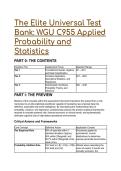
The Elite Universal Test
Bank: WGU C955 Applied
Probability and
Statistics
PART 0: THE CONTENTS
Cognitive Tier Assessment Focus Question Range
Tier 1 Foundational Syntax, Algebra, Q1 – Q10
and Data Classification
Tier 2 Complex Application, Q11 – Q20
Descriptive Statistics, and
Regression
Tier 3 Grandmaster Synthesis, Q21 – Q30
Probability Theory, and
Inference
PART I: THE PREVIEW
Mastery of the concepts within this assessment document transitions the analyst from a rote
memorizer to an elite statistical practitioner capable of translating raw empirical data into
definitive, actionable real-world intelligence. By internalizing the mathematical laws of
probability, variance, and regression, professionals possess the precise analytical frameworks
required to evaluate systemic risk, forecast economic or clinical trends, and systematically
eliminate cognitive bias in high-stakes operational environments.
Critical Axioms and Frameworks
Core Concept Definitive Axiom Application Context
The Empirical Rule 68% of data falls within 1 Exclusively applied to
standard deviation (\sigma), symmetrical, normal
95% within 2$\sigma$, and distributions to determine
99.7% within 3$\sigma$ of the precise percentile benchmarks.
mean (\mu).
Probability Addition Rule P(A \text{ or } B) = P(A) + P(B) - Utilized when calculating the
P(A \text{ and } B). union of events. If events are
mutually exclusive, the
,Core Concept Definitive Axiom Application Context
intersection is zero.
Linear Regression (y = mx + The slope (m) dictates the Applied to
b) predicted rate of change in the quantitative-to-quantitative (Q
response variable (y) for every \rightarrow Q) scatterplot data
single-unit increase in the to model continuous trends.
explanatory variable (x).
Simpson's Paradox A trend appearing in distinct Serves as the primary
subgroups disappears or diagnostic warning for the
reverses entirely when those presence of unmeasured
groups are aggregated. confounding or lurking
variables.
Type I vs. Type II Error Type I rejects a true null Fundamental to inferential
hypothesis (false positive); hypothesis testing, determining
Type II fails to reject a false null the operational risks of
hypothesis (false negative). decision-making limits (\alpha).
PART II: THE ELITE TEST BANK
Q1: A clinical researcher is recording the exact dosages of a trial medication administered to
patients, continuously measured in milligrams down to the third decimal place to ensure
metabolic precision. Based on the principles of data classification, which categorization is the
MOST ACCURATE for this variable? A) Qualitative and discrete B) Quantitative and discrete C)
Quantitative and continuous D) Categorical and continuous
● The Answer: C (Quantitative and continuous)
● Distractor Analysis:
○ A is incorrect: The data is explicitly numerical and measurable, not a descriptive
label, making it definitively quantitative rather than qualitative or categorical.
○ B is incorrect: While the variable is quantitative, it is not discrete. Discrete data
relies on finite, unconnected whole-number counts (e.g., number of patients
treated), whereas exact dosages can take on an infinite number of fractional values
within a measurement range.
○ D is incorrect: Categorical data represents groups or labels. Furthermore, the
structural taxonomy of statistics dictates that categorical data inherently cannot be
continuous.
The Mentor's Analysis: Data classification dictates the specific visual displays and statistical
formulas an analyst is permitted to utilize. Because physical dosage involves precise physical
measurement and encompasses an infinite number of fractional values within a specific interval,
it operates as a continuous metric. Professional/Academic Intuition: If a variable must be
measured with an instrument, it is continuous; if it is counted by tally, it is discrete.
Q2: An IT network analyst observes that a specific core server requires an immediate hard
reboot if the internal system temperature exceeds 85 degrees Celsius. If the emergency
monitoring software only displays output in Fahrenheit, which specific temperature threshold
IMMEDIATELY warrants a reboot? A) 153.0 degrees Fahrenheit B) 185.0 degrees Fahrenheit
C) 79.4 degrees Fahrenheit D) 120.5 degrees Fahrenheit
● The Answer: B (185.0 degrees Fahrenheit)
● Distractor Analysis:
○ A is incorrect: This value isolates the multiplication phase of the conversion (85
, \times 1.8) but represents a failure to execute the final additive constant, leaving the
calculation mathematically incomplete.
○ C is incorrect: This calculation is the result of erroneously applying the reverse
formula designed for Fahrenheit to Celsius conversion (C = (F - 32) \times
\frac{5}{9}).
○ D is incorrect: This represents a random calculation error generated by ignoring
standard thermal conversion ratios entirely.
The Mentor's Analysis: Mastery of basic algebraic conversion is a fundamental operational
necessity for global analysts. The standard formula to convert Celsius to Fahrenheit is F = C
\times \frac{9}{5} + 32, or F = 1.8C + 32. Substituting the recorded value yields 85 \times 1.8 =
153, and adding the 32-degree offset establishes the 185-degree threshold.
Professional/Academic Intuition: Analysts must strictly sequence operations: scale the
Celsius value by the 1.8 ratio FIRST, then integrate the 32-degree constant.
Q3: During a software engineering audit, the following multi-step expression dictates the
calculation of a critical vulnerability score: 12 - 4 \times (6 - 2^2) + 8 \div 2. Applying the
standard mathematical order of operations, what is the CORRECT final vulnerability score? A)
12 B) 16 C) 20 D) 4
● The Answer: B (16)
● Distractor Analysis:
○ A is incorrect: This result materializes if an analyst subtracts 4 from 12 before
resolving the multiplication, which violently violates the structural hierarchy of
operations.
○ C is incorrect: This output stems from ignoring the parentheses entirely and
evaluating exponents and division sequentially out of bounds.
○ D is incorrect: This occurs if terminal addition is prioritized incorrectly over the final
division step, corrupting the end value.
The Mentor's Analysis: Advanced statistical modeling collapses entirely without strict
adherence to foundational algebraic syntax. By applying the standard order of operations
(PEMDAS), the analyst first resolves the exponent inside the parentheses (2^2 = 4), then
completes the parentheses (6 - 4 = 2). Next, multiplication and division are performed
concurrently from left to right (4 \times 2 = 8 and 8 \div 2 = 4). The equation then simplifies
linearly to 12 - 8 + 4 = 16. Professional/Academic Intuition: Multiplication and division
share the exact same priority tier and must be resolved sequentially from left to right to
preserve mathematical integrity.
Q4: A macroeconomic analyst is evaluating the linear equation 3x - 4y = 12 to predict quarterly
corporate expenditures. To determine the exact rate of change, the analyst must convert this
standard form into slope-intercept form. What is the MOST ACCURATE slope of this predictive
equation? A) 3 B) -3 C) \frac{3}{4} D) -\frac{3}{4}
● The Answer: C (\frac{3}{4})
● Distractor Analysis:
○ A is incorrect: This answer isolates the x-variable incorrectly and ignores the
influence of the coefficient attached directly to y.
○ B is incorrect: This assumes the slope is simply the negative of the x-coefficient,
bypassing the mandatory division by the y-coefficient.
○ D is incorrect: This option represents a lethal sign error; when moving the positive
3x to the right side of the equation, it becomes -3x, and subsequently dividing by -4
must mathematically yield a positive fraction.
The Mentor's Analysis: Converting to slope-intercept form (y = mx + b) isolates the response
Bank: WGU C955 Applied
Probability and
Statistics
PART 0: THE CONTENTS
Cognitive Tier Assessment Focus Question Range
Tier 1 Foundational Syntax, Algebra, Q1 – Q10
and Data Classification
Tier 2 Complex Application, Q11 – Q20
Descriptive Statistics, and
Regression
Tier 3 Grandmaster Synthesis, Q21 – Q30
Probability Theory, and
Inference
PART I: THE PREVIEW
Mastery of the concepts within this assessment document transitions the analyst from a rote
memorizer to an elite statistical practitioner capable of translating raw empirical data into
definitive, actionable real-world intelligence. By internalizing the mathematical laws of
probability, variance, and regression, professionals possess the precise analytical frameworks
required to evaluate systemic risk, forecast economic or clinical trends, and systematically
eliminate cognitive bias in high-stakes operational environments.
Critical Axioms and Frameworks
Core Concept Definitive Axiom Application Context
The Empirical Rule 68% of data falls within 1 Exclusively applied to
standard deviation (\sigma), symmetrical, normal
95% within 2$\sigma$, and distributions to determine
99.7% within 3$\sigma$ of the precise percentile benchmarks.
mean (\mu).
Probability Addition Rule P(A \text{ or } B) = P(A) + P(B) - Utilized when calculating the
P(A \text{ and } B). union of events. If events are
mutually exclusive, the
,Core Concept Definitive Axiom Application Context
intersection is zero.
Linear Regression (y = mx + The slope (m) dictates the Applied to
b) predicted rate of change in the quantitative-to-quantitative (Q
response variable (y) for every \rightarrow Q) scatterplot data
single-unit increase in the to model continuous trends.
explanatory variable (x).
Simpson's Paradox A trend appearing in distinct Serves as the primary
subgroups disappears or diagnostic warning for the
reverses entirely when those presence of unmeasured
groups are aggregated. confounding or lurking
variables.
Type I vs. Type II Error Type I rejects a true null Fundamental to inferential
hypothesis (false positive); hypothesis testing, determining
Type II fails to reject a false null the operational risks of
hypothesis (false negative). decision-making limits (\alpha).
PART II: THE ELITE TEST BANK
Q1: A clinical researcher is recording the exact dosages of a trial medication administered to
patients, continuously measured in milligrams down to the third decimal place to ensure
metabolic precision. Based on the principles of data classification, which categorization is the
MOST ACCURATE for this variable? A) Qualitative and discrete B) Quantitative and discrete C)
Quantitative and continuous D) Categorical and continuous
● The Answer: C (Quantitative and continuous)
● Distractor Analysis:
○ A is incorrect: The data is explicitly numerical and measurable, not a descriptive
label, making it definitively quantitative rather than qualitative or categorical.
○ B is incorrect: While the variable is quantitative, it is not discrete. Discrete data
relies on finite, unconnected whole-number counts (e.g., number of patients
treated), whereas exact dosages can take on an infinite number of fractional values
within a measurement range.
○ D is incorrect: Categorical data represents groups or labels. Furthermore, the
structural taxonomy of statistics dictates that categorical data inherently cannot be
continuous.
The Mentor's Analysis: Data classification dictates the specific visual displays and statistical
formulas an analyst is permitted to utilize. Because physical dosage involves precise physical
measurement and encompasses an infinite number of fractional values within a specific interval,
it operates as a continuous metric. Professional/Academic Intuition: If a variable must be
measured with an instrument, it is continuous; if it is counted by tally, it is discrete.
Q2: An IT network analyst observes that a specific core server requires an immediate hard
reboot if the internal system temperature exceeds 85 degrees Celsius. If the emergency
monitoring software only displays output in Fahrenheit, which specific temperature threshold
IMMEDIATELY warrants a reboot? A) 153.0 degrees Fahrenheit B) 185.0 degrees Fahrenheit
C) 79.4 degrees Fahrenheit D) 120.5 degrees Fahrenheit
● The Answer: B (185.0 degrees Fahrenheit)
● Distractor Analysis:
○ A is incorrect: This value isolates the multiplication phase of the conversion (85
, \times 1.8) but represents a failure to execute the final additive constant, leaving the
calculation mathematically incomplete.
○ C is incorrect: This calculation is the result of erroneously applying the reverse
formula designed for Fahrenheit to Celsius conversion (C = (F - 32) \times
\frac{5}{9}).
○ D is incorrect: This represents a random calculation error generated by ignoring
standard thermal conversion ratios entirely.
The Mentor's Analysis: Mastery of basic algebraic conversion is a fundamental operational
necessity for global analysts. The standard formula to convert Celsius to Fahrenheit is F = C
\times \frac{9}{5} + 32, or F = 1.8C + 32. Substituting the recorded value yields 85 \times 1.8 =
153, and adding the 32-degree offset establishes the 185-degree threshold.
Professional/Academic Intuition: Analysts must strictly sequence operations: scale the
Celsius value by the 1.8 ratio FIRST, then integrate the 32-degree constant.
Q3: During a software engineering audit, the following multi-step expression dictates the
calculation of a critical vulnerability score: 12 - 4 \times (6 - 2^2) + 8 \div 2. Applying the
standard mathematical order of operations, what is the CORRECT final vulnerability score? A)
12 B) 16 C) 20 D) 4
● The Answer: B (16)
● Distractor Analysis:
○ A is incorrect: This result materializes if an analyst subtracts 4 from 12 before
resolving the multiplication, which violently violates the structural hierarchy of
operations.
○ C is incorrect: This output stems from ignoring the parentheses entirely and
evaluating exponents and division sequentially out of bounds.
○ D is incorrect: This occurs if terminal addition is prioritized incorrectly over the final
division step, corrupting the end value.
The Mentor's Analysis: Advanced statistical modeling collapses entirely without strict
adherence to foundational algebraic syntax. By applying the standard order of operations
(PEMDAS), the analyst first resolves the exponent inside the parentheses (2^2 = 4), then
completes the parentheses (6 - 4 = 2). Next, multiplication and division are performed
concurrently from left to right (4 \times 2 = 8 and 8 \div 2 = 4). The equation then simplifies
linearly to 12 - 8 + 4 = 16. Professional/Academic Intuition: Multiplication and division
share the exact same priority tier and must be resolved sequentially from left to right to
preserve mathematical integrity.
Q4: A macroeconomic analyst is evaluating the linear equation 3x - 4y = 12 to predict quarterly
corporate expenditures. To determine the exact rate of change, the analyst must convert this
standard form into slope-intercept form. What is the MOST ACCURATE slope of this predictive
equation? A) 3 B) -3 C) \frac{3}{4} D) -\frac{3}{4}
● The Answer: C (\frac{3}{4})
● Distractor Analysis:
○ A is incorrect: This answer isolates the x-variable incorrectly and ignores the
influence of the coefficient attached directly to y.
○ B is incorrect: This assumes the slope is simply the negative of the x-coefficient,
bypassing the mandatory division by the y-coefficient.
○ D is incorrect: This option represents a lethal sign error; when moving the positive
3x to the right side of the equation, it becomes -3x, and subsequently dividing by -4
must mathematically yield a positive fraction.
The Mentor's Analysis: Converting to slope-intercept form (y = mx + b) isolates the response


