
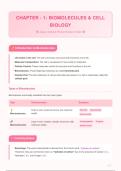
CHAPTER - 1: BIOMOLECULES & CELL
BIOLOGY
🌸 Clean, Styled & Perfect Revision Notes 🌸
✨ Introduction to Biomolecules
• Life exists in the cell: The cell is the basic structural and functional unit of life.
• Molecular Composition: The cell is composed of many kinds of molecules.
• Cellular Control: These molecules control the structure and functions of the cell.
• Biomolecules: These lifegiving molecules are called biomolecules.
• Cellular Pool: The total collection of various biomolecules present in a cell is collectively called the
cellular pool.
Types of Biomolecules
Biomolecules are broadly classified into two major types:
Type Characteristics Examples
💡 Small in size, simple structures, low molecular Glucose Nucleosides
Micromolecules weight. Amino acids
🧬 Large in size, complex complex structures, high Carbohydrates Proteins
Macromolecules molecular weight. Nucleic acids
1. Carbohydrates
• Etymology: The word carbohydrate is derived from the French word "hydrates de carbone" .
Therefore, they are commonly known as "hydrates of carbon" due to the presence of Carbon ( C ),
Hydrogen ( H ), and Oxygen ( O ).
Page 1
, • General Formula: The standard chemical formula for carbohydrates is C_n H_{2n} O_n .
• Elemental Ratio: The ratio of Hydrogen to Oxygen is always 2:1 (the same as water!).
• Primary Energy Source: Carbohydrates serve as the cheapest and main source of energy for living
organisms.
• Structural Variety: Their structures range from very simple monomers to highly complex polymers.
• Solubility: They can be either soluble or insoluble in water.
• Chemical Definition: Carbohydrates are polyhydroxy compounds (containing multiple -OH groups)
that contain either an Aldehyde group ( -CHO ) or a Ketone group ( C=O ).
Classification by Functional Groups
• Aldoses: Carbohydrates containing an aldehyde group. The -CHO group is always located at the
terminal position.
• Ketoses: Carbohydrates containing a ketone group. The C=O group is located at a sub-terminal
position.
Page 2
BIOLOGY
🌸 Clean, Styled & Perfect Revision Notes 🌸
✨ Introduction to Biomolecules
• Life exists in the cell: The cell is the basic structural and functional unit of life.
• Molecular Composition: The cell is composed of many kinds of molecules.
• Cellular Control: These molecules control the structure and functions of the cell.
• Biomolecules: These lifegiving molecules are called biomolecules.
• Cellular Pool: The total collection of various biomolecules present in a cell is collectively called the
cellular pool.
Types of Biomolecules
Biomolecules are broadly classified into two major types:
Type Characteristics Examples
💡 Small in size, simple structures, low molecular Glucose Nucleosides
Micromolecules weight. Amino acids
🧬 Large in size, complex complex structures, high Carbohydrates Proteins
Macromolecules molecular weight. Nucleic acids
1. Carbohydrates
• Etymology: The word carbohydrate is derived from the French word "hydrates de carbone" .
Therefore, they are commonly known as "hydrates of carbon" due to the presence of Carbon ( C ),
Hydrogen ( H ), and Oxygen ( O ).
Page 1
, • General Formula: The standard chemical formula for carbohydrates is C_n H_{2n} O_n .
• Elemental Ratio: The ratio of Hydrogen to Oxygen is always 2:1 (the same as water!).
• Primary Energy Source: Carbohydrates serve as the cheapest and main source of energy for living
organisms.
• Structural Variety: Their structures range from very simple monomers to highly complex polymers.
• Solubility: They can be either soluble or insoluble in water.
• Chemical Definition: Carbohydrates are polyhydroxy compounds (containing multiple -OH groups)
that contain either an Aldehyde group ( -CHO ) or a Ketone group ( C=O ).
Classification by Functional Groups
• Aldoses: Carbohydrates containing an aldehyde group. The -CHO group is always located at the
terminal position.
• Ketoses: Carbohydrates containing a ketone group. The C=O group is located at a sub-terminal
position.
Page 2


