
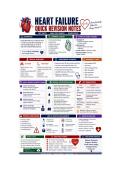
, HEART FAILURE
QUICK REVISION NOTES
High-Yield Clinical Pearls for Exam & Bedside
1. DEFINITIONS & CLASSIFICATION
1.1 Types of Heart Failure
Type EF Key Feature
HFrEF (Systolic) EF ≤ 40% Reduced contractility,
dilated ventricle
HFpEF (Diastolic) EF ≥ 50% Stiff ventricle, impaired
relaxation, preserved EF
HFmrEF EF 41-49% Mildly reduced EF,
mixed features
HFimpEF Improved from ≤40% Previously HFrEF, now
EF >40% on GDMT
1.2 NYHA Functional Classification
Class Symptoms Prognosis
I No symptoms with Good
ordinary activity
II Symptoms with ordinary Fair
activity; OK at rest
III Symptoms with minimal Poor
activity; OK only at rest
IV Symptoms AT REST; Very poor
any activity worsens
1.3 ACC/AHA Staging
Stage A: At risk (HTN, DM, CAD, family hx) → NO structural disease
Stage B: Structural disease, NO symptoms (post-MI, LVH, low EF)
Stage C: Structural disease WITH current/prior symptoms
Stage D: Refractory HF → needs specialized interventions (transplant, VAD,
hospice)
✓ Stage A & B = PREVENT progression | Stage C = MANAGE
symptoms | Stage D = ADVANCED therapies
, 2. PATHOPHYSIOLOGY — THE VICIOUS CYCLE
LOW CARDIAC OUTPUT → ↓ renal perfusion → ↑ RAAS activation →
↑ Angiotensin II + ↑ Aldosterone → Vasoconstriction + Sodium/water retention
→
↑ Preload + ↑ Afterload → WORSENING HF → ↓↓ Cardiac output → (cycle
repeats)
SIMULTANEOUSLY:
↓ Cardiac output → ↑ Sympathetic nervous system → ↑ Catecholamines →
↑ Heart rate + ↑ Contractility (short-term) → Myocardial remodeling + apoptosis
→
↓ Beta-receptor density + Myocardial fibrosis → WORSENING HF
2.1 Neurohormonal Activation — Why It Matters
• RAAS (Renin-Angiotensin-Aldosterone System): Vasoconstriction, fluid
retention, remodeling
• SNS (Sympathetic Nervous System): Tachycardia, arrhythmias, apoptosis,
remodeling
• Natriuretic Peptides (BNP/NT-proBNP): Counter-regulatory — released by
stretched ventricles
• Endothelin, Vasopressin, Cytokines (TNF-α): Contribute to vasoconstriction
and remodeling
✓ GDMT targets NEUROHORMONAL ACTIVATION — this is why
ACEi/ARB/BB/MRA all improve mortality!
2.2 Left-Sided vs Right-Sided HF
Finding LEFT-SIDED HF RIGHT-SIDED HF
Primary problem Pulmonary congestion Systemic venous
congestion
Key symptoms Dyspnea, orthopnea, JVD, hepatomegaly,
PND, cough, pink frothy ascites, peripheral
sputum edema, fatigue
Lung sounds Crackles, wheezes Usually clear (unless
biventricular)
Edema Pulmonary edema first Peripheral edema, sacral
edema
Nocturia Present (reclining Present
QUICK REVISION NOTES
High-Yield Clinical Pearls for Exam & Bedside
1. DEFINITIONS & CLASSIFICATION
1.1 Types of Heart Failure
Type EF Key Feature
HFrEF (Systolic) EF ≤ 40% Reduced contractility,
dilated ventricle
HFpEF (Diastolic) EF ≥ 50% Stiff ventricle, impaired
relaxation, preserved EF
HFmrEF EF 41-49% Mildly reduced EF,
mixed features
HFimpEF Improved from ≤40% Previously HFrEF, now
EF >40% on GDMT
1.2 NYHA Functional Classification
Class Symptoms Prognosis
I No symptoms with Good
ordinary activity
II Symptoms with ordinary Fair
activity; OK at rest
III Symptoms with minimal Poor
activity; OK only at rest
IV Symptoms AT REST; Very poor
any activity worsens
1.3 ACC/AHA Staging
Stage A: At risk (HTN, DM, CAD, family hx) → NO structural disease
Stage B: Structural disease, NO symptoms (post-MI, LVH, low EF)
Stage C: Structural disease WITH current/prior symptoms
Stage D: Refractory HF → needs specialized interventions (transplant, VAD,
hospice)
✓ Stage A & B = PREVENT progression | Stage C = MANAGE
symptoms | Stage D = ADVANCED therapies
, 2. PATHOPHYSIOLOGY — THE VICIOUS CYCLE
LOW CARDIAC OUTPUT → ↓ renal perfusion → ↑ RAAS activation →
↑ Angiotensin II + ↑ Aldosterone → Vasoconstriction + Sodium/water retention
→
↑ Preload + ↑ Afterload → WORSENING HF → ↓↓ Cardiac output → (cycle
repeats)
SIMULTANEOUSLY:
↓ Cardiac output → ↑ Sympathetic nervous system → ↑ Catecholamines →
↑ Heart rate + ↑ Contractility (short-term) → Myocardial remodeling + apoptosis
→
↓ Beta-receptor density + Myocardial fibrosis → WORSENING HF
2.1 Neurohormonal Activation — Why It Matters
• RAAS (Renin-Angiotensin-Aldosterone System): Vasoconstriction, fluid
retention, remodeling
• SNS (Sympathetic Nervous System): Tachycardia, arrhythmias, apoptosis,
remodeling
• Natriuretic Peptides (BNP/NT-proBNP): Counter-regulatory — released by
stretched ventricles
• Endothelin, Vasopressin, Cytokines (TNF-α): Contribute to vasoconstriction
and remodeling
✓ GDMT targets NEUROHORMONAL ACTIVATION — this is why
ACEi/ARB/BB/MRA all improve mortality!
2.2 Left-Sided vs Right-Sided HF
Finding LEFT-SIDED HF RIGHT-SIDED HF
Primary problem Pulmonary congestion Systemic venous
congestion
Key symptoms Dyspnea, orthopnea, JVD, hepatomegaly,
PND, cough, pink frothy ascites, peripheral
sputum edema, fatigue
Lung sounds Crackles, wheezes Usually clear (unless
biventricular)
Edema Pulmonary edema first Peripheral edema, sacral
edema
Nocturia Present (reclining Present


