
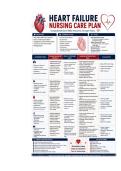
, HEART FAILURE Nursing Care Plan
Evidence-Based NANDA-I Diagnoses, Interventions and Outcomes
2025-2026 Edition
A comprehensive nursing care plan covering assessment, 8 NANDA-I nursing diagnoses
with SMART goals and rationales, medication monitoring, discharge education, and
documentation guidelines for patients with heart failure across all ejection fraction
phenotypes.
, 1. Nursing Assessment
Subjective Data
- Dyspnea (exertional, orthopnea, paroxysmal nocturnal dyspnea)
- Fatigue, weakness, decreased exercise tolerance
- Peripheral edema, abdominal bloating, early satiety
- Anxiety, fear, depression
- Medication adherence history, dietary habits
- Sleep patterns, number of pillows used
Objective Data
- VitalSigns: Tachycardia, tachypnea, hypertension or hypotension, fever (if infectious
trigger)
- Cardiovascular: S3 gallop (HFrEF), S4 (HFpEF), JVD, hepatojugular reflux, displaced
PMI, murmurs
- Respiratory: Crackles, wheezes, diminished breath sounds, pleural effusion, use of
accessory muscles
- Integumentary: Cool, clammy skin; pallor, cyanosis, mottling; peripheral edema (1+ to
4+ pitting)
- Neurological: Restlessness, confusion, decreased level of consciousness (late sign)
- GI: Hepatomegaly, ascites, nausea
- Renal: Oliguria, nocturia, elevated creatinine/BUN
- Labs:
Elevated BNP/NT-proBNP, elevated creatinine, hyponatremia, hyperkalemia,
anemia
- Diagnostics:Echo (LVEF), CXR (pulmonary congestion, cardiomegaly), ECG (rhythm,
QRS width), ABGs
Priority Assessment (First 24 Hours)
Parameter Frequency Rationale
Q4H (or more
Vital signs Detect hemodynamic changes early
frequently if unstable)
Cardiac rhythm Continuous telemetry Identify arrhythmias (AF, VT, brady)
Oxygen Continuous pulse
Monitor for hypoxemia
saturation oximetry
Same time, same Detect fluid retention (1 kg approx 1 L
Daily weight
scale, same clothing fluid)
Assess renal perfusion and diuretic
Strict I and O Continuous
response
Lung
Q4H Detect pulmonary congestion
auscultation
Evidence-Based NANDA-I Diagnoses, Interventions and Outcomes
2025-2026 Edition
A comprehensive nursing care plan covering assessment, 8 NANDA-I nursing diagnoses
with SMART goals and rationales, medication monitoring, discharge education, and
documentation guidelines for patients with heart failure across all ejection fraction
phenotypes.
, 1. Nursing Assessment
Subjective Data
- Dyspnea (exertional, orthopnea, paroxysmal nocturnal dyspnea)
- Fatigue, weakness, decreased exercise tolerance
- Peripheral edema, abdominal bloating, early satiety
- Anxiety, fear, depression
- Medication adherence history, dietary habits
- Sleep patterns, number of pillows used
Objective Data
- VitalSigns: Tachycardia, tachypnea, hypertension or hypotension, fever (if infectious
trigger)
- Cardiovascular: S3 gallop (HFrEF), S4 (HFpEF), JVD, hepatojugular reflux, displaced
PMI, murmurs
- Respiratory: Crackles, wheezes, diminished breath sounds, pleural effusion, use of
accessory muscles
- Integumentary: Cool, clammy skin; pallor, cyanosis, mottling; peripheral edema (1+ to
4+ pitting)
- Neurological: Restlessness, confusion, decreased level of consciousness (late sign)
- GI: Hepatomegaly, ascites, nausea
- Renal: Oliguria, nocturia, elevated creatinine/BUN
- Labs:
Elevated BNP/NT-proBNP, elevated creatinine, hyponatremia, hyperkalemia,
anemia
- Diagnostics:Echo (LVEF), CXR (pulmonary congestion, cardiomegaly), ECG (rhythm,
QRS width), ABGs
Priority Assessment (First 24 Hours)
Parameter Frequency Rationale
Q4H (or more
Vital signs Detect hemodynamic changes early
frequently if unstable)
Cardiac rhythm Continuous telemetry Identify arrhythmias (AF, VT, brady)
Oxygen Continuous pulse
Monitor for hypoxemia
saturation oximetry
Same time, same Detect fluid retention (1 kg approx 1 L
Daily weight
scale, same clothing fluid)
Assess renal perfusion and diuretic
Strict I and O Continuous
response
Lung
Q4H Detect pulmonary congestion
auscultation


