

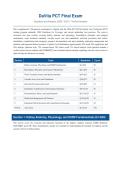
DaVita PCT Final Exam
Questions and Answers () - Verified Answers
This comprehensive 150-question examination is aligned with the 2026-2027 DaVita Patient Care Technician (PCT)
training program standards, CMS Conditions for Coverage, and current nephrology best practices. The exam is
structured into nine sections covering kidney anatomy and physiology, hemodialysis principles and transport
mechanisms, water treatment standards, vascular access care and cannulation, infection prevention and control,
intradialytic complications and emergency response, documentation and legal standards, medication management and
nutrition, and integrated clinical scenarios. Cognitive level distribution: approximately 30% recall, 50% application, and
20% analysis. Question style: 75% scenario-based, 20% direct recall, 5% clinical analysis. Each question includes a
verified correct answer marked with [CORRECT] and a detailed clinical rationale explaining why the correct answer is
right and why the distractors are wrong.
Section Topic Questions Count
1 Kidney Anatomy, Physiology, and ESRD Fundamentals Q1-Q20 20
2 Hemodialysis Principles and Transport Mechanisms Q21-Q40 20
3 Water Treatment Systems and Quality Standards Q41-Q55 15
4 Vascular Access Care and Cannulation Q56-Q75 20
5 Infection Prevention and Control Q76-Q90 15
6 Intradialytic Complications and Emergency Response Q91-Q110 20
7 Documentation, Safety, and Legal Standards Q111-Q125 15
8 Medication Management and Nutrition Q126-Q140 15
9 Integrated Clinical Scenarios and Comprehensive Reasoning Q141-Q150 10
TOTAL All sections Q1-Q150 150
Section 1: Kidney Anatomy, Physiology, and ESRD Fundamentals (Q1-Q20)
This section covers the excretory and endocrine functions of the kidneys, nephron structure, ESRD definition,
CKD-MBD, and LVH. These foundational concepts are essential for understanding the rationale for dialysis and the
systemic effects of kidney failure.
,Q1: A PCT is explaining kidney function to a newly diagnosed ESRD patient. The patient asks which structure is
considered the basic structural and functional unit of the kidney. Which response by the PCT is correct?
A. The renal cortex
B. The nephron [CORRECT]
C. The renal pelvis
D. The glomerular capsule only
Correct Answer: B
Rationale: The nephron is the basic structural and functional unit of the kidney, with approximately one million nephrons per
kidney responsible for filtering blood and producing urine. The cortex, pelvis, and capsule are anatomical structures but do not
independently perform filtration; the nephron (comprising the glomerulus and tubular system) is the functional unit that
produces urine through filtration, reabsorption, and secretion.
Q2: During a patient education session, a PCT states that a normal kidney contains approximately how many
nephrons per kidney. What is the correct number?
A. Approximately 100,000
B. Approximately 500,000
C. Approximately 1 million [CORRECT]
D. Approximately 5 million
Correct Answer: C
Rationale: Each kidney contains approximately one million nephrons. This large nephron reserve explains why kidney disease
often progresses silently, as significant function can be lost before symptoms appear. Once nephron loss reaches a critical
threshold, ESRD develops, requiring dialysis or transplant to sustain life.
Q3: A patient's lab results show a GFR of 12 mL/min/1.73m². The PCT understands that this value meets the
criteria for which condition?
A. Chronic kidney disease stage 3
B. Chronic kidney disease stage 4
C. End-Stage Renal Disease (ESRD) [CORRECT]
D. Acute kidney injury
Correct Answer: C
Rationale: End-Stage Renal Disease (ESRD) is defined as a GFR of less than 15 mL/min/1.73m², at which point dialysis or
kidney transplant is required to sustain life. Stage 3 CKD corresponds to GFR 30-59, Stage 4 to GFR 15-29, and acute kidney
injury is a sudden, potentially reversible decline rather than a GFR threshold diagnosis.
,Q4: A PCT is teaching a patient about how the kidneys maintain fluid balance. Which transport mechanism,
replicated during hemodialysis, is the PCT describing when explaining fluid removal?
A. Diffusion
B. Convection
C. Ultrafiltration [CORRECT]
D. Osmosis
Correct Answer: C
Rationale: Ultrafiltration is the excretory function of the kidney responsible for fluid balance, and it is replicated in
hemodialysis as controlled fluid removal through manipulation of hydrostatic pressure across the dialyzer membrane.
Diffusion handles electrolyte and solute balance, convection removes middle molecules, and osmosis involves fluid shifting
across a semipermeable membrane toward higher solute concentration.
Q5: When discussing electrolyte balance with a patient, the PCT correctly identifies that the kidney regulates
electrolytes such as sodium and potassium primarily through which mechanism, also used in dialysis to remove
them?
A. Diffusion [CORRECT]
B. Ultrafiltration
C. Osmosis
D. Convection
Correct Answer: A
Rationale: Diffusion is the movement of dissolved particles across a semipermeable membrane from high to low concentration
and is the primary mechanism for electrolyte balance (sodium, potassium, calcium) and waste removal (urea, creatinine).
Ultrafiltration removes fluid only, osmosis moves water toward solutes, and convection drags larger molecules with fluid.
Q6: A patient asks why they receive bicarbonate in their dialysate. The PCT correctly explains that the kidney
normally maintains acid/base balance through which mechanism?
A. Sodium reabsorption in the loop of Henle
B. Bicarbonate buffering and regeneration [CORRECT]
C. Chloride shift in the distal tubule
D. Potassium secretion in the collecting duct
Correct Answer: B
Rationale: The kidneys maintain acid/base balance by reabsorbing filtered bicarbonate and generating new bicarbonate to
buffer acids produced by metabolism. In ESRD this function fails, causing metabolic acidosis; therefore dialysate contains
bicarbonate to restore buffer capacity. Sodium, chloride, and potassium handling are electrolyte functions, not the primary
acid/base buffer system.
, Q7: Which of the following waste products is most commonly measured to assess dialysis adequacy and is a
primary waste removed by diffusion during hemodialysis?
A. Albumin
B. Glucose
C. Urea (BUN) [CORRECT]
D. Sodium
Correct Answer: C
Rationale: Urea (measured as BUN) is the primary small molecular weight waste product removed by diffusion during
hemodialysis and is the basis for Kt/V and URR adequacy calculations. Albumin is a large protein not normally removed,
glucose is a small molecule but not a waste product in this context, and sodium is an electrolyte regulated by the kidney and
dialysate rather than a waste product.
Q8: A patient with ESRD asks why they are taking a medication for blood pressure that affects the
renin-angiotensin system. The PCT understands that renin is secreted by the kidney as part of which endocrine
function?
A. Regulation of red blood cell production
B. Regulation of blood pressure via the RAAS system [CORRECT]
C. Activation of vitamin D
D. Regulation of calcium and phosphorus
Correct Answer: B
Rationale: Renin secretion activates the renin-angiotensin-aldosterone system (RAAS), which regulates blood pressure and
fluid balance. Erythropoietin production regulates red blood cell production, activated vitamin D (calcitriol) regulates
calcium/phosphorus absorption, and CKD-MBD involves mineral bone disorder. Renin specifically is the endocrine hormone
that drives RAAS-mediated blood pressure control.
Q9: A patient on dialysis has a hemoglobin of 8.2 g/dL. The PCT recognizes that the kidney's endocrine function
responsible for red blood cell production is:
A. Renin secretion
B. Erythropoietin (EPO) production [CORRECT]
C. Vitamin D activation
D. Aldosterone release
Correct Answer: B
Rationale: Erythropoietin (EPO) is produced by the peritubular cells of the kidney and stimulates red blood cell production in
the bone marrow. In ESRD, EPO deficiency causes anemia, treated with recombinant EPO (epoetin alfa) during dialysis.
Renin regulates blood pressure, vitamin D activation manages calcium, and aldosterone is from the adrenal gland.
Questions and Answers () - Verified Answers
This comprehensive 150-question examination is aligned with the 2026-2027 DaVita Patient Care Technician (PCT)
training program standards, CMS Conditions for Coverage, and current nephrology best practices. The exam is
structured into nine sections covering kidney anatomy and physiology, hemodialysis principles and transport
mechanisms, water treatment standards, vascular access care and cannulation, infection prevention and control,
intradialytic complications and emergency response, documentation and legal standards, medication management and
nutrition, and integrated clinical scenarios. Cognitive level distribution: approximately 30% recall, 50% application, and
20% analysis. Question style: 75% scenario-based, 20% direct recall, 5% clinical analysis. Each question includes a
verified correct answer marked with [CORRECT] and a detailed clinical rationale explaining why the correct answer is
right and why the distractors are wrong.
Section Topic Questions Count
1 Kidney Anatomy, Physiology, and ESRD Fundamentals Q1-Q20 20
2 Hemodialysis Principles and Transport Mechanisms Q21-Q40 20
3 Water Treatment Systems and Quality Standards Q41-Q55 15
4 Vascular Access Care and Cannulation Q56-Q75 20
5 Infection Prevention and Control Q76-Q90 15
6 Intradialytic Complications and Emergency Response Q91-Q110 20
7 Documentation, Safety, and Legal Standards Q111-Q125 15
8 Medication Management and Nutrition Q126-Q140 15
9 Integrated Clinical Scenarios and Comprehensive Reasoning Q141-Q150 10
TOTAL All sections Q1-Q150 150
Section 1: Kidney Anatomy, Physiology, and ESRD Fundamentals (Q1-Q20)
This section covers the excretory and endocrine functions of the kidneys, nephron structure, ESRD definition,
CKD-MBD, and LVH. These foundational concepts are essential for understanding the rationale for dialysis and the
systemic effects of kidney failure.
,Q1: A PCT is explaining kidney function to a newly diagnosed ESRD patient. The patient asks which structure is
considered the basic structural and functional unit of the kidney. Which response by the PCT is correct?
A. The renal cortex
B. The nephron [CORRECT]
C. The renal pelvis
D. The glomerular capsule only
Correct Answer: B
Rationale: The nephron is the basic structural and functional unit of the kidney, with approximately one million nephrons per
kidney responsible for filtering blood and producing urine. The cortex, pelvis, and capsule are anatomical structures but do not
independently perform filtration; the nephron (comprising the glomerulus and tubular system) is the functional unit that
produces urine through filtration, reabsorption, and secretion.
Q2: During a patient education session, a PCT states that a normal kidney contains approximately how many
nephrons per kidney. What is the correct number?
A. Approximately 100,000
B. Approximately 500,000
C. Approximately 1 million [CORRECT]
D. Approximately 5 million
Correct Answer: C
Rationale: Each kidney contains approximately one million nephrons. This large nephron reserve explains why kidney disease
often progresses silently, as significant function can be lost before symptoms appear. Once nephron loss reaches a critical
threshold, ESRD develops, requiring dialysis or transplant to sustain life.
Q3: A patient's lab results show a GFR of 12 mL/min/1.73m². The PCT understands that this value meets the
criteria for which condition?
A. Chronic kidney disease stage 3
B. Chronic kidney disease stage 4
C. End-Stage Renal Disease (ESRD) [CORRECT]
D. Acute kidney injury
Correct Answer: C
Rationale: End-Stage Renal Disease (ESRD) is defined as a GFR of less than 15 mL/min/1.73m², at which point dialysis or
kidney transplant is required to sustain life. Stage 3 CKD corresponds to GFR 30-59, Stage 4 to GFR 15-29, and acute kidney
injury is a sudden, potentially reversible decline rather than a GFR threshold diagnosis.
,Q4: A PCT is teaching a patient about how the kidneys maintain fluid balance. Which transport mechanism,
replicated during hemodialysis, is the PCT describing when explaining fluid removal?
A. Diffusion
B. Convection
C. Ultrafiltration [CORRECT]
D. Osmosis
Correct Answer: C
Rationale: Ultrafiltration is the excretory function of the kidney responsible for fluid balance, and it is replicated in
hemodialysis as controlled fluid removal through manipulation of hydrostatic pressure across the dialyzer membrane.
Diffusion handles electrolyte and solute balance, convection removes middle molecules, and osmosis involves fluid shifting
across a semipermeable membrane toward higher solute concentration.
Q5: When discussing electrolyte balance with a patient, the PCT correctly identifies that the kidney regulates
electrolytes such as sodium and potassium primarily through which mechanism, also used in dialysis to remove
them?
A. Diffusion [CORRECT]
B. Ultrafiltration
C. Osmosis
D. Convection
Correct Answer: A
Rationale: Diffusion is the movement of dissolved particles across a semipermeable membrane from high to low concentration
and is the primary mechanism for electrolyte balance (sodium, potassium, calcium) and waste removal (urea, creatinine).
Ultrafiltration removes fluid only, osmosis moves water toward solutes, and convection drags larger molecules with fluid.
Q6: A patient asks why they receive bicarbonate in their dialysate. The PCT correctly explains that the kidney
normally maintains acid/base balance through which mechanism?
A. Sodium reabsorption in the loop of Henle
B. Bicarbonate buffering and regeneration [CORRECT]
C. Chloride shift in the distal tubule
D. Potassium secretion in the collecting duct
Correct Answer: B
Rationale: The kidneys maintain acid/base balance by reabsorbing filtered bicarbonate and generating new bicarbonate to
buffer acids produced by metabolism. In ESRD this function fails, causing metabolic acidosis; therefore dialysate contains
bicarbonate to restore buffer capacity. Sodium, chloride, and potassium handling are electrolyte functions, not the primary
acid/base buffer system.
, Q7: Which of the following waste products is most commonly measured to assess dialysis adequacy and is a
primary waste removed by diffusion during hemodialysis?
A. Albumin
B. Glucose
C. Urea (BUN) [CORRECT]
D. Sodium
Correct Answer: C
Rationale: Urea (measured as BUN) is the primary small molecular weight waste product removed by diffusion during
hemodialysis and is the basis for Kt/V and URR adequacy calculations. Albumin is a large protein not normally removed,
glucose is a small molecule but not a waste product in this context, and sodium is an electrolyte regulated by the kidney and
dialysate rather than a waste product.
Q8: A patient with ESRD asks why they are taking a medication for blood pressure that affects the
renin-angiotensin system. The PCT understands that renin is secreted by the kidney as part of which endocrine
function?
A. Regulation of red blood cell production
B. Regulation of blood pressure via the RAAS system [CORRECT]
C. Activation of vitamin D
D. Regulation of calcium and phosphorus
Correct Answer: B
Rationale: Renin secretion activates the renin-angiotensin-aldosterone system (RAAS), which regulates blood pressure and
fluid balance. Erythropoietin production regulates red blood cell production, activated vitamin D (calcitriol) regulates
calcium/phosphorus absorption, and CKD-MBD involves mineral bone disorder. Renin specifically is the endocrine hormone
that drives RAAS-mediated blood pressure control.
Q9: A patient on dialysis has a hemoglobin of 8.2 g/dL. The PCT recognizes that the kidney's endocrine function
responsible for red blood cell production is:
A. Renin secretion
B. Erythropoietin (EPO) production [CORRECT]
C. Vitamin D activation
D. Aldosterone release
Correct Answer: B
Rationale: Erythropoietin (EPO) is produced by the peritubular cells of the kidney and stimulates red blood cell production in
the bone marrow. In ESRD, EPO deficiency causes anemia, treated with recombinant EPO (epoetin alfa) during dialysis.
Renin regulates blood pressure, vitamin D activation manages calcium, and aldosterone is from the adrenal gland.


