

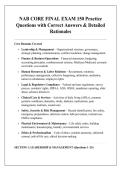
NAB CORE FINAL EXAM 150 Practice
Questions with Correct Answers & Detailed
Rationales
Core Domains Covered
• Leadership & Management – Organizational structure, governance,
strategic planning, communication, conflict resolution, change management
• Finance & Business Operations – Financial statements, budgeting,
accounting principles, reimbursement systems, Medicare/Medicaid, accounts
receivable, cost controls
• Human Resources & Labor Relations – Recruitment, retention,
performance management, collective bargaining, arbitration, mediation,
turnover calculations, employee rights
• Legal & Regulatory Compliance – Federal and state regulations, survey
process, residents' rights, HIPAA, ADA, OSHA, mandatory reporting, elder
abuse, advance directives
• Clinical Care & Services – Activities of daily living (ADLs), common
geriatric conditions, dementia, stroke, diabetes, medications, pain
management, nutrition, wound care
• Safety, Security & Risk Management – Hazard identification, fire safety,
emergency preparedness, infection control, falls prevention, restraint use,
OSHA compliance
• Physical Environment & Maintenance – Life safety codes, building
maintenance, housekeeping, laundry, environmental services
• Ethics & Professionalism – Code of ethics, resident autonomy, informed
consent, end-of-life care, ethical decision-making
SECTION 1: LEADERSHIP & MANAGEMENT (Questions 1–25)
,1. Which one of the following steps should be taken first in a risk management
program?
A. Purchasing of adequate insurance
B. Conducting of employee safety drills
C. Identifying hazards and risks
D. Conducting staff in-services on incident reporting
Rationale: The first step in any risk management program is to identify potential
hazards and risks. Insurance, training, and drills are all subsequent steps taken to
address the risks that have been identified.
2. The type of leadership that is most effective in a long-term care setting,
where staff need guidance and residents require consistent care, is:
A. Laissez-faire leadership
B. Transformational leadership
C. Autocratic leadership
D. Passive leadership
Rationale: Transformational leadership inspires and motivates staff, fosters a
positive culture, and encourages innovation, making it effective in healthcare
settings. Autocratic leadership can stifle staff engagement; laissez-faire provides
insufficient direction.
3. Which of the following is a component of the management function
"organizing"?
A. Setting organizational goals
B. Structuring resources and activities to achieve objectives
C. Monitoring performance against standards
D. Motivating employees to perform
Rationale: Organizing involves structuring resources (people, equipment,
finances) and activities to achieve organizational objectives. Setting goals is
planning; monitoring is controlling; motivating is leading/directing.
,4. An administrator who empowers staff to make decisions and solve
problems is demonstrating which leadership style?
A. Autocratic
B. Participative
C. Laissez-faire
D. Transactional
Rationale: Participative leadership involves employees in decision-making and
empowers them to solve problems. Autocratic leaders make decisions unilaterally;
laissez-faire leaders provide minimal guidance.
5. The primary purpose of a facility's mission statement is to:
A. Generate profit for stakeholders
B. Define the organization's purpose and reason for existence
C. Outline employee job descriptions
D. List all services provided
Rationale: The mission statement defines the organization's fundamental purpose,
values, and reason for existence. It guides strategic decisions and communicates
the organization's identity.
6. The "planning" function of management includes:
A. Hiring and training staff
B. Setting goals and determining how to achieve them
C. Monitoring performance
D. Resolving conflicts
Rationale: Planning involves setting goals, developing strategies, and determining
the actions needed to achieve those goals. Hiring/training is staffing; monitoring is
controlling; resolving conflicts is leading/directing.
7. The most effective way for an administrator to build a positive
organizational culture is to:
, A. Strictly enforce all policies
B. Model desired behaviors and communicate a clear vision
C. Focus solely on financial performance
D. Avoid all conflict
Rationale: Leaders build culture by modeling desired behaviors, communicating a
clear vision, and reinforcing values through daily actions. Strict enforcement
without modeling is less effective; avoiding conflict allows problems to fester.
8. A manager who focuses on tasks and procedures rather than people is using
a(n) ________ leadership orientation.
A. Employee-centered
B. Task-centered
C. Relationship-centered
D. Transformational
Rationale: Task-centered leaders focus on accomplishing tasks, following
procedures, and meeting deadlines. Employee/relationship-centered leaders focus
on staff well-being and development.
9. The "span of control" refers to:
A. The number of policies in the facility
B. The number of employees a manager supervises
C. The budget for a department
D. The geographical area of the facility
Rationale: Span of control is the number of direct reports a manager supervises. A
wide span of control means more employees per manager; a narrow span means
fewer.
10. Which of the following is a characteristic of effective communication in a
healthcare setting?
A. Using complex medical jargon
B. Active listening and clear, concise language
Questions with Correct Answers & Detailed
Rationales
Core Domains Covered
• Leadership & Management – Organizational structure, governance,
strategic planning, communication, conflict resolution, change management
• Finance & Business Operations – Financial statements, budgeting,
accounting principles, reimbursement systems, Medicare/Medicaid, accounts
receivable, cost controls
• Human Resources & Labor Relations – Recruitment, retention,
performance management, collective bargaining, arbitration, mediation,
turnover calculations, employee rights
• Legal & Regulatory Compliance – Federal and state regulations, survey
process, residents' rights, HIPAA, ADA, OSHA, mandatory reporting, elder
abuse, advance directives
• Clinical Care & Services – Activities of daily living (ADLs), common
geriatric conditions, dementia, stroke, diabetes, medications, pain
management, nutrition, wound care
• Safety, Security & Risk Management – Hazard identification, fire safety,
emergency preparedness, infection control, falls prevention, restraint use,
OSHA compliance
• Physical Environment & Maintenance – Life safety codes, building
maintenance, housekeeping, laundry, environmental services
• Ethics & Professionalism – Code of ethics, resident autonomy, informed
consent, end-of-life care, ethical decision-making
SECTION 1: LEADERSHIP & MANAGEMENT (Questions 1–25)
,1. Which one of the following steps should be taken first in a risk management
program?
A. Purchasing of adequate insurance
B. Conducting of employee safety drills
C. Identifying hazards and risks
D. Conducting staff in-services on incident reporting
Rationale: The first step in any risk management program is to identify potential
hazards and risks. Insurance, training, and drills are all subsequent steps taken to
address the risks that have been identified.
2. The type of leadership that is most effective in a long-term care setting,
where staff need guidance and residents require consistent care, is:
A. Laissez-faire leadership
B. Transformational leadership
C. Autocratic leadership
D. Passive leadership
Rationale: Transformational leadership inspires and motivates staff, fosters a
positive culture, and encourages innovation, making it effective in healthcare
settings. Autocratic leadership can stifle staff engagement; laissez-faire provides
insufficient direction.
3. Which of the following is a component of the management function
"organizing"?
A. Setting organizational goals
B. Structuring resources and activities to achieve objectives
C. Monitoring performance against standards
D. Motivating employees to perform
Rationale: Organizing involves structuring resources (people, equipment,
finances) and activities to achieve organizational objectives. Setting goals is
planning; monitoring is controlling; motivating is leading/directing.
,4. An administrator who empowers staff to make decisions and solve
problems is demonstrating which leadership style?
A. Autocratic
B. Participative
C. Laissez-faire
D. Transactional
Rationale: Participative leadership involves employees in decision-making and
empowers them to solve problems. Autocratic leaders make decisions unilaterally;
laissez-faire leaders provide minimal guidance.
5. The primary purpose of a facility's mission statement is to:
A. Generate profit for stakeholders
B. Define the organization's purpose and reason for existence
C. Outline employee job descriptions
D. List all services provided
Rationale: The mission statement defines the organization's fundamental purpose,
values, and reason for existence. It guides strategic decisions and communicates
the organization's identity.
6. The "planning" function of management includes:
A. Hiring and training staff
B. Setting goals and determining how to achieve them
C. Monitoring performance
D. Resolving conflicts
Rationale: Planning involves setting goals, developing strategies, and determining
the actions needed to achieve those goals. Hiring/training is staffing; monitoring is
controlling; resolving conflicts is leading/directing.
7. The most effective way for an administrator to build a positive
organizational culture is to:
, A. Strictly enforce all policies
B. Model desired behaviors and communicate a clear vision
C. Focus solely on financial performance
D. Avoid all conflict
Rationale: Leaders build culture by modeling desired behaviors, communicating a
clear vision, and reinforcing values through daily actions. Strict enforcement
without modeling is less effective; avoiding conflict allows problems to fester.
8. A manager who focuses on tasks and procedures rather than people is using
a(n) ________ leadership orientation.
A. Employee-centered
B. Task-centered
C. Relationship-centered
D. Transformational
Rationale: Task-centered leaders focus on accomplishing tasks, following
procedures, and meeting deadlines. Employee/relationship-centered leaders focus
on staff well-being and development.
9. The "span of control" refers to:
A. The number of policies in the facility
B. The number of employees a manager supervises
C. The budget for a department
D. The geographical area of the facility
Rationale: Span of control is the number of direct reports a manager supervises. A
wide span of control means more employees per manager; a narrow span means
fewer.
10. Which of the following is a characteristic of effective communication in a
healthcare setting?
A. Using complex medical jargon
B. Active listening and clear, concise language


