

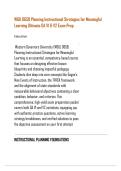
WGU D658 Planning Instructional Strategies for Meaningful
Learning Ultimate OA V1 & V2 Exam Prep
Education
Western Governors University (WGU) D658:
Planning Instructional Strategies for Meaningful
Learning is an essential, competency-based course
that focuses on designing effective lesson
blueprints and choosing impactful pedagogy.
Students dive deep into core concepts like Gagne’s
Nine Events of Instruction, the TPACK framework,
and the alignment of state standards with
measurable behavioral objectives containing a clear
condition, behavior, and criterion. This
comprehensive, high-yield exam preparation packet
covers both OA V1 and V2 variations, equipping you
with authentic practice questions, active learning
strategy breakdowns, and verified solutions to pass
the objective assessment on your first attempt
INSTRUCTIONAL PLANNING FOUNDATIONS
,Alignment means that objectives, instruction, and assessment are:
A. Flexible
B. Independent
C. Directly connected
D. Teacher-selected
Answer: C
Rationale: Alignment ensures coherence and effectiveness.
7. Which assessment BEST measures application of learning?
A. Multiple-choice quiz
B. Matching test
C. Performance task
D. True/false test
Answer: C
Rationale: Performance tasks assess real-world application.
8. Instructional strategies should be selected based on:
A. Teacher preference
B. Time available
C. Learning objectives and learner needs
,D. Technology access
Answer: C
Rationale: Strategies must support objectives and learners.
9. Scaffolding supports students by:
A. Lowering expectations
B. Removing challenges
C. Gradually releasing responsibility
D. Eliminating independence
Answer: C
Rationale: Scaffolding fades support as learners gain skills.
1. Meaningful learning occurs when instruction is:
A. Teacher-centered
B. Rote and repetitive
C. Connected to prior knowledge
D. Focused on memorization
, Answer: C
Rationale: Meaningful learning builds on what learners already know.
2. Backward design begins with:
A. Selecting activities
B. Identifying assessments
C. Identifying learning outcomes
D. Choosing materials
Answer: C
Rationale: Backward design starts with desired results.
3. Learning objectives should be written using:
A. Vague language
B. Student behaviors
C. Teacher actions
D. Instructional strategies
Answer: B
Rationale: Objectives describe what learners will do.
Learning Ultimate OA V1 & V2 Exam Prep
Education
Western Governors University (WGU) D658:
Planning Instructional Strategies for Meaningful
Learning is an essential, competency-based course
that focuses on designing effective lesson
blueprints and choosing impactful pedagogy.
Students dive deep into core concepts like Gagne’s
Nine Events of Instruction, the TPACK framework,
and the alignment of state standards with
measurable behavioral objectives containing a clear
condition, behavior, and criterion. This
comprehensive, high-yield exam preparation packet
covers both OA V1 and V2 variations, equipping you
with authentic practice questions, active learning
strategy breakdowns, and verified solutions to pass
the objective assessment on your first attempt
INSTRUCTIONAL PLANNING FOUNDATIONS
,Alignment means that objectives, instruction, and assessment are:
A. Flexible
B. Independent
C. Directly connected
D. Teacher-selected
Answer: C
Rationale: Alignment ensures coherence and effectiveness.
7. Which assessment BEST measures application of learning?
A. Multiple-choice quiz
B. Matching test
C. Performance task
D. True/false test
Answer: C
Rationale: Performance tasks assess real-world application.
8. Instructional strategies should be selected based on:
A. Teacher preference
B. Time available
C. Learning objectives and learner needs
,D. Technology access
Answer: C
Rationale: Strategies must support objectives and learners.
9. Scaffolding supports students by:
A. Lowering expectations
B. Removing challenges
C. Gradually releasing responsibility
D. Eliminating independence
Answer: C
Rationale: Scaffolding fades support as learners gain skills.
1. Meaningful learning occurs when instruction is:
A. Teacher-centered
B. Rote and repetitive
C. Connected to prior knowledge
D. Focused on memorization
, Answer: C
Rationale: Meaningful learning builds on what learners already know.
2. Backward design begins with:
A. Selecting activities
B. Identifying assessments
C. Identifying learning outcomes
D. Choosing materials
Answer: C
Rationale: Backward design starts with desired results.
3. Learning objectives should be written using:
A. Vague language
B. Student behaviors
C. Teacher actions
D. Instructional strategies
Answer: B
Rationale: Objectives describe what learners will do.


