
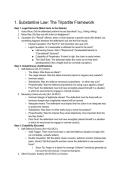
1. Substantive Law: The Tripartite Framework
Step 1: Legal Elements (Match facts to the Statute)
1. Actus Reus: Did the defendant perform the act described? (e.g., hitting, killing).
2. Mens Rea: Did they act with Intent or Negligence?
3. Causation (If a "Result" offence; when a crime requires a specific result (like death), but
something happens between the defendant's act and the final result):
○ Factual Causation: The "But For" test (Condicio sine qua non).
○ Legal Causation: Is it reasonable to attribute the result to the actor?
■ Intervening Cause: Was it "Responsive" (foreseeable/natural) or
"Coincidental" (bizarre)?
■ Culpability of Perpetrator: If intent is high, the chain is rarely broken.
■ Thin Skull Rule: The defendant takes the victim as he finds them
(predispositions like a fragile skull do not break causation).
Step 2: Unlawfulness (Justifications)
1. Self-Defence (Art 41(1) DCC):
○ The Attack: Was there an attack?
○ The Legal Interest: Was the attack imminent (about to happen) and unlawful?
○ Imminent attack
○ Subsidiarity: Was the defence necessary (subsidiarity - no other way out)?
○ Proportionality: Was the defence proportional (not using a gun against a slap)?
○ Prior Fault: the defendant must not have wrongfully placed himself in a situation
in which he was forced to engage in criminal conduct.
2. Necessity (choice of evils) (Art. 40 DCC):
○ Imminent danger of legitimate interest: The defendant must be faced with an
imminent danger that a legitimate interest will be harmed.
○ Adequate means: The defendant must expect that his action is an adequate way
to protect the interest.
○ Subsidiarity: Was there no other lawful way to solve the problem?
○ Proportionality: Was the interest they saved objectively more important than the
law they broke?
○ Prior Fault: the defendant must not have wrongfully placed himself in a situation
in which he was forced to engage in criminal conduct.
Step 3: Culpability (Excuses)
1. Self-Defence Excess (Art 41(2) DCC):
○ Valid Trigger: There must have been a valid self-defence situation to begin with
(an immediate, unlawful attack).
○ Double Causation: Did the attack cause a severe, asthenic emotion (intense fear,
panic, shock)? Did that specific emotion cause the defendant to use excessive
force?
i. Exam Tip: Anger or a desire for revenge ("sthenic" emotions) generally do
not count for this excuse. It must be fear/panic.
2. Other Excuses: Insanity (Art 39 DCC) or Duress.
, Full Question: Marcus Flint intentionally drives his car into a llama, severely injuring it. An ambulance is
called, but the driver gets lost, and the llama dies. A vet states the llama might have lived if the
ambulance arrived sooner. Marcus argues he didn't kill the llama; the ambulance delay did. Argue
whether the requisite causal connection for art. 350(2) DCC (killing an animal) can be established.
● Issue: Can the death of the llama be legally attributed to Marcus Flint’s act of driving into it, or did
the ambulance delay break the causal chain?
● Rule: 1. Factual Causation: The "But For" test (Condicio sine qua non). 2. Legal Causation: Is it
reasonable to attribute the result to the actor? 3. Intervening Causes: "Responsive" causes
(natural/foreseeable) usually do not break the chain, whereas "Coincidental"
(bizarre/unforeseeable) causes might. 4. Culpability of Perpetrator: If intent is high, the chain is
harder to break ("Intended consequences are never too remote").
● Analysis: * Factual: But for Marcus hitting the llama, the ambulance would not have been
necessary, and the llama would not have died.
○ Legal: The ambulance delay is a "Responsive" intervening cause. It is foreseeable that
an ambulance might be delayed or a driver might get lost; this is not a "bizarre" event.
○ Culpability: Marcus acted with direct intent ("Die you woolly bastard!"). Because he
intended the death, the delay is even less likely to break the chain.
● Conclusion: The causal connection is established. Marcus is liable for the death.
2. Substantive Law: If instigation
X is liable for … (murder/theft/etc) via instigation because...
Legal elements
Step 1: The Accessory Requirement (Derivative Liability)
● The Question: Did the factual perpetrator actually commit the crime (or a punishable
attempt)?
● The Rule: Instigation is "accessory." If the person who was talked into it never actually does
anything, there is no completed instigation.
● In your answer: "First, it must be established that [Perpetrator] committed the act of
[Crime]. Based on the facts, [Perpetrator] did [X], which fulfills the definition of [Article
#]."
Step 2: Psychological Causation
● The Question: Did the instigator cause (psychological causation) the perpetrator to want
to do it?
● The Rule: The instigator must be the "intellectual author." If the perpetrator was already planning
to do it anyway, it’s not instigation (it might be aiding).
● In your answer: "The instigator must have moved the will of the perpetrator. But for
[Instigator]'s actions, [Perpetrator] would not have formed the intent to commit the
crime."
Step 3: The Specific Means (Art. 47(1)(2) DCC)
● The Question: The instigator must have been the one to "trigger" the perpetrator’s
intent. If the perpetrator had already decided to commit the crime before the instigator
spoke to them, it is not instigation (it might be aiding). Did the instigator use one of the
legal "tools" allowed by the Code (If dutch law)?
● The Rule: You must name at least one of these:
Step 1: Legal Elements (Match facts to the Statute)
1. Actus Reus: Did the defendant perform the act described? (e.g., hitting, killing).
2. Mens Rea: Did they act with Intent or Negligence?
3. Causation (If a "Result" offence; when a crime requires a specific result (like death), but
something happens between the defendant's act and the final result):
○ Factual Causation: The "But For" test (Condicio sine qua non).
○ Legal Causation: Is it reasonable to attribute the result to the actor?
■ Intervening Cause: Was it "Responsive" (foreseeable/natural) or
"Coincidental" (bizarre)?
■ Culpability of Perpetrator: If intent is high, the chain is rarely broken.
■ Thin Skull Rule: The defendant takes the victim as he finds them
(predispositions like a fragile skull do not break causation).
Step 2: Unlawfulness (Justifications)
1. Self-Defence (Art 41(1) DCC):
○ The Attack: Was there an attack?
○ The Legal Interest: Was the attack imminent (about to happen) and unlawful?
○ Imminent attack
○ Subsidiarity: Was the defence necessary (subsidiarity - no other way out)?
○ Proportionality: Was the defence proportional (not using a gun against a slap)?
○ Prior Fault: the defendant must not have wrongfully placed himself in a situation
in which he was forced to engage in criminal conduct.
2. Necessity (choice of evils) (Art. 40 DCC):
○ Imminent danger of legitimate interest: The defendant must be faced with an
imminent danger that a legitimate interest will be harmed.
○ Adequate means: The defendant must expect that his action is an adequate way
to protect the interest.
○ Subsidiarity: Was there no other lawful way to solve the problem?
○ Proportionality: Was the interest they saved objectively more important than the
law they broke?
○ Prior Fault: the defendant must not have wrongfully placed himself in a situation
in which he was forced to engage in criminal conduct.
Step 3: Culpability (Excuses)
1. Self-Defence Excess (Art 41(2) DCC):
○ Valid Trigger: There must have been a valid self-defence situation to begin with
(an immediate, unlawful attack).
○ Double Causation: Did the attack cause a severe, asthenic emotion (intense fear,
panic, shock)? Did that specific emotion cause the defendant to use excessive
force?
i. Exam Tip: Anger or a desire for revenge ("sthenic" emotions) generally do
not count for this excuse. It must be fear/panic.
2. Other Excuses: Insanity (Art 39 DCC) or Duress.
, Full Question: Marcus Flint intentionally drives his car into a llama, severely injuring it. An ambulance is
called, but the driver gets lost, and the llama dies. A vet states the llama might have lived if the
ambulance arrived sooner. Marcus argues he didn't kill the llama; the ambulance delay did. Argue
whether the requisite causal connection for art. 350(2) DCC (killing an animal) can be established.
● Issue: Can the death of the llama be legally attributed to Marcus Flint’s act of driving into it, or did
the ambulance delay break the causal chain?
● Rule: 1. Factual Causation: The "But For" test (Condicio sine qua non). 2. Legal Causation: Is it
reasonable to attribute the result to the actor? 3. Intervening Causes: "Responsive" causes
(natural/foreseeable) usually do not break the chain, whereas "Coincidental"
(bizarre/unforeseeable) causes might. 4. Culpability of Perpetrator: If intent is high, the chain is
harder to break ("Intended consequences are never too remote").
● Analysis: * Factual: But for Marcus hitting the llama, the ambulance would not have been
necessary, and the llama would not have died.
○ Legal: The ambulance delay is a "Responsive" intervening cause. It is foreseeable that
an ambulance might be delayed or a driver might get lost; this is not a "bizarre" event.
○ Culpability: Marcus acted with direct intent ("Die you woolly bastard!"). Because he
intended the death, the delay is even less likely to break the chain.
● Conclusion: The causal connection is established. Marcus is liable for the death.
2. Substantive Law: If instigation
X is liable for … (murder/theft/etc) via instigation because...
Legal elements
Step 1: The Accessory Requirement (Derivative Liability)
● The Question: Did the factual perpetrator actually commit the crime (or a punishable
attempt)?
● The Rule: Instigation is "accessory." If the person who was talked into it never actually does
anything, there is no completed instigation.
● In your answer: "First, it must be established that [Perpetrator] committed the act of
[Crime]. Based on the facts, [Perpetrator] did [X], which fulfills the definition of [Article
#]."
Step 2: Psychological Causation
● The Question: Did the instigator cause (psychological causation) the perpetrator to want
to do it?
● The Rule: The instigator must be the "intellectual author." If the perpetrator was already planning
to do it anyway, it’s not instigation (it might be aiding).
● In your answer: "The instigator must have moved the will of the perpetrator. But for
[Instigator]'s actions, [Perpetrator] would not have formed the intent to commit the
crime."
Step 3: The Specific Means (Art. 47(1)(2) DCC)
● The Question: The instigator must have been the one to "trigger" the perpetrator’s
intent. If the perpetrator had already decided to commit the crime before the instigator
spoke to them, it is not instigation (it might be aiding). Did the instigator use one of the
legal "tools" allowed by the Code (If dutch law)?
● The Rule: You must name at least one of these:


