
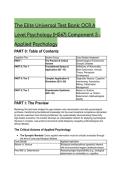
The Elite Universal Test Bank: OCR A
Level Psychology (H567) Component 3 -
Applied Psychology
PART 0: Table of Contents
Cognitive Tier Section Focus Core Studies Assessed
PART I The Preview & Critical Epistemological Frameworks,
Axioms Synoptic Debates
PART II: Tier 1 Foundational Syntax & Definitions of Abnormality,
Application (Q1–10) Brain Dysfunction, Arousal
Theory, Perceptual
Development
PART II: Tier 2 Complex Application & Diagnostic Nuance, Cognitive
Simulation (Q11–20) Interviewing, Assortative
Mating, Catastrophe
Management
PART II: Tier 3 Grandmaster Synthesis Nature vs. Nurture,
(Q21–30) Reductionism vs. Holism,
Determinism, Methodological
Validity
PART I: The Preview
Mastering this test bank bridges the gap between rote memorization and elite psychological
synthesis, transforming foundational knowledge into the exact analytical competence demanded
by top-tier examiners and clinical practitioners. By systematically deconstructing these thirty
high-stakes scenarios, the scholar develops an unbreakable intuition for applying psychological
theories to complex, real-world environments while flawlessly navigating methodological and
ethical debates.
The Critical Axioms of Applied Psychology
● The Synoptic Mandate: Every applied intervention must be critically evaluated through
the lens of core psychological debates.
Core Debate Applied Implication
Nature vs. Nurture Biological predispositions (genetics) interact
with environmental triggers (diathesis-stress).
Free Will vs. Determinism Assessing legal responsibility (e.g., biological
determinism in criminality) vs. cognitive
,Core Debate Applied Implication
autonomy.
Reductionism vs. Holism Reducing behavior to neurochemistry vs.
exploring multi-dimensional situational factors.
Individual vs. Situational Dispositional traits (personality) versus
contextual pressures (e.g., coaching
environment, psychiatric wards).
● The Epistemological Divide: The conceptualization of mental health is fundamentally
divided between the Medical Model (pathological illness requiring biological intervention)
and Alternative Models (behavioral adaptations, problems in living, or linguistic
metaphors).
● The Neurological Arousal Threshold: Across developmental and sporting contexts, the
midbrain (ventral striatum, amygdala) and sympathetic nervous system drive reward and
arousal, while the prefrontal cortex dictates executive control and catastrophe mitigation.
PART II: The Elite Test Bank
Q1: A clinician evaluates a corporate executive who maintains high financial productivity but
completely lacks self-esteem, demonstrates no personal growth, and relies entirely on their
spouse for environmental mastery. Based on the principles of defining abnormality in mental
health, which conclusion is the MOST ACCURATE? A) The patient is abnormal according to the
statistical infrequency definition, as their behavior is mathematically rare. B) The patient is
normal according to the failure to function adequately definition, as they maintain a highly
demanding job. C) The patient is abnormal according to Jahoda's deviation from ideal mental
health, specifically failing the criteria of autonomy and self-actualization. D) The patient is
normal according to the deviation from social norms definition, as marriage inherently involves
shared decisions and environmental management.
● Answer: C (The patient is abnormal according to Jahoda's deviation from ideal mental
health, specifically failing the criteria of autonomy and self-actualization.)
● Distractor Analysis:
○ A is incorrect: While the behavior may be uncommon, statistical infrequency relies
on measurable, quantifiable data (like an IQ score on a normal distribution curve)
rather than qualitative emotional dependencies.
○ B is incorrect: Failure to function adequately encompasses more than just
employment; relying entirely on a spouse for all basic environmental mastery could
still indicate an inability to cope with independent daily living, making this a poor
absolute conclusion.
○ D is incorrect: A total lack of personal decision-making exceeds standard marital
sharing and violates Western societal norms regarding adult independence, making
this technically flawed and culturally relative.
The Mentor's Analysis: Defining abnormality requires selecting the appropriate theoretical
lens. When facing a patient who functions superficially but lacks self-actualization, the
immediate priority is applying Jahoda's criteria. By utilizing Deviation from Ideal Mental Health,
the practitioner bypasses the common trap of assuming economic productivity equals
psychological health. Professional/Academic Intuition: Absence of overt distress does not
equal mental health; autonomy, mastery, and accurate perception of reality are strictly
required for the ideal psychological baseline.
, Q2: During an intake assessment, a psychiatric team discovers that a patient was hospitalized
for schizophrenia ten years ago. Despite the patient currently presenting only with mild
situational anxiety regarding a new job, the team begins interpreting the patient's note-taking
during the session as "obsessive writing behavior." Based on the principles of Rosenhan (1973),
which phenomenon is MOST LIKELY occurring? A) The fundamental attribution error, where the
team blames the patient's disposition rather than the stressful job. B) The self-fulfilling prophecy,
where the patient begins to act schizophrenic because the doctors expect it. C) The stickiness
of labels, where a historical psychiatric diagnosis permanently colors the interpretation of all
subsequent normal behavior. D) Institutionalization, where the patient has internalized the
behaviors required to survive in a psychiatric ward.
● Answer: C (The stickiness of labels, where a historical psychiatric diagnosis permanently
colors the interpretation of all subsequent normal behavior.)
● Distractor Analysis:
○ A is incorrect: While related to attribution, this scenario specifically describes how a
medical label frames clinical observation (a Type II diagnostic error), not a general
social psychology bias.
○ B is incorrect: The scenario explicitly states the patient is exhibiting normal
note-taking behavior; they are not manifesting new symptoms to meet clinical
expectations.
○ D is incorrect: Institutionalization refers to a loss of independent living skills due to
prolonged confinement, which is irrelevant to the clinicians' biased, top-down
observations.
The Mentor's Analysis: Psychiatric diagnoses carry immense systemic weight. When facing a
clinical history of severe mental illness, the immediate priority is maintaining objective
observation of current behaviors. By utilizing the concept of the Stickiness of Labels, the
practitioner bypasses the common trap of interpreting benign actions through the lens of a
legacy diagnosis. Professional/Academic Intuition: A psychiatric diagnosis acts as a
cognitive filter that alters clinical perception; benign behaviors are frequently
pathologized to fit the established label.
Q3: A researcher conducts a longitudinal family study on the heritability of severe mental
disorders. They observe that offspring with two parents diagnosed with schizophrenia have a
27.3% probability of developing the disorder. Based on the principles of Gottesman et al. (2010),
which conclusion is the MOST ACCURATE? A) The data provides absolute proof of genetic
determinism in the etiology of schizophrenia, as 27.3% represents a genetic certainty. B) The
data indicates a strong genetic vulnerability, supporting the medical model, but explicitly requires
the interaction of shared environmental stressors. C) The data refutes the medical model by
demonstrating that parents model schizophrenic behavior for their children to imitate via social
learning. D) The data suggests that schizophrenia is entirely caused by brain structure
abnormalities inherited at birth.
● Answer: B (The data indicates a strong genetic vulnerability, supporting the medical
model, but explicitly requires the interaction of shared environmental stressors.)
● Distractor Analysis:
○ A is incorrect: Gottesman's study shows increased risk (vulnerability), not 100%
concordance. A 27.3% probability cannot prove absolute genetic determinism.
○ C is incorrect: The study was designed to investigate genetic links (the medical
model), not social learning theory; attributing the findings solely to behavioral
imitation ignores the primary biological hypothesis.
○ D is incorrect: While genetics influence brain structure, the study specifically
Level Psychology (H567) Component 3 -
Applied Psychology
PART 0: Table of Contents
Cognitive Tier Section Focus Core Studies Assessed
PART I The Preview & Critical Epistemological Frameworks,
Axioms Synoptic Debates
PART II: Tier 1 Foundational Syntax & Definitions of Abnormality,
Application (Q1–10) Brain Dysfunction, Arousal
Theory, Perceptual
Development
PART II: Tier 2 Complex Application & Diagnostic Nuance, Cognitive
Simulation (Q11–20) Interviewing, Assortative
Mating, Catastrophe
Management
PART II: Tier 3 Grandmaster Synthesis Nature vs. Nurture,
(Q21–30) Reductionism vs. Holism,
Determinism, Methodological
Validity
PART I: The Preview
Mastering this test bank bridges the gap between rote memorization and elite psychological
synthesis, transforming foundational knowledge into the exact analytical competence demanded
by top-tier examiners and clinical practitioners. By systematically deconstructing these thirty
high-stakes scenarios, the scholar develops an unbreakable intuition for applying psychological
theories to complex, real-world environments while flawlessly navigating methodological and
ethical debates.
The Critical Axioms of Applied Psychology
● The Synoptic Mandate: Every applied intervention must be critically evaluated through
the lens of core psychological debates.
Core Debate Applied Implication
Nature vs. Nurture Biological predispositions (genetics) interact
with environmental triggers (diathesis-stress).
Free Will vs. Determinism Assessing legal responsibility (e.g., biological
determinism in criminality) vs. cognitive
,Core Debate Applied Implication
autonomy.
Reductionism vs. Holism Reducing behavior to neurochemistry vs.
exploring multi-dimensional situational factors.
Individual vs. Situational Dispositional traits (personality) versus
contextual pressures (e.g., coaching
environment, psychiatric wards).
● The Epistemological Divide: The conceptualization of mental health is fundamentally
divided between the Medical Model (pathological illness requiring biological intervention)
and Alternative Models (behavioral adaptations, problems in living, or linguistic
metaphors).
● The Neurological Arousal Threshold: Across developmental and sporting contexts, the
midbrain (ventral striatum, amygdala) and sympathetic nervous system drive reward and
arousal, while the prefrontal cortex dictates executive control and catastrophe mitigation.
PART II: The Elite Test Bank
Q1: A clinician evaluates a corporate executive who maintains high financial productivity but
completely lacks self-esteem, demonstrates no personal growth, and relies entirely on their
spouse for environmental mastery. Based on the principles of defining abnormality in mental
health, which conclusion is the MOST ACCURATE? A) The patient is abnormal according to the
statistical infrequency definition, as their behavior is mathematically rare. B) The patient is
normal according to the failure to function adequately definition, as they maintain a highly
demanding job. C) The patient is abnormal according to Jahoda's deviation from ideal mental
health, specifically failing the criteria of autonomy and self-actualization. D) The patient is
normal according to the deviation from social norms definition, as marriage inherently involves
shared decisions and environmental management.
● Answer: C (The patient is abnormal according to Jahoda's deviation from ideal mental
health, specifically failing the criteria of autonomy and self-actualization.)
● Distractor Analysis:
○ A is incorrect: While the behavior may be uncommon, statistical infrequency relies
on measurable, quantifiable data (like an IQ score on a normal distribution curve)
rather than qualitative emotional dependencies.
○ B is incorrect: Failure to function adequately encompasses more than just
employment; relying entirely on a spouse for all basic environmental mastery could
still indicate an inability to cope with independent daily living, making this a poor
absolute conclusion.
○ D is incorrect: A total lack of personal decision-making exceeds standard marital
sharing and violates Western societal norms regarding adult independence, making
this technically flawed and culturally relative.
The Mentor's Analysis: Defining abnormality requires selecting the appropriate theoretical
lens. When facing a patient who functions superficially but lacks self-actualization, the
immediate priority is applying Jahoda's criteria. By utilizing Deviation from Ideal Mental Health,
the practitioner bypasses the common trap of assuming economic productivity equals
psychological health. Professional/Academic Intuition: Absence of overt distress does not
equal mental health; autonomy, mastery, and accurate perception of reality are strictly
required for the ideal psychological baseline.
, Q2: During an intake assessment, a psychiatric team discovers that a patient was hospitalized
for schizophrenia ten years ago. Despite the patient currently presenting only with mild
situational anxiety regarding a new job, the team begins interpreting the patient's note-taking
during the session as "obsessive writing behavior." Based on the principles of Rosenhan (1973),
which phenomenon is MOST LIKELY occurring? A) The fundamental attribution error, where the
team blames the patient's disposition rather than the stressful job. B) The self-fulfilling prophecy,
where the patient begins to act schizophrenic because the doctors expect it. C) The stickiness
of labels, where a historical psychiatric diagnosis permanently colors the interpretation of all
subsequent normal behavior. D) Institutionalization, where the patient has internalized the
behaviors required to survive in a psychiatric ward.
● Answer: C (The stickiness of labels, where a historical psychiatric diagnosis permanently
colors the interpretation of all subsequent normal behavior.)
● Distractor Analysis:
○ A is incorrect: While related to attribution, this scenario specifically describes how a
medical label frames clinical observation (a Type II diagnostic error), not a general
social psychology bias.
○ B is incorrect: The scenario explicitly states the patient is exhibiting normal
note-taking behavior; they are not manifesting new symptoms to meet clinical
expectations.
○ D is incorrect: Institutionalization refers to a loss of independent living skills due to
prolonged confinement, which is irrelevant to the clinicians' biased, top-down
observations.
The Mentor's Analysis: Psychiatric diagnoses carry immense systemic weight. When facing a
clinical history of severe mental illness, the immediate priority is maintaining objective
observation of current behaviors. By utilizing the concept of the Stickiness of Labels, the
practitioner bypasses the common trap of interpreting benign actions through the lens of a
legacy diagnosis. Professional/Academic Intuition: A psychiatric diagnosis acts as a
cognitive filter that alters clinical perception; benign behaviors are frequently
pathologized to fit the established label.
Q3: A researcher conducts a longitudinal family study on the heritability of severe mental
disorders. They observe that offspring with two parents diagnosed with schizophrenia have a
27.3% probability of developing the disorder. Based on the principles of Gottesman et al. (2010),
which conclusion is the MOST ACCURATE? A) The data provides absolute proof of genetic
determinism in the etiology of schizophrenia, as 27.3% represents a genetic certainty. B) The
data indicates a strong genetic vulnerability, supporting the medical model, but explicitly requires
the interaction of shared environmental stressors. C) The data refutes the medical model by
demonstrating that parents model schizophrenic behavior for their children to imitate via social
learning. D) The data suggests that schizophrenia is entirely caused by brain structure
abnormalities inherited at birth.
● Answer: B (The data indicates a strong genetic vulnerability, supporting the medical
model, but explicitly requires the interaction of shared environmental stressors.)
● Distractor Analysis:
○ A is incorrect: Gottesman's study shows increased risk (vulnerability), not 100%
concordance. A 27.3% probability cannot prove absolute genetic determinism.
○ C is incorrect: The study was designed to investigate genetic links (the medical
model), not social learning theory; attributing the findings solely to behavioral
imitation ignores the primary biological hypothesis.
○ D is incorrect: While genetics influence brain structure, the study specifically


