

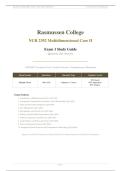
Rasmussen College MDC 2 Exam 1 Study Guide (2026/2027) Verified Answers with Rationales
Rasmussen College
NUR 2392 Multidimensional Care II
Exam 1 Study Guide
Questions and Answers
2026/2027 Academic Year | Verified Answers | Comprehensive Rationales
Exam Format Questions Question Type Cognitive Levels
30% Recall
Multiple Choice 100 (A-D) 4 Options, 1 Correct 50% Application
20% Analysis
Exam Sections:
1. Foundations of Multidimensional Care (Q1-Q15)
2. Therapeutic Communication and Nurse-Client Relationship (Q16-Q25)
3. Fluid and Electrolyte Imbalances (Q26-Q40)
4. Pain Management (Q41-Q50)
5. Skin Integrity and Wound Care (Q51-Q60)
6. Mobility and Immobility Interventions (Q61-Q68)
7. Cultural Competence and Diversity (Q69-Q78)
8. Legal, Ethical, and Professional Issues (Q79-Q86)
9. Safety and Infection Control (Q87-Q94)
10. Integrated Clinical Scenarios and Comprehensive Reasoning (Q95-Q100)
Aligned with 2026-2027 Rasmussen College NUR 2392 Curriculum Standards and NCLEX-RN Competencies
Page 1
,Rasmussen College MDC 2 Exam 1 Study Guide (2026/2027) Verified Answers with Rationales
Section 1: Foundations of Multidimensional Care
1. A nurse is caring for a client who was admitted following a motor vehicle crash. The client has a
fractured left femur, a laceration on the forehead, and reports shortness of breath. Using the ABC
priority framework, which action should the nurse take FIRST?
A. A. Splint the fractured femur to prevent further injury
B. B. Assess the client's airway and respiratory status [CORRECT]
C. C. Obtain a detailed medical history from the client
D. D. Apply a sterile dressing to the forehead laceration
Correct Answer: B
Rationale: The ABC priority framework (Airway, Breathing, Circulation) is the highest-priority approach in nursing. The
client reports shortness of breath, which indicates a potential compromise in the airway or breathing, making this the most
urgent concern. While splinting the fracture and dressing the laceration are important interventions, they are secondary to
ensuring the client has a patent airway and adequate oxygenation. Obtaining a medical history, though valuable, can be
deferred until life-threatening conditions are addressed.
2. A nurse is developing a care plan for a client who is at risk for falls. Which goal statement follows
the SMART goal framework correctly?
A. A. The client will be safe during hospitalization
B. B. The client will not fall
C. C. The client will ambulate 50 feet with a rolling walker independently by day 3 of hospitalization
[CORRECT]
D. D. The client will understand fall prevention strategies
Correct Answer: C
Rationale: A SMART goal must be Specific, Measurable, Attainable, Relevant, and Time-bound. Option C is specific
(ambulate 50 feet with a rolling walker), measurable (50 feet), attainable (realistic for rehabilitation), relevant (addresses
fall risk through safe mobility), and time-bound (by day 3). Options A and B are too vague to measure. Option D lacks
specificity, measurability, and a time frame, making it impossible to evaluate whether the goal has been achieved.
3. Which of the following is an example of an independent nursing intervention?
A. A. Administering morphine 2 mg IV as prescribed for pain
B. B. Instructing a postoperative client on deep breathing and coughing exercises [CORRECT]
C. C. Referring a client to a physical therapist for gait training
D. D. Obtaining a blood specimen for a complete blood count as ordered
Correct Answer: B
Rationale: Independent nursing interventions are actions the nurse can perform without a provider's order, based on the
nurse's professional judgment and scope of practice. Teaching deep breathing and coughing exercises is an independent
intervention that requires no provider order. Administering morphine and obtaining lab specimens are dependent
interventions (require a provider's order). Referring to physical therapy is a collaborative intervention that involves another
healthcare professional. Understanding the distinction between independent, dependent, and collaborative interventions is
essential for safe nursing practice and proper delegation.
4. A nurse is collecting data on a newly admitted client. Which of the following is an example of
objective data?
A. A. The client reports feeling nauseated
B. B. The client states, 'I have been having chest pain for two hours'
C. C. The client's blood pressure is 162/94 mmHg [CORRECT]
Page 2
,Rasmussen College MDC 2 Exam 1 Study Guide (2026/2027) Verified Answers with Rationales
D. D. The client expresses anxiety about the upcoming surgery
Correct Answer: C
Rationale: Objective data are measurable, observable, and verifiable facts obtained through physical assessment,
laboratory results, or diagnostic testing. A blood pressure reading of 162/94 mmHg is a quantifiable, observable
measurement. The client's report of nausea, chest pain, and anxiety are all subjective data because they represent the client's
perceptions and feelings, which cannot be directly measured or verified by the nurse. Distinguishing between subjective and
objective data is a fundamental skill in the assessment phase of the nursing process.
5. A nurse is prioritizing care for four clients. Using Maslow's Hierarchy of Needs, which client
should the nurse address FIRST?
A. A. A client who expresses feelings of loneliness after being isolated for 3 days
B. B. A client who needs assistance with bathing and grooming
C. C. A client who is experiencing acute respiratory distress with an oxygen saturation of 86%
[CORRECT]
D. D. A client who is concerned about losing their job during hospitalization
Correct Answer: C
Rationale: Maslow's Hierarchy of Needs prioritizes physiological needs as the most fundamental, followed by safety, love
and belonging, esteem, and self-actualization. The client with acute respiratory distress has a compromised physiological
need (oxygenation), which takes absolute priority over all other needs. Bathing and grooming also relate to physiological
needs but are not immediately life-threatening. Loneliness (love/belonging) and job concerns (safety/security or esteem) are
higher-level needs that are addressed only after physiological and safety needs are stabilized.
6. A nurse is using evidence-based practice (EBP) to develop a plan of care for a client with a
pressure injury. Which of the following represents the correct integration of EBP components?
A. A. Applying the latest wound care product because a sales representative recommended it
B. B. Combining current research evidence, clinical expertise, and the patient's preferences to guide
care decisions [CORRECT]
C. C. Following the facility's wound care protocol exactly as written without considering individual patient
factors
D. D. Using only clinical experience to determine the best wound care approach
Correct Answer: B
Rationale: Evidence-based practice integrates three key components: the best available research evidence, the clinician's
expertise and clinical judgment, and the patient's values and preferences. Option B correctly reflects this triad. Relying
solely on product recommendations, rigid protocols without individualization, or only clinical experience each represents
only one component and fails to integrate the full EBP framework. EBP ensures that nursing care is both scientifically
sound and patient-centered.
7. A nurse is caring for a client with a NANDA-I nursing diagnosis of 'Risk for Impaired Skin
Integrity related to immobility.' Which type of nursing diagnosis is this?
A. A. Problem-focused diagnosis
B. B. Risk diagnosis [CORRECT]
C. C. Health promotion diagnosis
D. D. Syndrome diagnosis
Correct Answer: B
Rationale: A risk nursing diagnosis describes a potential problem that the client does not currently have but is vulnerable to
developing. 'Risk for Impaired Skin Integrity' indicates that the client has risk factors (immobility) that could lead to skin
breakdown, but no actual impairment exists at this time. A problem-focused diagnosis describes an actual human response
Page 3
, Rasmussen College MDC 2 Exam 1 Study Guide (2026/2027) Verified Answers with Rationales
to a health condition. A health promotion diagnosis focuses on enhancing wellness. A syndrome diagnosis involves a cluster
of actual or risk nursing diagnoses.
8. During the evaluation phase of the nursing process, a nurse determines that a client's expected
outcomes have not been met. What is the MOST appropriate next action?
A. A. Discontinue the care plan since it was ineffective
B. B. Document the findings and continue with the same interventions
C. C. Reassess the client, modify the care plan, and implement revised interventions [CORRECT]
D. D. Notify the provider that the nursing interventions have failed
Correct Answer: C
Rationale: The evaluation phase involves comparing the client's actual outcomes with the expected outcomes. When
outcomes are not met, the nurse must reassess the client to determine why the goals were not achieved, then modify the care
plan accordingly. This may involve changing interventions, revising goals, or identifying new nursing diagnoses. Simply
discontinuing the care plan or continuing unchanged interventions does not promote the client's recovery. Notifying the
provider is unnecessary at this stage because nursing care plan modifications are within the nurse's scope of practice.
9. A nurse is delegating a task to an unlicensed assistive personnel (UAP). Which of the following
tasks is MOST appropriate to delegate?
A. A. Performing an initial admission assessment on a new client
B. B. Measuring and recording a client's intake and output [CORRECT]
C. C. Evaluating the effectiveness of a new pain management regimen
D. D. Developing a teaching plan for a client newly diagnosed with diabetes
Correct Answer: B
Rationale: Delegation principles require that tasks delegated to UAPs must be within their scope of practice, do not require
nursing judgment, and have predictable outcomes. Measuring and recording intake and output is a routine, standardized
task that UAPs can safely perform. Admission assessments, evaluation of interventions, and patient teaching all require
professional nursing knowledge, clinical judgment, and critical thinking, and therefore cannot be delegated to unlicensed
personnel.
10. A nurse is caring for multiple clients on a medical-surgical unit. Which of the following situations
requires the nurse's IMMEDIATE attention?
A. A. A client who is scheduled for a chest X-ray in 30 minutes
B. B. A postoperative client whose incision dressing has a small amount of serous drainage
C. C. A client with heart failure who reports increasing dyspnea and has new crackles bilaterally
[CORRECT]
D. D. A client who requests PRN pain medication for a pain level of 4 out of 10
Correct Answer: C
Rationale: The client with heart failure who reports increasing dyspnea and has new bilateral crackles is showing signs of
fluid overload and potential pulmonary edema, which is a life-threatening condition requiring immediate intervention.
Using the ABCs and acute vs. stable assessment framework, this client is the most unstable and has the highest priority. The
other situations, while requiring nursing attention, are not immediately life-threatening and can be addressed after the
unstable client is stabilized.
11. A nurse is conducting a comprehensive assessment. Which of the following differentiates a
comprehensive assessment from a focused assessment?
A. A. A comprehensive assessment is performed only on admission; a focused assessment is performed at
every shift change
Page 4
Rasmussen College
NUR 2392 Multidimensional Care II
Exam 1 Study Guide
Questions and Answers
2026/2027 Academic Year | Verified Answers | Comprehensive Rationales
Exam Format Questions Question Type Cognitive Levels
30% Recall
Multiple Choice 100 (A-D) 4 Options, 1 Correct 50% Application
20% Analysis
Exam Sections:
1. Foundations of Multidimensional Care (Q1-Q15)
2. Therapeutic Communication and Nurse-Client Relationship (Q16-Q25)
3. Fluid and Electrolyte Imbalances (Q26-Q40)
4. Pain Management (Q41-Q50)
5. Skin Integrity and Wound Care (Q51-Q60)
6. Mobility and Immobility Interventions (Q61-Q68)
7. Cultural Competence and Diversity (Q69-Q78)
8. Legal, Ethical, and Professional Issues (Q79-Q86)
9. Safety and Infection Control (Q87-Q94)
10. Integrated Clinical Scenarios and Comprehensive Reasoning (Q95-Q100)
Aligned with 2026-2027 Rasmussen College NUR 2392 Curriculum Standards and NCLEX-RN Competencies
Page 1
,Rasmussen College MDC 2 Exam 1 Study Guide (2026/2027) Verified Answers with Rationales
Section 1: Foundations of Multidimensional Care
1. A nurse is caring for a client who was admitted following a motor vehicle crash. The client has a
fractured left femur, a laceration on the forehead, and reports shortness of breath. Using the ABC
priority framework, which action should the nurse take FIRST?
A. A. Splint the fractured femur to prevent further injury
B. B. Assess the client's airway and respiratory status [CORRECT]
C. C. Obtain a detailed medical history from the client
D. D. Apply a sterile dressing to the forehead laceration
Correct Answer: B
Rationale: The ABC priority framework (Airway, Breathing, Circulation) is the highest-priority approach in nursing. The
client reports shortness of breath, which indicates a potential compromise in the airway or breathing, making this the most
urgent concern. While splinting the fracture and dressing the laceration are important interventions, they are secondary to
ensuring the client has a patent airway and adequate oxygenation. Obtaining a medical history, though valuable, can be
deferred until life-threatening conditions are addressed.
2. A nurse is developing a care plan for a client who is at risk for falls. Which goal statement follows
the SMART goal framework correctly?
A. A. The client will be safe during hospitalization
B. B. The client will not fall
C. C. The client will ambulate 50 feet with a rolling walker independently by day 3 of hospitalization
[CORRECT]
D. D. The client will understand fall prevention strategies
Correct Answer: C
Rationale: A SMART goal must be Specific, Measurable, Attainable, Relevant, and Time-bound. Option C is specific
(ambulate 50 feet with a rolling walker), measurable (50 feet), attainable (realistic for rehabilitation), relevant (addresses
fall risk through safe mobility), and time-bound (by day 3). Options A and B are too vague to measure. Option D lacks
specificity, measurability, and a time frame, making it impossible to evaluate whether the goal has been achieved.
3. Which of the following is an example of an independent nursing intervention?
A. A. Administering morphine 2 mg IV as prescribed for pain
B. B. Instructing a postoperative client on deep breathing and coughing exercises [CORRECT]
C. C. Referring a client to a physical therapist for gait training
D. D. Obtaining a blood specimen for a complete blood count as ordered
Correct Answer: B
Rationale: Independent nursing interventions are actions the nurse can perform without a provider's order, based on the
nurse's professional judgment and scope of practice. Teaching deep breathing and coughing exercises is an independent
intervention that requires no provider order. Administering morphine and obtaining lab specimens are dependent
interventions (require a provider's order). Referring to physical therapy is a collaborative intervention that involves another
healthcare professional. Understanding the distinction between independent, dependent, and collaborative interventions is
essential for safe nursing practice and proper delegation.
4. A nurse is collecting data on a newly admitted client. Which of the following is an example of
objective data?
A. A. The client reports feeling nauseated
B. B. The client states, 'I have been having chest pain for two hours'
C. C. The client's blood pressure is 162/94 mmHg [CORRECT]
Page 2
,Rasmussen College MDC 2 Exam 1 Study Guide (2026/2027) Verified Answers with Rationales
D. D. The client expresses anxiety about the upcoming surgery
Correct Answer: C
Rationale: Objective data are measurable, observable, and verifiable facts obtained through physical assessment,
laboratory results, or diagnostic testing. A blood pressure reading of 162/94 mmHg is a quantifiable, observable
measurement. The client's report of nausea, chest pain, and anxiety are all subjective data because they represent the client's
perceptions and feelings, which cannot be directly measured or verified by the nurse. Distinguishing between subjective and
objective data is a fundamental skill in the assessment phase of the nursing process.
5. A nurse is prioritizing care for four clients. Using Maslow's Hierarchy of Needs, which client
should the nurse address FIRST?
A. A. A client who expresses feelings of loneliness after being isolated for 3 days
B. B. A client who needs assistance with bathing and grooming
C. C. A client who is experiencing acute respiratory distress with an oxygen saturation of 86%
[CORRECT]
D. D. A client who is concerned about losing their job during hospitalization
Correct Answer: C
Rationale: Maslow's Hierarchy of Needs prioritizes physiological needs as the most fundamental, followed by safety, love
and belonging, esteem, and self-actualization. The client with acute respiratory distress has a compromised physiological
need (oxygenation), which takes absolute priority over all other needs. Bathing and grooming also relate to physiological
needs but are not immediately life-threatening. Loneliness (love/belonging) and job concerns (safety/security or esteem) are
higher-level needs that are addressed only after physiological and safety needs are stabilized.
6. A nurse is using evidence-based practice (EBP) to develop a plan of care for a client with a
pressure injury. Which of the following represents the correct integration of EBP components?
A. A. Applying the latest wound care product because a sales representative recommended it
B. B. Combining current research evidence, clinical expertise, and the patient's preferences to guide
care decisions [CORRECT]
C. C. Following the facility's wound care protocol exactly as written without considering individual patient
factors
D. D. Using only clinical experience to determine the best wound care approach
Correct Answer: B
Rationale: Evidence-based practice integrates three key components: the best available research evidence, the clinician's
expertise and clinical judgment, and the patient's values and preferences. Option B correctly reflects this triad. Relying
solely on product recommendations, rigid protocols without individualization, or only clinical experience each represents
only one component and fails to integrate the full EBP framework. EBP ensures that nursing care is both scientifically
sound and patient-centered.
7. A nurse is caring for a client with a NANDA-I nursing diagnosis of 'Risk for Impaired Skin
Integrity related to immobility.' Which type of nursing diagnosis is this?
A. A. Problem-focused diagnosis
B. B. Risk diagnosis [CORRECT]
C. C. Health promotion diagnosis
D. D. Syndrome diagnosis
Correct Answer: B
Rationale: A risk nursing diagnosis describes a potential problem that the client does not currently have but is vulnerable to
developing. 'Risk for Impaired Skin Integrity' indicates that the client has risk factors (immobility) that could lead to skin
breakdown, but no actual impairment exists at this time. A problem-focused diagnosis describes an actual human response
Page 3
, Rasmussen College MDC 2 Exam 1 Study Guide (2026/2027) Verified Answers with Rationales
to a health condition. A health promotion diagnosis focuses on enhancing wellness. A syndrome diagnosis involves a cluster
of actual or risk nursing diagnoses.
8. During the evaluation phase of the nursing process, a nurse determines that a client's expected
outcomes have not been met. What is the MOST appropriate next action?
A. A. Discontinue the care plan since it was ineffective
B. B. Document the findings and continue with the same interventions
C. C. Reassess the client, modify the care plan, and implement revised interventions [CORRECT]
D. D. Notify the provider that the nursing interventions have failed
Correct Answer: C
Rationale: The evaluation phase involves comparing the client's actual outcomes with the expected outcomes. When
outcomes are not met, the nurse must reassess the client to determine why the goals were not achieved, then modify the care
plan accordingly. This may involve changing interventions, revising goals, or identifying new nursing diagnoses. Simply
discontinuing the care plan or continuing unchanged interventions does not promote the client's recovery. Notifying the
provider is unnecessary at this stage because nursing care plan modifications are within the nurse's scope of practice.
9. A nurse is delegating a task to an unlicensed assistive personnel (UAP). Which of the following
tasks is MOST appropriate to delegate?
A. A. Performing an initial admission assessment on a new client
B. B. Measuring and recording a client's intake and output [CORRECT]
C. C. Evaluating the effectiveness of a new pain management regimen
D. D. Developing a teaching plan for a client newly diagnosed with diabetes
Correct Answer: B
Rationale: Delegation principles require that tasks delegated to UAPs must be within their scope of practice, do not require
nursing judgment, and have predictable outcomes. Measuring and recording intake and output is a routine, standardized
task that UAPs can safely perform. Admission assessments, evaluation of interventions, and patient teaching all require
professional nursing knowledge, clinical judgment, and critical thinking, and therefore cannot be delegated to unlicensed
personnel.
10. A nurse is caring for multiple clients on a medical-surgical unit. Which of the following situations
requires the nurse's IMMEDIATE attention?
A. A. A client who is scheduled for a chest X-ray in 30 minutes
B. B. A postoperative client whose incision dressing has a small amount of serous drainage
C. C. A client with heart failure who reports increasing dyspnea and has new crackles bilaterally
[CORRECT]
D. D. A client who requests PRN pain medication for a pain level of 4 out of 10
Correct Answer: C
Rationale: The client with heart failure who reports increasing dyspnea and has new bilateral crackles is showing signs of
fluid overload and potential pulmonary edema, which is a life-threatening condition requiring immediate intervention.
Using the ABCs and acute vs. stable assessment framework, this client is the most unstable and has the highest priority. The
other situations, while requiring nursing attention, are not immediately life-threatening and can be addressed after the
unstable client is stabilized.
11. A nurse is conducting a comprehensive assessment. Which of the following differentiates a
comprehensive assessment from a focused assessment?
A. A. A comprehensive assessment is performed only on admission; a focused assessment is performed at
every shift change
Page 4


