
NIGHTINGALE COLLEGE BSN 225
1 0 0 % C O RRE C T | G RADE A
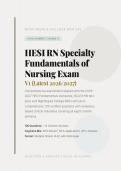
HESI RN Specialty
Fundamentals of
Nursing Exam
V1 (Latest 2026/2027)
Comprehensive examination aligned with the 2026-
2027 HESI Fundamentals standards, NCLEX-RN test
plan, and Nightingale College BSN curriculum
competencies. 100 verified questions with evidence-
based clinical rationales covering all eight content
domains.
100 Questions — 8 Content Sections
Cognitive Mix: 30% Recall | 50% Application | 20% Analysis
Format: Multiple Choice (A-D) with Rationales
Q U E S T I O N S & A N S W E R S | N C L E X- R N A L I G N E D
, BSN 225 HESI RN Specialty
Fundamentals of Nursing Exam V1
Latest Update | 100% Correct | Grade A
Nightingale College BSN Curriculum Aligned
NCLEX-RN Test Plan Compliant | Evidence-Based Practice
Total Questions Cognitive Levels Format Pass Guarantee
30% Recall Multiple Choice
100% Verified
100 Questions 50% Application 4 Options (A-D)
Correct Answers
20% Analysis One Correct Answer
Comprehensive rationales with clinical reasoning aligned with 2026-2027 HESI Fundamentals examination standards.
BSN 225 HESI Fundamentals Exam V1 (2026/2027) | Page 1
,Section 1: Safe, Effective Care Environment
(Management of Care, Safety & Infection Control)
Q1: A nurse is preparing a client for a colonoscopy. The client asks the nurse to explain the procedure.
What is the nurse's BEST response?
A. I will explain the procedure to you in detail right now.
B. The provider will explain the procedure, risks, and benefits. I will be here to answer any questions
afterward. [CORRECT]
C. You should sign the consent form first, and then the provider will speak with you.
D. I cannot discuss the procedure until the day of surgery.
Correct Answer: B
Rationale: The provider is responsible for obtaining informed consent, which includes explaining the procedure, risks,
benefits, and alternatives. The nurse's role is to witness the signature and confirm the client understands. Telling the client
the provider will explain respects the legal division of responsibility and ensures accurate, complete information is delivered
by the performing provider.
Q2: A nurse witnesses a client sign an informed consent form for a surgical procedure. The client then
states, 'I really do not understand what they are going to do.' What should the nurse do FIRST?
A. Reassure the client that the surgeon is highly qualified and proceed.
B. Notify the provider immediately that the client has questions and does not fully understand the
procedure. [CORRECT]
C. Have the client sign a second form acknowledging the lack of understanding.
D. Document the client's statement and continue with preoperative preparations.
Correct Answer: B
Rationale: The nurse's role in informed consent is to witness the signature and confirm understanding. If the client expresses
confusion, the nurse must immediately notify the provider before the procedure proceeds. Obtaining valid informed consent
requires the client to understand the procedure, risks, benefits, and alternatives. Proceeding without understanding
invalidates the consent.
Q3: A competent adult client diagnosed with cancer refuses chemotherapy. The nurse overhears the family
pressuring the client to accept treatment. Which action by the nurse is MOST appropriate?
A. Encourage the family to continue persuading the client to accept treatment.
B. Respect the client's decision, document the refusal, and notify the provider. [CORRECT]
C. Call an ethics committee meeting immediately without informing the client.
D. Administer the chemotherapy while the client is sleeping to save the client's life.
Correct Answer: B
Rationale: Competent adults have the legal and ethical right to refuse treatment, even life-saving treatment. The nurse must
advocate for the client's autonomy by respecting the decision, documenting the refusal thoroughly, and notifying the provider.
Coercing treatment or administering it without consent constitutes battery, which is a violation of the client's legal rights and
nursing ethics.
Q4: A nurse is admitting a client who has a Durable Power of Attorney for Health Care (DPOA-HC)
designating their daughter as the healthcare agent. The client is now unconscious. Who should the nurse
BSN 225 HESI Fundamentals Exam V1 (2026/2027) | Page 2
, consult for treatment decisions?
A. The client's spouse, regardless of the DPOA-HC designation.
B. The designated daughter as the legal healthcare agent per the DPOA-HC document. [CORRECT]
C. The hospital administrator, since the client cannot communicate.
D. The nursing supervisor, who can make decisions on behalf of all unconscious clients.
Correct Answer: B
Rationale: A DPOA-HC legally designates a specific individual to make healthcare decisions when the client becomes unable
to do so. The nurse must consult the designated agent, who in this case is the daughter. The DPOA-HC supersedes other
family members' opinions and must be followed. The nurse should verify the document is current and communicate the
agent's decisions to the healthcare team.
Q5: Under the Patient Self-Determination Act (PSDA), which action is REQUIRED of healthcare
facilities?
A. Create advance directives on behalf of all patients upon admission.
B. Inform patients of their right to create advance directives at the time of admission. [CORRECT]
C. Ensure all patients sign a living will before receiving any treatment.
D. Override a patient's advance directive if the family disagrees with the patient's wishes.
Correct Answer: B
Rationale: The PSDA requires healthcare facilities that receive Medicare or Medicaid funding to inform patients of their
right to create advance directives, including living wills and DPOA-HC documents, at the time of admission. The facility
must document whether the patient has existing advance directives but is not required to create them on the patient's behalf
or force patients to sign them.
Q6: A nurse is caring for a client with HIV. The client's employer calls the nursing station and asks for
information about the client's diagnosis. What is the nurse's BEST response?
A. Provide the information since the employer may need it for insurance purposes.
B. Confirm that the client is a patient but refuse to disclose the diagnosis.
C. Refuse to confirm or deny that the client is a patient and provide no health information. [CORRECT]
D. Transfer the call to the provider so the provider can decide what to disclose.
Correct Answer: C
Rationale: HIPAA prohibits sharing Protected Health Information (PHI) without the patient's written consent, except for
Treatment, Payment, or Operations (TPO). An employer inquiry does not fall under TPO exceptions. The nurse should not
even confirm the client is a patient, as this itself constitutes PHI. Any disclosure of HIV status is a serious HIPAA violation
with both legal and professional consequences.
Q7: A nurse is caring for a client who is 2 hours postoperative following abdominal surgery. Which task is
MOST appropriate for the nurse to delegate to the unlicensed assistive personnel (UAP)?
A. Assess the surgical incision for signs of infection.
B. Measure and record the client's intake and output. [CORRECT]
C. Evaluate the client's level of pain and determine the need for medication.
D. Teach the client about deep-breathing and coughing exercises.
Correct Answer: B
Rationale: The Five Rights of Delegation guide task assignment. Measuring and recording intake and output is within the
UAP scope of practice, as it involves basic data collection. Assessment, evaluation, client education, and nursing judgment
cannot be delegated. Assessing the incision and evaluating pain require clinical judgment by the RN. Teaching requires
nursing knowledge and cannot be delegated to UAP.
BSN 225 HESI Fundamentals Exam V1 (2026/2027) | Page 3
1 0 0 % C O RRE C T | G RADE A
HESI RN Specialty
Fundamentals of
Nursing Exam
V1 (Latest 2026/2027)
Comprehensive examination aligned with the 2026-
2027 HESI Fundamentals standards, NCLEX-RN test
plan, and Nightingale College BSN curriculum
competencies. 100 verified questions with evidence-
based clinical rationales covering all eight content
domains.
100 Questions — 8 Content Sections
Cognitive Mix: 30% Recall | 50% Application | 20% Analysis
Format: Multiple Choice (A-D) with Rationales
Q U E S T I O N S & A N S W E R S | N C L E X- R N A L I G N E D
, BSN 225 HESI RN Specialty
Fundamentals of Nursing Exam V1
Latest Update | 100% Correct | Grade A
Nightingale College BSN Curriculum Aligned
NCLEX-RN Test Plan Compliant | Evidence-Based Practice
Total Questions Cognitive Levels Format Pass Guarantee
30% Recall Multiple Choice
100% Verified
100 Questions 50% Application 4 Options (A-D)
Correct Answers
20% Analysis One Correct Answer
Comprehensive rationales with clinical reasoning aligned with 2026-2027 HESI Fundamentals examination standards.
BSN 225 HESI Fundamentals Exam V1 (2026/2027) | Page 1
,Section 1: Safe, Effective Care Environment
(Management of Care, Safety & Infection Control)
Q1: A nurse is preparing a client for a colonoscopy. The client asks the nurse to explain the procedure.
What is the nurse's BEST response?
A. I will explain the procedure to you in detail right now.
B. The provider will explain the procedure, risks, and benefits. I will be here to answer any questions
afterward. [CORRECT]
C. You should sign the consent form first, and then the provider will speak with you.
D. I cannot discuss the procedure until the day of surgery.
Correct Answer: B
Rationale: The provider is responsible for obtaining informed consent, which includes explaining the procedure, risks,
benefits, and alternatives. The nurse's role is to witness the signature and confirm the client understands. Telling the client
the provider will explain respects the legal division of responsibility and ensures accurate, complete information is delivered
by the performing provider.
Q2: A nurse witnesses a client sign an informed consent form for a surgical procedure. The client then
states, 'I really do not understand what they are going to do.' What should the nurse do FIRST?
A. Reassure the client that the surgeon is highly qualified and proceed.
B. Notify the provider immediately that the client has questions and does not fully understand the
procedure. [CORRECT]
C. Have the client sign a second form acknowledging the lack of understanding.
D. Document the client's statement and continue with preoperative preparations.
Correct Answer: B
Rationale: The nurse's role in informed consent is to witness the signature and confirm understanding. If the client expresses
confusion, the nurse must immediately notify the provider before the procedure proceeds. Obtaining valid informed consent
requires the client to understand the procedure, risks, benefits, and alternatives. Proceeding without understanding
invalidates the consent.
Q3: A competent adult client diagnosed with cancer refuses chemotherapy. The nurse overhears the family
pressuring the client to accept treatment. Which action by the nurse is MOST appropriate?
A. Encourage the family to continue persuading the client to accept treatment.
B. Respect the client's decision, document the refusal, and notify the provider. [CORRECT]
C. Call an ethics committee meeting immediately without informing the client.
D. Administer the chemotherapy while the client is sleeping to save the client's life.
Correct Answer: B
Rationale: Competent adults have the legal and ethical right to refuse treatment, even life-saving treatment. The nurse must
advocate for the client's autonomy by respecting the decision, documenting the refusal thoroughly, and notifying the provider.
Coercing treatment or administering it without consent constitutes battery, which is a violation of the client's legal rights and
nursing ethics.
Q4: A nurse is admitting a client who has a Durable Power of Attorney for Health Care (DPOA-HC)
designating their daughter as the healthcare agent. The client is now unconscious. Who should the nurse
BSN 225 HESI Fundamentals Exam V1 (2026/2027) | Page 2
, consult for treatment decisions?
A. The client's spouse, regardless of the DPOA-HC designation.
B. The designated daughter as the legal healthcare agent per the DPOA-HC document. [CORRECT]
C. The hospital administrator, since the client cannot communicate.
D. The nursing supervisor, who can make decisions on behalf of all unconscious clients.
Correct Answer: B
Rationale: A DPOA-HC legally designates a specific individual to make healthcare decisions when the client becomes unable
to do so. The nurse must consult the designated agent, who in this case is the daughter. The DPOA-HC supersedes other
family members' opinions and must be followed. The nurse should verify the document is current and communicate the
agent's decisions to the healthcare team.
Q5: Under the Patient Self-Determination Act (PSDA), which action is REQUIRED of healthcare
facilities?
A. Create advance directives on behalf of all patients upon admission.
B. Inform patients of their right to create advance directives at the time of admission. [CORRECT]
C. Ensure all patients sign a living will before receiving any treatment.
D. Override a patient's advance directive if the family disagrees with the patient's wishes.
Correct Answer: B
Rationale: The PSDA requires healthcare facilities that receive Medicare or Medicaid funding to inform patients of their
right to create advance directives, including living wills and DPOA-HC documents, at the time of admission. The facility
must document whether the patient has existing advance directives but is not required to create them on the patient's behalf
or force patients to sign them.
Q6: A nurse is caring for a client with HIV. The client's employer calls the nursing station and asks for
information about the client's diagnosis. What is the nurse's BEST response?
A. Provide the information since the employer may need it for insurance purposes.
B. Confirm that the client is a patient but refuse to disclose the diagnosis.
C. Refuse to confirm or deny that the client is a patient and provide no health information. [CORRECT]
D. Transfer the call to the provider so the provider can decide what to disclose.
Correct Answer: C
Rationale: HIPAA prohibits sharing Protected Health Information (PHI) without the patient's written consent, except for
Treatment, Payment, or Operations (TPO). An employer inquiry does not fall under TPO exceptions. The nurse should not
even confirm the client is a patient, as this itself constitutes PHI. Any disclosure of HIV status is a serious HIPAA violation
with both legal and professional consequences.
Q7: A nurse is caring for a client who is 2 hours postoperative following abdominal surgery. Which task is
MOST appropriate for the nurse to delegate to the unlicensed assistive personnel (UAP)?
A. Assess the surgical incision for signs of infection.
B. Measure and record the client's intake and output. [CORRECT]
C. Evaluate the client's level of pain and determine the need for medication.
D. Teach the client about deep-breathing and coughing exercises.
Correct Answer: B
Rationale: The Five Rights of Delegation guide task assignment. Measuring and recording intake and output is within the
UAP scope of practice, as it involves basic data collection. Assessment, evaluation, client education, and nursing judgment
cannot be delegated. Assessing the incision and evaluating pain require clinical judgment by the RN. Teaching requires
nursing knowledge and cannot be delegated to UAP.
BSN 225 HESI Fundamentals Exam V1 (2026/2027) | Page 3


