
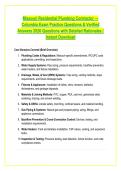
Missouri Residential Plumbing Contractor —
Columbia Exam Practice Questions & Verified
Answers 2026 Questions with Detailed Rationales |
Instant Download
Core Domains Covered (Brief Overview):
1. Plumbing Codes & Regulations: Missouri-specific amendments, IPC/UPC code
applications, permitting, and inspections.
2. Water Supply Systems: Pipe sizing, pressure requirements, backflow prevention,
water heaters, and fixture installation.
3. Drainage, Waste, & Vent (DWV) Systems: Trap sizing, venting methods, slope
requirements, and fixture drainage loads.
4. Fixtures & Appliances: Installation of toilets, sinks, showers, bathtubs,
dishwashers, and garbage disposals.
5. Materials & Joining Methods: PVC, copper, PEX, cast iron, galvanized steel,
soldering, brazing, and solvent welding.
6. Safety & OSHA: Jobsite safety, trenching, confined space, and material handling.
7. Gas Piping & Systems: Natural gas and propane piping, sizing, fittings, and
appliance connections.
8. Backflow Prevention & Cross-Connection Control: Devices, testing, and
installation requirements.
9. Water Heaters: Tank and tankless installation, T&P valves, venting, and expansion
tanks.
10. Inspection & Testing: Pressure testing, leak detection, fixture function, and code
compliance checks.
,1. What is the primary purpose of a plumbing trap?
A. Increase water pressure
B. Prevent sewer gases from entering the building
C. Increase drainage speed
D. Filter solid waste
Rationale: A trap holds water to form a seal that blocks sewer gases from entering the
building through the drain system.
2. What is the minimum recommended slope for a residential drainage pipe (3-inch or
smaller)?
A. 1/8 inch per foot
B. 1/4 inch per foot
C. 1 inch per foot
D. Level is acceptable
Rationale: Most plumbing codes require a minimum slope of 1/4 inch per foot for proper
gravity drainage of pipes 3 inches in diameter and smaller.
3. Which pipe material is most commonly used for DWV (Drain, Waste, and Vent)
systems in residential plumbing?
A. Copper Type M
B. Galvanized steel
C. PVC
D. Brass
Rationale: PVC (polyvinyl chloride) is widely used for DWV systems due to its corrosion
resistance, cost efficiency, and lightweight nature.
4. What is the primary function of a vent system in plumbing?
A. Increase water pressure
B. Allow sewer gases to escape outdoors and maintain trap seals
C. Filter debris
D. Increase pipe size capacity
Rationale: Venting prevents siphoning of trap seals and releases sewer gases safely above
the roof.
5. What is the minimum fixture branch pipe size for a residential water closet (toilet)?
A. 1/2 inch
B. 2 inches
, C. 3 inches
D. 4 inches
Rationale: The minimum drainage pipe size for a water closet is 3 inches, as required by
most plumbing codes.
6. Which type of backflow prevention device is commonly used on residential hose
bibbs?
A. Reduced pressure zone (RPZ) valve
B. Double check valve assembly
C. Atmospheric vacuum breaker (AVB)
D. Pressure vacuum breaker (PVB)
Rationale: An atmospheric vacuum breaker (AVB) is a common and cost-effective backflow
prevention device installed on hose bibbs.
7. What is the maximum distance a trap can be from a vent (trap-to-vent distance) for
a 2-inch pipe?
A. 3 feet
B. 5 feet
C. 8 feet
D. 10 feet
Rationale: For a 2-inch pipe, the maximum trap-to-vent distance is typically 8 feet (may
vary by code).
8. What is the minimum water pressure required at a residential fixture?
A. 20 psi
B. 30 psi
C. 40 psi
D. 80 psi
Rationale: Most codes require a minimum pressure of 40 psi at the fixture, though 30-40
psi is often acceptable.
9. Which material is commonly used for hot water supply lines in residential
plumbing?
A. Schedule 40 PVC
B. Copper Type L
C. Cast iron
D. Galvanized steel
Columbia Exam Practice Questions & Verified
Answers 2026 Questions with Detailed Rationales |
Instant Download
Core Domains Covered (Brief Overview):
1. Plumbing Codes & Regulations: Missouri-specific amendments, IPC/UPC code
applications, permitting, and inspections.
2. Water Supply Systems: Pipe sizing, pressure requirements, backflow prevention,
water heaters, and fixture installation.
3. Drainage, Waste, & Vent (DWV) Systems: Trap sizing, venting methods, slope
requirements, and fixture drainage loads.
4. Fixtures & Appliances: Installation of toilets, sinks, showers, bathtubs,
dishwashers, and garbage disposals.
5. Materials & Joining Methods: PVC, copper, PEX, cast iron, galvanized steel,
soldering, brazing, and solvent welding.
6. Safety & OSHA: Jobsite safety, trenching, confined space, and material handling.
7. Gas Piping & Systems: Natural gas and propane piping, sizing, fittings, and
appliance connections.
8. Backflow Prevention & Cross-Connection Control: Devices, testing, and
installation requirements.
9. Water Heaters: Tank and tankless installation, T&P valves, venting, and expansion
tanks.
10. Inspection & Testing: Pressure testing, leak detection, fixture function, and code
compliance checks.
,1. What is the primary purpose of a plumbing trap?
A. Increase water pressure
B. Prevent sewer gases from entering the building
C. Increase drainage speed
D. Filter solid waste
Rationale: A trap holds water to form a seal that blocks sewer gases from entering the
building through the drain system.
2. What is the minimum recommended slope for a residential drainage pipe (3-inch or
smaller)?
A. 1/8 inch per foot
B. 1/4 inch per foot
C. 1 inch per foot
D. Level is acceptable
Rationale: Most plumbing codes require a minimum slope of 1/4 inch per foot for proper
gravity drainage of pipes 3 inches in diameter and smaller.
3. Which pipe material is most commonly used for DWV (Drain, Waste, and Vent)
systems in residential plumbing?
A. Copper Type M
B. Galvanized steel
C. PVC
D. Brass
Rationale: PVC (polyvinyl chloride) is widely used for DWV systems due to its corrosion
resistance, cost efficiency, and lightweight nature.
4. What is the primary function of a vent system in plumbing?
A. Increase water pressure
B. Allow sewer gases to escape outdoors and maintain trap seals
C. Filter debris
D. Increase pipe size capacity
Rationale: Venting prevents siphoning of trap seals and releases sewer gases safely above
the roof.
5. What is the minimum fixture branch pipe size for a residential water closet (toilet)?
A. 1/2 inch
B. 2 inches
, C. 3 inches
D. 4 inches
Rationale: The minimum drainage pipe size for a water closet is 3 inches, as required by
most plumbing codes.
6. Which type of backflow prevention device is commonly used on residential hose
bibbs?
A. Reduced pressure zone (RPZ) valve
B. Double check valve assembly
C. Atmospheric vacuum breaker (AVB)
D. Pressure vacuum breaker (PVB)
Rationale: An atmospheric vacuum breaker (AVB) is a common and cost-effective backflow
prevention device installed on hose bibbs.
7. What is the maximum distance a trap can be from a vent (trap-to-vent distance) for
a 2-inch pipe?
A. 3 feet
B. 5 feet
C. 8 feet
D. 10 feet
Rationale: For a 2-inch pipe, the maximum trap-to-vent distance is typically 8 feet (may
vary by code).
8. What is the minimum water pressure required at a residential fixture?
A. 20 psi
B. 30 psi
C. 40 psi
D. 80 psi
Rationale: Most codes require a minimum pressure of 40 psi at the fixture, though 30-40
psi is often acceptable.
9. Which material is commonly used for hot water supply lines in residential
plumbing?
A. Schedule 40 PVC
B. Copper Type L
C. Cast iron
D. Galvanized steel


