

CHEM 104, MODULE 1 –MODULE 6 Exam
Questions with Verified Answers 100%
Guarantee passing score| Portage
Learning
Module 1: Chemical Kinetics & Reaction Rates
Question 1. In the reaction of gaseous N₂O₅ to yield NO₂ gas and O₂ gas as shown below, the
following data table is obtained:
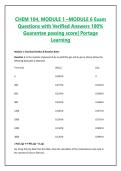
Time (sec) [N₂O₅] [O₂]
0 0.300 M 0
300 0.272 M 0.014 M
600 0.224 M 0.038 M
900 0.204 M 0.048 M
1200 0.186 M 0.057 M
1800 0.156 M 0.072 M
2400 0.134 M 0.083 M
3000 0.120 M 0.090 M
2 N₂O₅ (g) → 4 NO₂ (g) + O₂ (g)
1a. Using the [O₂] data from the table, show the calculation of the instantaneous rate early in
the reaction (0 secs to 300 sec).
,1b. Using the [O₂] data from the table, show the calculation of the instantaneous rate late in the
reaction (2400 secs to 3000 secs).
1c. Explain the relative values of the early instantaneous rate and the late instantaneous rate.
Answer:
1a. rate = (0.014 - 0) / (300 - 0) = 4.67 × 10⁻⁵ mol/L·s
1b. rate = (0.090 - 0.083) / (3000 - 2400) = 1.167 × 10⁻⁵ mol/L·s
1c. The late instantaneous rate is smaller than the early instantaneous rate because reactant
concentrations decrease over time, slowing the reaction .
Question 2. What is the definition of kinetics?
A) The study of equilibrium concentrations
B) The study of rates of reactions and how they are influenced by factors like concentration,
temperature, catalysts, and surface area
C) The study of thermodynamics
D) The study of acid-base reactions
Answer: B
Rationale: Kinetics is the study of reaction rates and the factors that influence them, such as
concentration, temperature, catalysts, and surface area .
Question 3. What is the definition of a catalyst?
A) A substance that slows down a reaction
B) A substance that increases the rate of a chemical reaction without being consumed
C) A substance that changes the equilibrium position
D) A substance that is consumed in a reaction
Answer: B
Rationale: A catalyst increases the rate of a reaction by providing an alternative pathway with
lower activation energy without being consumed in the overall reaction .
Question 4. What is a rate law?
A) A mathematical equation that describes the dependence of reaction rate on reactant
concentrations
B) The equilibrium constant expression
,C) The thermodynamic equation for a reaction
D) The balanced chemical equation
Answer: A
Rationale: A rate law is a mathematical equation that describes how the reaction rate depends
on the concentrations of some of the reactants .
Question 5. The rate of a reaction is dependent on:
A) The concentration of products only
B) The concentration of reactants
C) The concentration of reactants and catalysts
D) The equilibrium constant
Answer: C
Rationale: The reaction rate depends on the concentrations of the reactants and any catalyst
present .
Question 6. Can exponents representing the order of each reactant be determined by the
written equation without experiments?
A) Yes
B) No
Answer: B
Rationale: Reaction orders must be determined experimentally; they cannot be predicted from
the stoichiometric coefficients of the balanced equation .
Question 7. What are the four factors that contribute to or change reaction rate?
A) Temperature, pressure, volume, mass
B) Concentration, reactant phase, temperature, catalyst
C) pH, temperature, concentration, time
D) Catalyst, solvent, concentration, pressure
Answer: B
Rationale: The four factors that affect reaction rate are: concentration, physical state (phase) of
reactants, temperature, and presence of a catalyst .
, Question 8. The early instantaneous rate will be __________ than the late instantaneous rate or
the average rate.
A) Greater
B) Lesser
C) Equal to
D) Unrelated to
Answer: A
Rationale: The early instantaneous rate is greater than the late instantaneous rate because
reactant concentrations are highest at the beginning of the reaction .
Question 9. What does the rate constant (k) in a rate law depend on?
A) Concentration of reactants
B) Temperature and activation energy
C) Volume of the container
D) Amount of product formed
Answer: B
Rationale: The rate constant k depends on temperature and the activation energy of the
reaction, as described by the Arrhenius equation.
Question 10. A first-order reaction has a half-life of 5720 years. Calculate the rate constant k.
A) 1.21 × 10⁻⁴ yr⁻¹
B) 3.96 × 10³ yr⁻¹
C) 1.21 × 10⁴ yr⁻¹
D) 2.42 × 10⁻⁴ yr⁻¹
Answer: A
Rationale: For a first-order reaction: t₁/₂ = 0.693 / k. Therefore, k = 0. = 1.21 × 10⁻⁴
yr⁻¹ .
Question 11. A radioactive isotope has a half-life of 5720 years. A sample currently has 19.8
grams of the isotope. If it originally contained 100 grams, how old is the sample?
A) 13,384 years
Questions with Verified Answers 100%
Guarantee passing score| Portage
Learning
Module 1: Chemical Kinetics & Reaction Rates
Question 1. In the reaction of gaseous N₂O₅ to yield NO₂ gas and O₂ gas as shown below, the
following data table is obtained:
Time (sec) [N₂O₅] [O₂]
0 0.300 M 0
300 0.272 M 0.014 M
600 0.224 M 0.038 M
900 0.204 M 0.048 M
1200 0.186 M 0.057 M
1800 0.156 M 0.072 M
2400 0.134 M 0.083 M
3000 0.120 M 0.090 M
2 N₂O₅ (g) → 4 NO₂ (g) + O₂ (g)
1a. Using the [O₂] data from the table, show the calculation of the instantaneous rate early in
the reaction (0 secs to 300 sec).
,1b. Using the [O₂] data from the table, show the calculation of the instantaneous rate late in the
reaction (2400 secs to 3000 secs).
1c. Explain the relative values of the early instantaneous rate and the late instantaneous rate.
Answer:
1a. rate = (0.014 - 0) / (300 - 0) = 4.67 × 10⁻⁵ mol/L·s
1b. rate = (0.090 - 0.083) / (3000 - 2400) = 1.167 × 10⁻⁵ mol/L·s
1c. The late instantaneous rate is smaller than the early instantaneous rate because reactant
concentrations decrease over time, slowing the reaction .
Question 2. What is the definition of kinetics?
A) The study of equilibrium concentrations
B) The study of rates of reactions and how they are influenced by factors like concentration,
temperature, catalysts, and surface area
C) The study of thermodynamics
D) The study of acid-base reactions
Answer: B
Rationale: Kinetics is the study of reaction rates and the factors that influence them, such as
concentration, temperature, catalysts, and surface area .
Question 3. What is the definition of a catalyst?
A) A substance that slows down a reaction
B) A substance that increases the rate of a chemical reaction without being consumed
C) A substance that changes the equilibrium position
D) A substance that is consumed in a reaction
Answer: B
Rationale: A catalyst increases the rate of a reaction by providing an alternative pathway with
lower activation energy without being consumed in the overall reaction .
Question 4. What is a rate law?
A) A mathematical equation that describes the dependence of reaction rate on reactant
concentrations
B) The equilibrium constant expression
,C) The thermodynamic equation for a reaction
D) The balanced chemical equation
Answer: A
Rationale: A rate law is a mathematical equation that describes how the reaction rate depends
on the concentrations of some of the reactants .
Question 5. The rate of a reaction is dependent on:
A) The concentration of products only
B) The concentration of reactants
C) The concentration of reactants and catalysts
D) The equilibrium constant
Answer: C
Rationale: The reaction rate depends on the concentrations of the reactants and any catalyst
present .
Question 6. Can exponents representing the order of each reactant be determined by the
written equation without experiments?
A) Yes
B) No
Answer: B
Rationale: Reaction orders must be determined experimentally; they cannot be predicted from
the stoichiometric coefficients of the balanced equation .
Question 7. What are the four factors that contribute to or change reaction rate?
A) Temperature, pressure, volume, mass
B) Concentration, reactant phase, temperature, catalyst
C) pH, temperature, concentration, time
D) Catalyst, solvent, concentration, pressure
Answer: B
Rationale: The four factors that affect reaction rate are: concentration, physical state (phase) of
reactants, temperature, and presence of a catalyst .
, Question 8. The early instantaneous rate will be __________ than the late instantaneous rate or
the average rate.
A) Greater
B) Lesser
C) Equal to
D) Unrelated to
Answer: A
Rationale: The early instantaneous rate is greater than the late instantaneous rate because
reactant concentrations are highest at the beginning of the reaction .
Question 9. What does the rate constant (k) in a rate law depend on?
A) Concentration of reactants
B) Temperature and activation energy
C) Volume of the container
D) Amount of product formed
Answer: B
Rationale: The rate constant k depends on temperature and the activation energy of the
reaction, as described by the Arrhenius equation.
Question 10. A first-order reaction has a half-life of 5720 years. Calculate the rate constant k.
A) 1.21 × 10⁻⁴ yr⁻¹
B) 3.96 × 10³ yr⁻¹
C) 1.21 × 10⁴ yr⁻¹
D) 2.42 × 10⁻⁴ yr⁻¹
Answer: A
Rationale: For a first-order reaction: t₁/₂ = 0.693 / k. Therefore, k = 0. = 1.21 × 10⁻⁴
yr⁻¹ .
Question 11. A radioactive isotope has a half-life of 5720 years. A sample currently has 19.8
grams of the isotope. If it originally contained 100 grams, how old is the sample?
A) 13,384 years


