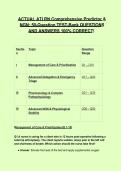
ACTUAL ATI RN Comprehensive Predictor &
NGN: 50-Question TEST-Bank QUESTIONS
AND ANSWERS 100% CORRECT!
Sectio Topic Question
n Range
I Management of Care & Prioritization Q1 – Q10
II Advanced Delegation & Emergency Q11 – Q20
Triage
III Pharmacology & Complex Q21 – Q35
Pathophysiology
IV Advanced NGN & Physiological Q36 – Q50
Stability
Management of Care & Prioritization(Q 1-10)
Q1.A nurse is caring for a client who is 12 hours post-operative following a
total hip arthroplasty. The client reports sudden, sharp pain in the left calf
and shortness of breath. Which action should the nurse take first?
● Answer: Elevate the head of the bed and apply supplemental oxygen.
, ● Rationale: The client is exhibiting signs of a pulmonary embolism (PE), a
life-threatening complication of a DVT. Immediate oxygenation (ABC
priority) is required before further assessment or notification of the
provider.
Q2. A nurse is reviewing the chart of a client admitted with acute
pancreatitis. Which of the following laboratory findings should the nurse
expect to see?
● Answer: Elevated serum lipase and amylase, and hypocalcemia.
● Rationale: In pancreatitis, enzymes leak into the surrounding tissue, and
calcium binds with fatty acids (fat necrosis), leading to hypocalcemia.
Q3. A nurse is assessing a client with chronic heart failure who is receiving
a loop diuretic. The client reports muscle weakness and palpitations. An
ECG shows a prominent U-wave. Which electrolyte imbalance should the
nurse suspect?
● Answer: Hypokalemia.
● Rationale: Loop diuretics (like furosemide) cause significant potassium
wasting. Hypokalemia often presents with cardiac rhythm changes
(U-waves) and muscle weakness.
Q4. A client in the third trimester of pregnancy is admitted with severe
abdominal pain and "board-like" rigidity of the uterus. Fetal heart tones are
absent. What is the priority nursing intervention?
● Answer: Prepare the client for an emergency cesarean section.
● Rationale: The symptoms are classic for abruptio placentae, which is a
life-threatening obstetric emergency for both mother and fetus.
Q5. A nurse is planning care for a client who has a history of bipolar
disorder and is experiencing a manic episode. Which action should the
nurse include in the plan of care?
● Answer: Provide frequent, high-calorie finger foods throughout the day.
● Rationale: Manic clients are often too hyperactive to sit for meals; finger
foods ensure adequate caloric intake to meet their increased metabolic
demands.
NGN: 50-Question TEST-Bank QUESTIONS
AND ANSWERS 100% CORRECT!
Sectio Topic Question
n Range
I Management of Care & Prioritization Q1 – Q10
II Advanced Delegation & Emergency Q11 – Q20
Triage
III Pharmacology & Complex Q21 – Q35
Pathophysiology
IV Advanced NGN & Physiological Q36 – Q50
Stability
Management of Care & Prioritization(Q 1-10)
Q1.A nurse is caring for a client who is 12 hours post-operative following a
total hip arthroplasty. The client reports sudden, sharp pain in the left calf
and shortness of breath. Which action should the nurse take first?
● Answer: Elevate the head of the bed and apply supplemental oxygen.
, ● Rationale: The client is exhibiting signs of a pulmonary embolism (PE), a
life-threatening complication of a DVT. Immediate oxygenation (ABC
priority) is required before further assessment or notification of the
provider.
Q2. A nurse is reviewing the chart of a client admitted with acute
pancreatitis. Which of the following laboratory findings should the nurse
expect to see?
● Answer: Elevated serum lipase and amylase, and hypocalcemia.
● Rationale: In pancreatitis, enzymes leak into the surrounding tissue, and
calcium binds with fatty acids (fat necrosis), leading to hypocalcemia.
Q3. A nurse is assessing a client with chronic heart failure who is receiving
a loop diuretic. The client reports muscle weakness and palpitations. An
ECG shows a prominent U-wave. Which electrolyte imbalance should the
nurse suspect?
● Answer: Hypokalemia.
● Rationale: Loop diuretics (like furosemide) cause significant potassium
wasting. Hypokalemia often presents with cardiac rhythm changes
(U-waves) and muscle weakness.
Q4. A client in the third trimester of pregnancy is admitted with severe
abdominal pain and "board-like" rigidity of the uterus. Fetal heart tones are
absent. What is the priority nursing intervention?
● Answer: Prepare the client for an emergency cesarean section.
● Rationale: The symptoms are classic for abruptio placentae, which is a
life-threatening obstetric emergency for both mother and fetus.
Q5. A nurse is planning care for a client who has a history of bipolar
disorder and is experiencing a manic episode. Which action should the
nurse include in the plan of care?
● Answer: Provide frequent, high-calorie finger foods throughout the day.
● Rationale: Manic clients are often too hyperactive to sit for meals; finger
foods ensure adequate caloric intake to meet their increased metabolic
demands.