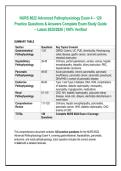
NURS 8022 Advanced Pathophysiology Exam 4 – 120
Practice Questions & Answers Complete Exam Study Guide
– Latest 2025/2026 | 100% Verified
SUMMARY TABLE
Section Questions Key Topics Covered
Gastrointestinal 1-25 GERD, Crohn's, UC, PUD, diverticulitis, Hirschsprung,
Pathophysiology celiac disease, gastric cancer, carcinoid syndrome,
intestinal obstruction
Hepatobiliary 26-45 Cirrhosis, portal hypertension, ascites, varices, hepatic
Pathophysiology encephalopathy, hepatitis, biliary obstruction, PBC,
hepatocellular carcinoma
Pancreatic 46-65 Acute pancreatitis, chronic pancreatitis, pancreatic
Pathophysiology insufficiency, pancreatic cancer, pancreatic pseudocyst,
DKA/HHS in context of pancreatic disease
Endocrine 66-90 Type 1 and Type 2 diabetes, DKA, HHS, complications
Pathophysiology of diabetes, diabetic nephropathy, retinopathy,
neuropathy, hypoglycemia, medications
Renal 91-110 CKD, AKI, diabetic nephropathy, polycystic kidney
Pathophysiology disease, renal colic, dialysis, electrolyte disturbances in
renal failure
Comprehensive 111-120 Cirrhosis, hepatic encephalopathy, pancreatitis,
Review pancreatic cancer, HHS, diabetic nephropathy, CKD,
anemia of CKD
TOTAL 120 Complete NURS 8022 Exam 4 Coverage
Questions
This comprehensive document contains 120 practice questions for the NURS 8022
Advanced Pathophysiology Exam 4, covering gastrointestinal, hepatobiliary, pancreatic,
endocrine, and renal pathophysiology. Each question includes the correct answer
in bold with a detailed rationale.
,SECTION 1: GASTROINTESTINAL PATHOPHYSIOLOGY (Questions 1–25)
1. A 45-year-old with chronic GERD is at risk for developing which condition?
A) Gastric ulcer
B) Barrett's esophagus
C) Crohn's disease
D) Diverticulitis
Answer: B
Chronic gastroesophageal reflux disease (GERD) can lead to Barrett's esophagus, where
the normal squamous epithelium of the lower esophagus is replaced by metaplastic
columnar epithelium. Barrett's esophagus is a premalignant condition that increases the risk
of esophageal adenocarcinoma. This is a classic example of metaplasia.
2. A patient presents with dark, tarry stools. Which condition is the most likely
cause?
A) Hemorrhoids
B) Upper GI bleeding
C) Diverticulitis
D) Colon cancer
Answer: B
Dark, tarry stools (melena) indicate bleeding in the upper gastrointestinal tract (esophagus,
stomach, or duodenum). The blood is digested by gastric acid and intestinal enzymes,
resulting in a characteristic black, sticky appearance. Hemorrhoids and lower GI bleeding
typically present with bright red or maroon-colored blood.
3. A 28-year-old presents with recurrent abdominal pain, diarrhea, and weight loss.
Endoscopy reveals skip lesions, cobblestone appearance, and transmural
inflammation. What is the most likely diagnosis?
A) Ulcerative colitis
B) Crohn's disease
C) Irritable bowel syndrome
D) Celiac disease
,Answer: B
Crohn's disease is characterized by transmural inflammation, skip lesions, and a
cobblestone appearance on endoscopy. Unlike ulcerative colitis (which is continuous and
limited to the mucosa), Crohn's disease can affect any part of the GI tract from mouth to
anus.
4. Which of the following is a characteristic finding in ulcerative colitis?
A) Transmural inflammation
B) Continuous mucosal inflammation starting in the rectum
C) Skip lesions
D) Fistula formation
Answer: B
Ulcerative colitis is characterized by continuous mucosal inflammation that typically starts in
the rectum and extends proximally. Unlike Crohn's disease, it does not involve transmural
inflammation, skip lesions, or fistula formation. The inflammation is limited to the mucosa
and submucosa.
5. A 52-year-old presents with right upper quadrant pain, fever, and jaundice. What is
the most likely diagnosis?
A) Acute pancreatitis
B) Acute cholecystitis
C) Peptic ulcer disease
D) Appendicitis
Answer: B
Acute cholecystitis presents with right upper quadrant pain (often radiating to the right
shoulder), fever, and jaundice. The pain is typically triggered by fatty meals. Murphy's sign
(pain with deep palpation during inspiration) is a classic physical exam finding.
6. What is the primary pathophysiology of peptic ulcer disease?
A) Excessive gastric acid production alone
B) Imbalance between aggressive factors (acid, pepsin) and protective factors
, (mucus, bicarbonate)
C) Autoimmune destruction of parietal cells
D) Bacterial infection of the pancreas
Answer: B
Peptic ulcer disease results from an imbalance between aggressive factors (gastric acid,
pepsin, H. pylori infection, NSAIDs) and protective factors (mucus, bicarbonate,
prostaglandins). The disruption of the mucosal barrier allows acid and pepsin to damage the
underlying tissue.
7. A 72-year-old with diverticulosis presents with sudden onset of left lower quadrant
pain, fever, and leukocytosis. What is the most likely complication?
A) Diverticular bleeding
B) Acute diverticulitis
C) Bowel obstruction
D) Perforation
Answer: B
Acute diverticulitis is the inflammation of diverticula, most commonly in the sigmoid colon. It
presents with left lower quadrant pain, fever, nausea, and leukocytosis. Diverticular bleeding
typically presents with painless hematochezia.
8. A newborn presents with bilious vomiting, abdominal distention, and failure to
pass meconium within 24 hours. What is the most likely diagnosis?
A) Pyloric stenosis
B) Hirschsprung disease
C) Intussusception
D) Malrotation with volvulus
Answer: B
Hirschsprung disease (congenital aganglionic megacolon) presents with failure to pass
meconium within 24-48 hours, bilious vomiting, and abdominal distention. Pyloric stenosis
presents with non-bilious projectile vomiting. Intussusception is more common in older
infants and presents with currant jelly stools.
Practice Questions & Answers Complete Exam Study Guide
– Latest 2025/2026 | 100% Verified
SUMMARY TABLE
Section Questions Key Topics Covered
Gastrointestinal 1-25 GERD, Crohn's, UC, PUD, diverticulitis, Hirschsprung,
Pathophysiology celiac disease, gastric cancer, carcinoid syndrome,
intestinal obstruction
Hepatobiliary 26-45 Cirrhosis, portal hypertension, ascites, varices, hepatic
Pathophysiology encephalopathy, hepatitis, biliary obstruction, PBC,
hepatocellular carcinoma
Pancreatic 46-65 Acute pancreatitis, chronic pancreatitis, pancreatic
Pathophysiology insufficiency, pancreatic cancer, pancreatic pseudocyst,
DKA/HHS in context of pancreatic disease
Endocrine 66-90 Type 1 and Type 2 diabetes, DKA, HHS, complications
Pathophysiology of diabetes, diabetic nephropathy, retinopathy,
neuropathy, hypoglycemia, medications
Renal 91-110 CKD, AKI, diabetic nephropathy, polycystic kidney
Pathophysiology disease, renal colic, dialysis, electrolyte disturbances in
renal failure
Comprehensive 111-120 Cirrhosis, hepatic encephalopathy, pancreatitis,
Review pancreatic cancer, HHS, diabetic nephropathy, CKD,
anemia of CKD
TOTAL 120 Complete NURS 8022 Exam 4 Coverage
Questions
This comprehensive document contains 120 practice questions for the NURS 8022
Advanced Pathophysiology Exam 4, covering gastrointestinal, hepatobiliary, pancreatic,
endocrine, and renal pathophysiology. Each question includes the correct answer
in bold with a detailed rationale.
,SECTION 1: GASTROINTESTINAL PATHOPHYSIOLOGY (Questions 1–25)
1. A 45-year-old with chronic GERD is at risk for developing which condition?
A) Gastric ulcer
B) Barrett's esophagus
C) Crohn's disease
D) Diverticulitis
Answer: B
Chronic gastroesophageal reflux disease (GERD) can lead to Barrett's esophagus, where
the normal squamous epithelium of the lower esophagus is replaced by metaplastic
columnar epithelium. Barrett's esophagus is a premalignant condition that increases the risk
of esophageal adenocarcinoma. This is a classic example of metaplasia.
2. A patient presents with dark, tarry stools. Which condition is the most likely
cause?
A) Hemorrhoids
B) Upper GI bleeding
C) Diverticulitis
D) Colon cancer
Answer: B
Dark, tarry stools (melena) indicate bleeding in the upper gastrointestinal tract (esophagus,
stomach, or duodenum). The blood is digested by gastric acid and intestinal enzymes,
resulting in a characteristic black, sticky appearance. Hemorrhoids and lower GI bleeding
typically present with bright red or maroon-colored blood.
3. A 28-year-old presents with recurrent abdominal pain, diarrhea, and weight loss.
Endoscopy reveals skip lesions, cobblestone appearance, and transmural
inflammation. What is the most likely diagnosis?
A) Ulcerative colitis
B) Crohn's disease
C) Irritable bowel syndrome
D) Celiac disease
,Answer: B
Crohn's disease is characterized by transmural inflammation, skip lesions, and a
cobblestone appearance on endoscopy. Unlike ulcerative colitis (which is continuous and
limited to the mucosa), Crohn's disease can affect any part of the GI tract from mouth to
anus.
4. Which of the following is a characteristic finding in ulcerative colitis?
A) Transmural inflammation
B) Continuous mucosal inflammation starting in the rectum
C) Skip lesions
D) Fistula formation
Answer: B
Ulcerative colitis is characterized by continuous mucosal inflammation that typically starts in
the rectum and extends proximally. Unlike Crohn's disease, it does not involve transmural
inflammation, skip lesions, or fistula formation. The inflammation is limited to the mucosa
and submucosa.
5. A 52-year-old presents with right upper quadrant pain, fever, and jaundice. What is
the most likely diagnosis?
A) Acute pancreatitis
B) Acute cholecystitis
C) Peptic ulcer disease
D) Appendicitis
Answer: B
Acute cholecystitis presents with right upper quadrant pain (often radiating to the right
shoulder), fever, and jaundice. The pain is typically triggered by fatty meals. Murphy's sign
(pain with deep palpation during inspiration) is a classic physical exam finding.
6. What is the primary pathophysiology of peptic ulcer disease?
A) Excessive gastric acid production alone
B) Imbalance between aggressive factors (acid, pepsin) and protective factors
, (mucus, bicarbonate)
C) Autoimmune destruction of parietal cells
D) Bacterial infection of the pancreas
Answer: B
Peptic ulcer disease results from an imbalance between aggressive factors (gastric acid,
pepsin, H. pylori infection, NSAIDs) and protective factors (mucus, bicarbonate,
prostaglandins). The disruption of the mucosal barrier allows acid and pepsin to damage the
underlying tissue.
7. A 72-year-old with diverticulosis presents with sudden onset of left lower quadrant
pain, fever, and leukocytosis. What is the most likely complication?
A) Diverticular bleeding
B) Acute diverticulitis
C) Bowel obstruction
D) Perforation
Answer: B
Acute diverticulitis is the inflammation of diverticula, most commonly in the sigmoid colon. It
presents with left lower quadrant pain, fever, nausea, and leukocytosis. Diverticular bleeding
typically presents with painless hematochezia.
8. A newborn presents with bilious vomiting, abdominal distention, and failure to
pass meconium within 24 hours. What is the most likely diagnosis?
A) Pyloric stenosis
B) Hirschsprung disease
C) Intussusception
D) Malrotation with volvulus
Answer: B
Hirschsprung disease (congenital aganglionic megacolon) presents with failure to pass
meconium within 24-48 hours, bilious vomiting, and abdominal distention. Pyloric stenosis
presents with non-bilious projectile vomiting. Intussusception is more common in older
infants and presents with currant jelly stools.