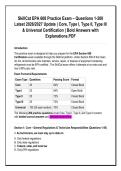
SkillCat EPA 608 Practice Exam – Questions 1-200
Latest 2026/2027 Update | Core, Type I, Type II, Type III
& Universal Certification | Bold Answers with
Explanations.PDF
Introduction
This practice exam is designed to help you prepare for the EPA Section 608
Certification exam available through the SkillCat platform. Under Section 608 of the Clean
Air Act, all technicians who maintain, service, repair, or dispose of equipment containing
refrigerants must be EPA certified . The SkillCat exam offers 4 attempts at no extra cost and
has a 98% pass rate .
Exam Format & Requirements
Exam Type Questions Passing Score Format
Core 25 84% Closed Book
Type I 25 84% Open Book
Type II 25 72% Closed Book
Type III 25 72% Closed Book
Universal 100 (25 each section) 70% Closed Book
The following 200 practice questions cover Core, Type I, Type II, and Type III content
with bolded correct answers and italicized explanations .
Section 1: Core – General Regulations & Technician Responsibilities (Questions 1-50)
1. As technicians, we must stay up to date on:
A. Only federal regulations
B. Only state regulations
C. Federal, state, and local law
D. Only EPA regulations
,Rationale: Technicians must comply with federal, state, and local regulations, which may
vary and can be stricter than federal requirements .
2. For universal certification, how many questions will you receive?
A. 50
B. 100
C. 150
D. 200
Rationale: The Universal exam consists of 100 questions: 25 from each section (Core, Type
I, Type II, Type III) .
3. What is the passing grade for all EPA 608 certification exams?
A. 60%
B. 65%
C. 70%
D. 75%
Rationale: The passing grade for all EPA 608 certification exams is 70% .
4. True or false: You must memorize all EPA regulations because they will stay the
same forever.
A. True
B. False
Rationale: EPA regulations change over time as new environmental standards and
refrigerant phase-outs occur. Technicians must stay up to date .
5. Can chlorine from the environment come from natural resources such as
volcanoes?
A. Yes, but they are not the primary source
B. No, chlorine only comes from refrigerants
,C. Yes, volcanoes are the primary source
D. No, chlorine does not exist in nature
Rationale: Natural sources like volcanoes and oceans do release some chlorine, but the
primary source of stratospheric chlorine is emissions from CFCs and HCFCs .
6. True or false: Ground-level ozone is what reflects and absorbs harmful UV rays
from the sun.
A. True
B. False
Rationale: Ground-level (tropospheric) ozone is a pollutant and does not protect against UV
radiation. The protective ozone layer is in the stratosphere .
7. In which way does ozone depletion affect humans?
A. Lower risk of skin cancer
B. Increased risk of skin cancer and cataracts
C. Improved immune function
D. No effect on human health
Rationale: Ozone depletion increases UV radiation reaching Earth's surface, leading to
increased risks of skin cancer, cataracts, and immune system suppression .
8. Is there evidence that refrigerants are in the stratosphere?
A. No
B. Yes
C. Only CFCs are in the stratosphere
D. Only HCFCs are in the stratosphere
Rationale: Scientific evidence confirms that refrigerants, particularly CFCs and HCFCs, are
present in the stratosphere where they contribute to ozone depletion .
9. One molecule of chlorine can destroy how many molecules of ozone?
, A. 10,000
B. 100,000
C. 1,000,000
D. 10,000,000
Rationale: A single chlorine atom can catalytically destroy up to 100,000 ozone molecules in
the stratosphere before being removed from the cycle .
10. Ozone has how many oxygen atoms?
A. 1
B. 3
C. 2
D. 4
Rationale: Ozone is a molecule composed of three oxygen atoms (O₃), which distinguishes
it from the oxygen we breathe (O₂) .
11. True or false: The majority of the ozone is located in the troposphere.
A. True
B. False
Rationale: The majority of ozone is located in the stratosphere, not the troposphere .
12. How many molecules of ozone can three molecules of chlorine destroy?
A. 100,000
B. 300,000
C. 30,000
D. 1,000,000
Rationale: Since one chlorine atom can destroy up to 100,000 ozone molecules, three
chlorine atoms can destroy up to 300,000 ozone molecules .
13. What is the major function of ozone in the stratosphere?
Latest 2026/2027 Update | Core, Type I, Type II, Type III
& Universal Certification | Bold Answers with
Explanations.PDF
Introduction
This practice exam is designed to help you prepare for the EPA Section 608
Certification exam available through the SkillCat platform. Under Section 608 of the Clean
Air Act, all technicians who maintain, service, repair, or dispose of equipment containing
refrigerants must be EPA certified . The SkillCat exam offers 4 attempts at no extra cost and
has a 98% pass rate .
Exam Format & Requirements
Exam Type Questions Passing Score Format
Core 25 84% Closed Book
Type I 25 84% Open Book
Type II 25 72% Closed Book
Type III 25 72% Closed Book
Universal 100 (25 each section) 70% Closed Book
The following 200 practice questions cover Core, Type I, Type II, and Type III content
with bolded correct answers and italicized explanations .
Section 1: Core – General Regulations & Technician Responsibilities (Questions 1-50)
1. As technicians, we must stay up to date on:
A. Only federal regulations
B. Only state regulations
C. Federal, state, and local law
D. Only EPA regulations
,Rationale: Technicians must comply with federal, state, and local regulations, which may
vary and can be stricter than federal requirements .
2. For universal certification, how many questions will you receive?
A. 50
B. 100
C. 150
D. 200
Rationale: The Universal exam consists of 100 questions: 25 from each section (Core, Type
I, Type II, Type III) .
3. What is the passing grade for all EPA 608 certification exams?
A. 60%
B. 65%
C. 70%
D. 75%
Rationale: The passing grade for all EPA 608 certification exams is 70% .
4. True or false: You must memorize all EPA regulations because they will stay the
same forever.
A. True
B. False
Rationale: EPA regulations change over time as new environmental standards and
refrigerant phase-outs occur. Technicians must stay up to date .
5. Can chlorine from the environment come from natural resources such as
volcanoes?
A. Yes, but they are not the primary source
B. No, chlorine only comes from refrigerants
,C. Yes, volcanoes are the primary source
D. No, chlorine does not exist in nature
Rationale: Natural sources like volcanoes and oceans do release some chlorine, but the
primary source of stratospheric chlorine is emissions from CFCs and HCFCs .
6. True or false: Ground-level ozone is what reflects and absorbs harmful UV rays
from the sun.
A. True
B. False
Rationale: Ground-level (tropospheric) ozone is a pollutant and does not protect against UV
radiation. The protective ozone layer is in the stratosphere .
7. In which way does ozone depletion affect humans?
A. Lower risk of skin cancer
B. Increased risk of skin cancer and cataracts
C. Improved immune function
D. No effect on human health
Rationale: Ozone depletion increases UV radiation reaching Earth's surface, leading to
increased risks of skin cancer, cataracts, and immune system suppression .
8. Is there evidence that refrigerants are in the stratosphere?
A. No
B. Yes
C. Only CFCs are in the stratosphere
D. Only HCFCs are in the stratosphere
Rationale: Scientific evidence confirms that refrigerants, particularly CFCs and HCFCs, are
present in the stratosphere where they contribute to ozone depletion .
9. One molecule of chlorine can destroy how many molecules of ozone?
, A. 10,000
B. 100,000
C. 1,000,000
D. 10,000,000
Rationale: A single chlorine atom can catalytically destroy up to 100,000 ozone molecules in
the stratosphere before being removed from the cycle .
10. Ozone has how many oxygen atoms?
A. 1
B. 3
C. 2
D. 4
Rationale: Ozone is a molecule composed of three oxygen atoms (O₃), which distinguishes
it from the oxygen we breathe (O₂) .
11. True or false: The majority of the ozone is located in the troposphere.
A. True
B. False
Rationale: The majority of ozone is located in the stratosphere, not the troposphere .
12. How many molecules of ozone can three molecules of chlorine destroy?
A. 100,000
B. 300,000
C. 30,000
D. 1,000,000
Rationale: Since one chlorine atom can destroy up to 100,000 ozone molecules, three
chlorine atoms can destroy up to 300,000 ozone molecules .
13. What is the major function of ozone in the stratosphere?