
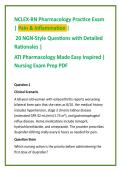
NCLEX-RN Pharmacology Practice Exam
| Pain & Inflammation |
20 NGN-Style Questions with Detailed
Rationales |
ATI Pharmacology Made Easy Inspired |
Nursing Exam Prep PDF
Question 1
Clinical Scenario
A 68-year-old woman with osteoarthritis reports worsening
bilateral knee pain that she rates as 8/10. Her medical history
includes hypertension, stage 3 chronic kidney disease
(estimated GFR 42 mL/min/1.73 m²), and gastroesophageal
reflux disease. Home medications include lisinopril,
hydrochlorothiazide, and omeprazole. The provider prescribes
ibuprofen 600 mg orally every 6 hours as needed for pain.
Question Stem
Which nursing action is the priority before administering the
first dose of ibuprofen?
,A. Administer the medication with food to reduce gastric
irritation.
B. Review the client's renal function and notify the provider
about impaired kidney function.
C. Encourage increased fluid intake to prevent constipation.
D. Teach the client to avoid dairy products while taking the
medication.
Correct Answer
Correct Answer: B. Review the client's renal function and
notify the provider about impaired kidney function.
Detailed Rationale
Ibuprofen is a nonsteroidal anti-inflammatory drug (NSAID) that
inhibits cyclooxygenase (COX) enzymes, reducing prostaglandin
synthesis. While effective for pain and inflammation,
prostaglandins also help maintain renal blood flow, particularly
in older adults and those with chronic kidney disease. In this
client, stage 3 CKD significantly increases the risk of NSAID-
induced acute kidney injury and worsening renal function.
Additionally, concurrent use of an ACE inhibitor (lisinopril) and a
diuretic (hydrochlorothiazide) creates the "triple whammy"
combination, which further elevates the risk of kidney injury.
The nurse should review renal laboratory results and
,collaborate with the provider before administering the
medication.
Option A is appropriate patient teaching but does not address
the most immediate safety concern. Option C is incorrect
because constipation is more commonly associated with opioid
analgesics rather than NSAIDs. Option D is unrelated, as dairy
products do not significantly affect ibuprofen therapy.
The nurse should monitor serum creatinine, estimated GFR,
urine output, blood pressure, and signs of gastrointestinal
bleeding throughout NSAID therapy. Alternative pain
management strategies may be safer for clients with impaired
renal function.
Learning Objectives
After completing this question, the learner should be able to:
• Identify patients at increased risk for NSAID-induced
kidney injury.
• Prioritize assessment before administering NSAIDs.
• Recognize medication combinations that increase
nephrotoxicity.
• Apply safe medication administration principles for older
adults.
Medication Safety Focus
, Monitoring
Question 2
Clinical Scenario
A 45-year-old man is admitted with severe low back pain
following a lifting injury. The provider prescribes morphine 4 mg
IV every 3 hours as needed. Thirty minutes after administration,
the nurse assesses the client and notes the following:
• Respiratory rate: 8/min
• Oxygen saturation: 90% on room air
• Blood pressure: 102/64 mm Hg
• Heart rate: 62/min
• Client difficult to arouse
Question Stem
Which nursing action should the nurse perform first?
A. Encourage the client to cough and deep breathe.
B. Administer naloxone as prescribed.
C. Document that the medication is effective.
D. Administer another dose of morphine for breakthrough pain.
Correct Answer
| Pain & Inflammation |
20 NGN-Style Questions with Detailed
Rationales |
ATI Pharmacology Made Easy Inspired |
Nursing Exam Prep PDF
Question 1
Clinical Scenario
A 68-year-old woman with osteoarthritis reports worsening
bilateral knee pain that she rates as 8/10. Her medical history
includes hypertension, stage 3 chronic kidney disease
(estimated GFR 42 mL/min/1.73 m²), and gastroesophageal
reflux disease. Home medications include lisinopril,
hydrochlorothiazide, and omeprazole. The provider prescribes
ibuprofen 600 mg orally every 6 hours as needed for pain.
Question Stem
Which nursing action is the priority before administering the
first dose of ibuprofen?
,A. Administer the medication with food to reduce gastric
irritation.
B. Review the client's renal function and notify the provider
about impaired kidney function.
C. Encourage increased fluid intake to prevent constipation.
D. Teach the client to avoid dairy products while taking the
medication.
Correct Answer
Correct Answer: B. Review the client's renal function and
notify the provider about impaired kidney function.
Detailed Rationale
Ibuprofen is a nonsteroidal anti-inflammatory drug (NSAID) that
inhibits cyclooxygenase (COX) enzymes, reducing prostaglandin
synthesis. While effective for pain and inflammation,
prostaglandins also help maintain renal blood flow, particularly
in older adults and those with chronic kidney disease. In this
client, stage 3 CKD significantly increases the risk of NSAID-
induced acute kidney injury and worsening renal function.
Additionally, concurrent use of an ACE inhibitor (lisinopril) and a
diuretic (hydrochlorothiazide) creates the "triple whammy"
combination, which further elevates the risk of kidney injury.
The nurse should review renal laboratory results and
,collaborate with the provider before administering the
medication.
Option A is appropriate patient teaching but does not address
the most immediate safety concern. Option C is incorrect
because constipation is more commonly associated with opioid
analgesics rather than NSAIDs. Option D is unrelated, as dairy
products do not significantly affect ibuprofen therapy.
The nurse should monitor serum creatinine, estimated GFR,
urine output, blood pressure, and signs of gastrointestinal
bleeding throughout NSAID therapy. Alternative pain
management strategies may be safer for clients with impaired
renal function.
Learning Objectives
After completing this question, the learner should be able to:
• Identify patients at increased risk for NSAID-induced
kidney injury.
• Prioritize assessment before administering NSAIDs.
• Recognize medication combinations that increase
nephrotoxicity.
• Apply safe medication administration principles for older
adults.
Medication Safety Focus
, Monitoring
Question 2
Clinical Scenario
A 45-year-old man is admitted with severe low back pain
following a lifting injury. The provider prescribes morphine 4 mg
IV every 3 hours as needed. Thirty minutes after administration,
the nurse assesses the client and notes the following:
• Respiratory rate: 8/min
• Oxygen saturation: 90% on room air
• Blood pressure: 102/64 mm Hg
• Heart rate: 62/min
• Client difficult to arouse
Question Stem
Which nursing action should the nurse perform first?
A. Encourage the client to cough and deep breathe.
B. Administer naloxone as prescribed.
C. Document that the medication is effective.
D. Administer another dose of morphine for breakthrough pain.
Correct Answer


