

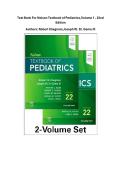
Test Bank For Nelson Textbook of Pediatrics,Volume 1 , 22nd
Edition
Authors: Robert Kliegman,Joseph W. St. Geme III
,Nelson Textbook of Pediatrics, 22nd Edition
Part I: The Field of Pediatrics
Clinical/Application MCQs (15)
Question 1
A previously healthy 2-year-old boy is brought for a routine well-child visit. His weight
has fallen from the 60th percentile to the 20th percentile over 8 months, while his
height remains at the 50th percentile. Development is appropriate. Which is the most
appropriate next step?
A. Diagnose failure to thrive immediately
B. Repeat measurements, review dietary intake, and evaluate growth trend
C. Order brain MRI
D. Begin high-calorie formula without evaluation
Correct Answer: B
Detailed Explanation
Growth assessment relies on serial measurements rather than a single point.
Crossing major percentile lines warrants careful assessment of nutrition, medical
history, psychosocial factors, and measurement accuracy before diagnosing growth
failure.
Why the Other Options Are Incorrect
A. Growth trends are more informative than one isolated measurement.
C. Neuroimaging is not indicated without neurological abnormalities.
D. Nutritional intervention should follow identification of contributing factors.
Question 2
A 6-month-old infant receives routine immunizations. Shortly afterward, the infant
develops a fever of 38.2°C but remains playful and feeds normally. What is the best
management?
A. Immediate hospital admission
,B. Start broad-spectrum antibiotics
C. Provide parental reassurance and supportive care
D. Delay all future immunizations
Correct Answer: C
Detailed Explanation
Low-grade fever after immunization is an expected immune response. Supportive
care and reassurance are appropriate while educating caregivers about warning signs
requiring evaluation.
Why the Other Options Are Incorrect
A. Admission is unnecessary in an otherwise well infant.
B. Fever alone after vaccination does not suggest bacterial infection.
D. Mild vaccine reactions are not contraindications to future vaccines.
Question 3
A pediatrician notices bruises of varying ages on the trunk and upper arms of a
nonambulatory 5-month-old infant. The parents provide inconsistent explanations.
What is the most appropriate immediate action?
A. Discharge with reassurance
B. Document findings carefully and initiate child protection evaluation
C. Wait until another injury occurs
D. Prescribe vitamin K
Correct Answer: B
Detailed Explanation
Bruising in a nonmobile infant is highly concerning for abuse. Accurate
documentation, ensuring child safety, and multidisciplinary evaluation are essential.
Why the Other Options Are Incorrect
A. This may place the child at continued risk.
, C. Delaying intervention is inappropriate.
D. Vitamin K deficiency is unlikely to explain the presentation without supporting
evidence.
Question 4
A physician is discussing treatment options with parents of a 14-year-old adolescent
who has decision-making capacity. The adolescent disagrees with the parents
regarding a non-emergency treatment. Which ethical principle is most applicable?
A. Justice
B. Beneficence
C. Respect for developing autonomy
D. Fidelity
Correct Answer: C
Detailed Explanation
Adolescents with adequate maturity should participate meaningfully in healthcare
decisions. Respecting evolving autonomy while considering legal requirements is an
important principle in pediatrics.
Why the Other Options Are Incorrect
A. Justice concerns fairness in healthcare.
B. Beneficence involves acting in the patient's best interest but does not specifically
address decision-making rights.
D. Fidelity concerns maintaining professional commitments.
Question 5
A 7-year-old girl presents for preventive care. Which intervention provides the
greatest long-term health benefit?
A. Annual chest radiograph
B. Routine developmental surveillance and anticipatory guidance
Edition
Authors: Robert Kliegman,Joseph W. St. Geme III
,Nelson Textbook of Pediatrics, 22nd Edition
Part I: The Field of Pediatrics
Clinical/Application MCQs (15)
Question 1
A previously healthy 2-year-old boy is brought for a routine well-child visit. His weight
has fallen from the 60th percentile to the 20th percentile over 8 months, while his
height remains at the 50th percentile. Development is appropriate. Which is the most
appropriate next step?
A. Diagnose failure to thrive immediately
B. Repeat measurements, review dietary intake, and evaluate growth trend
C. Order brain MRI
D. Begin high-calorie formula without evaluation
Correct Answer: B
Detailed Explanation
Growth assessment relies on serial measurements rather than a single point.
Crossing major percentile lines warrants careful assessment of nutrition, medical
history, psychosocial factors, and measurement accuracy before diagnosing growth
failure.
Why the Other Options Are Incorrect
A. Growth trends are more informative than one isolated measurement.
C. Neuroimaging is not indicated without neurological abnormalities.
D. Nutritional intervention should follow identification of contributing factors.
Question 2
A 6-month-old infant receives routine immunizations. Shortly afterward, the infant
develops a fever of 38.2°C but remains playful and feeds normally. What is the best
management?
A. Immediate hospital admission
,B. Start broad-spectrum antibiotics
C. Provide parental reassurance and supportive care
D. Delay all future immunizations
Correct Answer: C
Detailed Explanation
Low-grade fever after immunization is an expected immune response. Supportive
care and reassurance are appropriate while educating caregivers about warning signs
requiring evaluation.
Why the Other Options Are Incorrect
A. Admission is unnecessary in an otherwise well infant.
B. Fever alone after vaccination does not suggest bacterial infection.
D. Mild vaccine reactions are not contraindications to future vaccines.
Question 3
A pediatrician notices bruises of varying ages on the trunk and upper arms of a
nonambulatory 5-month-old infant. The parents provide inconsistent explanations.
What is the most appropriate immediate action?
A. Discharge with reassurance
B. Document findings carefully and initiate child protection evaluation
C. Wait until another injury occurs
D. Prescribe vitamin K
Correct Answer: B
Detailed Explanation
Bruising in a nonmobile infant is highly concerning for abuse. Accurate
documentation, ensuring child safety, and multidisciplinary evaluation are essential.
Why the Other Options Are Incorrect
A. This may place the child at continued risk.
, C. Delaying intervention is inappropriate.
D. Vitamin K deficiency is unlikely to explain the presentation without supporting
evidence.
Question 4
A physician is discussing treatment options with parents of a 14-year-old adolescent
who has decision-making capacity. The adolescent disagrees with the parents
regarding a non-emergency treatment. Which ethical principle is most applicable?
A. Justice
B. Beneficence
C. Respect for developing autonomy
D. Fidelity
Correct Answer: C
Detailed Explanation
Adolescents with adequate maturity should participate meaningfully in healthcare
decisions. Respecting evolving autonomy while considering legal requirements is an
important principle in pediatrics.
Why the Other Options Are Incorrect
A. Justice concerns fairness in healthcare.
B. Beneficence involves acting in the patient's best interest but does not specifically
address decision-making rights.
D. Fidelity concerns maintaining professional commitments.
Question 5
A 7-year-old girl presents for preventive care. Which intervention provides the
greatest long-term health benefit?
A. Annual chest radiograph
B. Routine developmental surveillance and anticipatory guidance


