

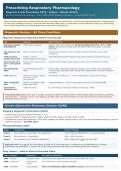
Prescribing Respiratory Pharmacology
Diagnosis & Safe Prescribing: COPD • Asthma • Allergic Rhinitis
NSG 533 Advanced Pharmacology — GOLD / GINA / NAEPP Stepwise Frameworks — Chisholm-Burns, 7th ed.
How to use this guide: Each condition follows the same clinical logic a prescriber uses: 1) confirm the diagnosis objectively, 2) stage severity,
3) match drug class/step to severity, 4) know the black-box/major safety issues, 5) know what to monitor and when to step up or down therapy.
That is exactly what NCLEX-style and graduate pharmacology exam questions test.
Diagnostic Workup — All Three Conditions
Objective Testing You Must Know Before You Prescribe
Test Used For What It Tells You
Spirometry (pre/post COPD & Asthma diagnosis FEV1/FVC ratio confirms obstruction. Post-bronchodilator FEV1/FVC < 0.70 = COPD
bronchodilator) (GOLD). Asthma: FEV1 increases ≥12% and ≥200 mL after bronchodilator = reversible
obstruction.
Peak Expiratory Flow Asthma monitoring at home Personal-best comparison. Green zone ≥80%, Yellow 50–79% (step up), Red <50%
(PEF) (emergency).
FeNO (fractional Asthma — confirms High FeNO predicts good ICS response; helps confirm asthma dx and adherence to ICS.
exhaled nitric oxide) eosinophilic/type-2 inflammation
Allergy testing (skin Allergic rhinitis; allergic asthma Identifies specific triggers; guides allergen avoidance and immunotherapy candidacy.
prick / serum-specific phenotype
IgE)
Arterial Blood Gas Acute exacerbations, severe Chronic COPD = compensated respiratory acidosis (↑CO2, ↑HCO3). Acute exacerbation =
(ABG) COPD uncompensated respiratory acidosis. Guides need for NIV/ventilation, not routine outpatient
prescribing.
Chest X-ray / CT COPD (hyperinflation, flattened Not diagnostic of COPD alone — confirms hyperinflation, excludes other pathology.
diaphragm), rule out
cancer/infection
Alpha-1 antitrypsin COPD in a nonsmoker or early- Congenital deficiency — screen once per patient with early or non-smoking COPD.
level onset (<45y) COPD
Sputum/blood COPD phenotyping Eos ≥300 cells/µL predicts good response to adding ICS in COPD.
eosinophil count
Prescribing safety pearl: Never start or escalate maintenance inhaler therapy for COPD or asthma without objective spirometry confirming
obstruction first — "wheezing" alone is not a diagnosis, and both under- and over-treatment carry risk (steroid exposure, missed pulmonary
embolism/CHF/other mimics).
Chronic Obstructive Pulmonary Disease (COPD)
Staging & Diagnostic Confirmation (GOLD)
Confirmed by post-bronchodilator FEV1/FVC < 0.70.
Severity by FEV1 % predicted: GOLD 1 ≥80%, GOLD 2 50–79%, GOLD 3 30–49%, GOLD 4 <30%.
Symptom/risk group (ABE assessment, 2023 GOLD update) uses mMRC dyspnea scale or CAT score plus exacerbation history to pick the
starting drug group — not FEV1 alone.
Pharmacotherapy Ladder
Group Presentation First-line Therapy
Group A Few symptoms, ≤1 exacerbation (no hospitalization) A bronchodilator (SABA/SAMA prn or a long-acting agent)
Group B More symptoms, ≤1 exacerbation LABA + LAMA combination
Group E ≥2 exacerbations or ≥1 leading to hospitalization LABA + LAMA; add ICS only if blood eos ≥300
High-yield rule: ICS is not first-line monotherapy in COPD and is never used alone. It is added on top of LABA/LAMA only in frequent
exacerbators with eosinophilia — because ICS in COPD raises pneumonia risk without the mortality benefit seen in asthma.
Drug Classes — What to Know to Prescribe Safely
Class / Examples Mechanism Key Safety & Monitoring
SABA — albuterol β2-agonist, rescue Tachycardia, tremor, hypokalemia; overuse (>2x/wk) signals poor control
SAMA — ipratropium Anticholinergic, Dry mouth; caution narrow-angle glaucoma, BPH
rescue
LABA — salmeterol, Long-acting β2- Never as monotherapy without ICS/LAMA in practice; cardiac stimulation, tremor
, formoterol, vilanterol agonist
LAMA — tiotropium, Long-acting Anticholinergic effects; caution glaucoma, urinary retention, BPH
umeclidinium, glycopyrrolate anticholinergic
ICS (combo only) — Anti-inflammatory ↑pneumonia risk in COPD; oral thrush — rinse mouth; use only if eos ≥300 and exacerbating
fluticasone, budesonide
Roflumilast (PDE-4 Anti-inflammatory, For chronic bronchitis phenotype with exacerbations; GI upset, weight loss, avoid in liver impairment,
inhibitor) add-on avoid combining with theophylline, monitor for depression/SI
Azithromycin (chronic, Immunomodulatory Reduces exacerbations in frequent exacerbators; check QT interval and hearing before starting; risk
3x/wk) add-on of macrolide resistance
Theophylline Methylxanthine Narrow therapeutic index 10–20 mcg/mL; toxicity = seizures, arrhythmia; many drug interactions
(rarely used now) (CYP1A2)
Alpha-1 proteinase Augmentation Only for confirmed AAT deficiency-related COPD
inhibitor therapy
Exam pearl: Roflumilast + theophylline = avoid combining (additive toxicity, no added benefit). Azithromycin prophylaxis requires a baseline
EKG/QTc and audiogram before starting.
Non-pharmacologic prescribing responsibilities
Smoking cessation counseling/pharmacotherapy at every visit — the single most effective intervention.
Annual influenza vaccine; pneumococcal vaccination per current ACIP schedule; COVID vaccination current.
Pulmonary rehabilitation referral for Group B/E.
Confirm correct inhaler technique/device at every visit — technique failure is the most common cause of "treatment failure."
Diagnosis & Safe Prescribing: COPD • Asthma • Allergic Rhinitis
NSG 533 Advanced Pharmacology — GOLD / GINA / NAEPP Stepwise Frameworks — Chisholm-Burns, 7th ed.
How to use this guide: Each condition follows the same clinical logic a prescriber uses: 1) confirm the diagnosis objectively, 2) stage severity,
3) match drug class/step to severity, 4) know the black-box/major safety issues, 5) know what to monitor and when to step up or down therapy.
That is exactly what NCLEX-style and graduate pharmacology exam questions test.
Diagnostic Workup — All Three Conditions
Objective Testing You Must Know Before You Prescribe
Test Used For What It Tells You
Spirometry (pre/post COPD & Asthma diagnosis FEV1/FVC ratio confirms obstruction. Post-bronchodilator FEV1/FVC < 0.70 = COPD
bronchodilator) (GOLD). Asthma: FEV1 increases ≥12% and ≥200 mL after bronchodilator = reversible
obstruction.
Peak Expiratory Flow Asthma monitoring at home Personal-best comparison. Green zone ≥80%, Yellow 50–79% (step up), Red <50%
(PEF) (emergency).
FeNO (fractional Asthma — confirms High FeNO predicts good ICS response; helps confirm asthma dx and adherence to ICS.
exhaled nitric oxide) eosinophilic/type-2 inflammation
Allergy testing (skin Allergic rhinitis; allergic asthma Identifies specific triggers; guides allergen avoidance and immunotherapy candidacy.
prick / serum-specific phenotype
IgE)
Arterial Blood Gas Acute exacerbations, severe Chronic COPD = compensated respiratory acidosis (↑CO2, ↑HCO3). Acute exacerbation =
(ABG) COPD uncompensated respiratory acidosis. Guides need for NIV/ventilation, not routine outpatient
prescribing.
Chest X-ray / CT COPD (hyperinflation, flattened Not diagnostic of COPD alone — confirms hyperinflation, excludes other pathology.
diaphragm), rule out
cancer/infection
Alpha-1 antitrypsin COPD in a nonsmoker or early- Congenital deficiency — screen once per patient with early or non-smoking COPD.
level onset (<45y) COPD
Sputum/blood COPD phenotyping Eos ≥300 cells/µL predicts good response to adding ICS in COPD.
eosinophil count
Prescribing safety pearl: Never start or escalate maintenance inhaler therapy for COPD or asthma without objective spirometry confirming
obstruction first — "wheezing" alone is not a diagnosis, and both under- and over-treatment carry risk (steroid exposure, missed pulmonary
embolism/CHF/other mimics).
Chronic Obstructive Pulmonary Disease (COPD)
Staging & Diagnostic Confirmation (GOLD)
Confirmed by post-bronchodilator FEV1/FVC < 0.70.
Severity by FEV1 % predicted: GOLD 1 ≥80%, GOLD 2 50–79%, GOLD 3 30–49%, GOLD 4 <30%.
Symptom/risk group (ABE assessment, 2023 GOLD update) uses mMRC dyspnea scale or CAT score plus exacerbation history to pick the
starting drug group — not FEV1 alone.
Pharmacotherapy Ladder
Group Presentation First-line Therapy
Group A Few symptoms, ≤1 exacerbation (no hospitalization) A bronchodilator (SABA/SAMA prn or a long-acting agent)
Group B More symptoms, ≤1 exacerbation LABA + LAMA combination
Group E ≥2 exacerbations or ≥1 leading to hospitalization LABA + LAMA; add ICS only if blood eos ≥300
High-yield rule: ICS is not first-line monotherapy in COPD and is never used alone. It is added on top of LABA/LAMA only in frequent
exacerbators with eosinophilia — because ICS in COPD raises pneumonia risk without the mortality benefit seen in asthma.
Drug Classes — What to Know to Prescribe Safely
Class / Examples Mechanism Key Safety & Monitoring
SABA — albuterol β2-agonist, rescue Tachycardia, tremor, hypokalemia; overuse (>2x/wk) signals poor control
SAMA — ipratropium Anticholinergic, Dry mouth; caution narrow-angle glaucoma, BPH
rescue
LABA — salmeterol, Long-acting β2- Never as monotherapy without ICS/LAMA in practice; cardiac stimulation, tremor
, formoterol, vilanterol agonist
LAMA — tiotropium, Long-acting Anticholinergic effects; caution glaucoma, urinary retention, BPH
umeclidinium, glycopyrrolate anticholinergic
ICS (combo only) — Anti-inflammatory ↑pneumonia risk in COPD; oral thrush — rinse mouth; use only if eos ≥300 and exacerbating
fluticasone, budesonide
Roflumilast (PDE-4 Anti-inflammatory, For chronic bronchitis phenotype with exacerbations; GI upset, weight loss, avoid in liver impairment,
inhibitor) add-on avoid combining with theophylline, monitor for depression/SI
Azithromycin (chronic, Immunomodulatory Reduces exacerbations in frequent exacerbators; check QT interval and hearing before starting; risk
3x/wk) add-on of macrolide resistance
Theophylline Methylxanthine Narrow therapeutic index 10–20 mcg/mL; toxicity = seizures, arrhythmia; many drug interactions
(rarely used now) (CYP1A2)
Alpha-1 proteinase Augmentation Only for confirmed AAT deficiency-related COPD
inhibitor therapy
Exam pearl: Roflumilast + theophylline = avoid combining (additive toxicity, no added benefit). Azithromycin prophylaxis requires a baseline
EKG/QTc and audiogram before starting.
Non-pharmacologic prescribing responsibilities
Smoking cessation counseling/pharmacotherapy at every visit — the single most effective intervention.
Annual influenza vaccine; pneumococcal vaccination per current ACIP schedule; COVID vaccination current.
Pulmonary rehabilitation referral for Group B/E.
Confirm correct inhaler technique/device at every visit — technique failure is the most common cause of "treatment failure."


