

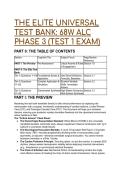
THE ELITE UNIVERSAL
TEST BANK: 68W ALC
PHASE 3 (TEST 1 EXAM)
PART 0: THE TABLE OF CONTENTS
Section Cognitive Tier Subject Focus Page/Section
Reference
PART I: The Preview Pre-Assessment Critical Axioms & Rules Section 1.0
of Engagement
PART II: The Elite Test
Bank
Tier 1 (Questions 1–10) Foundational Syntax &Hard Deck Definitions, Section 2.1
Application Formulas, Baselines
Tier 2 (Questions Complex Application &Situation/Variable Section 2.2
11–20) Simulation Shifts, Immediate
Actions
Tier 3 (Questions Grandmaster Synthesis High-Stakes Scenarios, Section 2.3
21–30) Multi-System Synthesis
PART I: THE PREVIEW
Mastering this test bank translates directly to elite clinical performance by replacing rote
memorization with a surgical, mechanistic understanding of combat medicine, Limited Primary
Care (LPC), and Prolonged Casualty Care (PCC). This document will forge your analytical
stamina, ensuring your academic mastery translates flawlessly into the operational environment
where hesitancy is fatal.
The "Critical Axioms" Cheat Sheet:
● The Hemorrhagic Resuscitation Standard: Whole Blood (LTOWB) is the universally
mandated standard. Administer early. Always supplement massive transfusions with 1g of
Calcium to counteract citrate toxicity.
● The Neurological Evacuation Mandate: A Level 3 Evacuation Red Flag in a Traumatic
Brain Injury (TBI)—including progressively declining levels of consciousness, pupil
asymmetry, or seizures—demands immediate surgical evacuation. You cannot reverse
brainstem herniation in a Role 1 facility.
● The Cardiac Perfusion Principle: Treat the patient, not just the monitor. In complex EKG
rhythms, always assess hemodynamic stability before deploying chemical interventions
(e.g., Amiodarone) or synchronized electrical therapies.
● The Chain of Infection Law: Mechanical friction via handwashing remains the single
most effective means of breaking the chain of direct contact transmission. Never bypass
, baseline aseptic protocols in prolonged care.
Physiological Stress Phase Pulse Rate (BPM) Cognitive/Motor Output
Condition White 60–80 Normal cognition; fine motor
skills intact.
Condition Yellow 80–115 Heightened awareness; fine
motor skills deteriorate.
Condition Red 115–145 Complex motor skills, cognition,
and visual reaction peak.
Condition Black 145–175 Cognition decreases; loss of
depth perception; auditory
exclusion.
PART II: THE ELITE TEST BANK
Tier 1: Foundational Syntax & Application (Questions 1–10)
Q1: According to the most current Department of Defense (DoD) Prolonged Casualty Care
(PCC) guidelines, the continuum of prehospital care is divided into specific tiers. Based on the
principles of Tactical Combat Casualty Care (TCCC) structure, which classification is MOST
ACCURATE regarding the operational scope of a Combat Medic/Corpsman? A) Tier 1 Provider
B) Tier 2 Provider C) Tier 3 Provider D) Tier 4 Provider
● The Answer: C (Tier 3 Provider)
● Distractor Analysis:
○ A is incorrect: Tier 1 represents All Service Members (ASM), focusing on baseline
lifesaving skills rather than advanced medical training.
○ B is incorrect: Tier 2 represents the Combat Life Saver (CLS), who bridges the gap
between basic self-aid and professional medic intervention.
○ D is incorrect: Tier 4 represents a Combat Paramedic or advanced Provider,
operating with a broader scope of practice than standard 68W baseline.
The Mentor's Analysis: TCCC guidelines categorize care to standardize expectations across
the battlefield. As a 68W ALC graduate, you operate at Tier 3, meaning your algorithmic
approach must synthesize advanced trauma life support with a limited logistical footprint.
Professional/Academic Intuition: Know your echelon of care; it defines your legal and
operational boundaries.
Q2: A casualty is brought to a Role 1 facility after sustaining a catastrophic lower extremity
amputation from an improvised explosive device. Hemorrhage is controlled via tourniquet.
Based on the principles of TCCC pharmacology updates, what is the MOST APPROPRIATE
administration protocol for Tranexamic Acid (TXA)? A) 1 gram of TXA via rapid IV push
immediately, followed by 1 gram infused over 8 hours. B) 2 grams of TXA via slow IV or IO push
as soon as possible, but not later than 3 hours after injury. C) 1 gram of TXA mixed with 500mL
of Lactated Ringers, administered within 6 hours. D) 2 grams of TXA via rapid IV push
immediately upon securing an intravenous line.
● The Answer: B (2 grams of TXA via slow IV or IO push as soon as possible, but not later
than 3 hours after injury.)
● Distractor Analysis:
○ A is incorrect: This is the legacy TCCC protocol. The standard was updated in
November 2020 to simplify administration and maximize early antifibrinolytic action.
○ C is incorrect: TXA administered after 3 hours has been shown to increase mortality
, and the risk of thromboembolic events.
○ D is incorrect: Rapid IV push of TXA can cause severe hypotension, which is highly
detrimental to a patient already in hemorrhagic shock.
The Mentor's Analysis: The 2-gram slow push rule eliminates the need for secondary
infusions, which were logistically complex in austere environments. By giving it early and slowly,
you stabilize the clot without crashing the patient's blood pressure. Professional/Academic
Intuition: TXA stops the clot from breaking; it does not replace lost blood. Administer
slowly, within 3 hours.
Q3: An outbreak of an infectious disease occurs in a deployed unit. The pathogen is identified
as a single-celled organism without a nucleus that relies on protective capsules to survive
extreme environmental conditions. Based on the chain of infection and microbiology, which
statement regarding this organism is MOST ACCURATE? A) The organism is a protozoa,
requiring an intermediate vector for transmission. B) The organism is a fungus, and transmission
is broken by systemic antifungal prophylaxis. C) The organism is a virus that relies entirely on
the host's ability to synthesize proteins. D) The organism is a spore-forming bacteria, which is
the most difficult pathogen to control and destroy.
● The Answer: D (The organism is a spore-forming bacteria, which is the most difficult
pathogen to control and destroy.)
● Distractor Analysis:
○ A is incorrect: Protozoa (e.g., Trichomonas vaginalis) are single-celled but possess
a nucleus and do not form the extreme protective spores described here.
○ B is incorrect: Fungi (yeasts and molds) are eukaryotic organisms and differ entirely
from anucleated bacteria.
○ C is incorrect: Viruses are not single-celled organisms; they are genetic material
enclosed in a protein coat that hijack host cellular machinery.
The Mentor's Analysis: Spores are biological armor. Pathogens like Clostridium create these
shells to survive desiccation, chemical disinfectants, and extreme temperatures. Understanding
this dictates your sterilization protocols. Professional/Academic Intuition: When facing
spore-forming bacteria, standard alcohol-based sanitizers fail. Mechanical friction and
specific sporicidal agents are required.
Q4: A 68W is preparing to administer a 2 mL intramuscular (IM) injection of an antibiotic to a
non-combat casualty. Based on Limited Primary Care (LPC) injection parameters, which action
is MOST APPROPRIATE? A) Inject the medication into the deltoid using a 23-gauge, 1/2-inch
needle at a 45-degree angle. B) Inject the medication into the vastus lateralis using a 20-22
gauge, 1-2 inch needle at a 90-degree angle. C) Inject the medication into the upper arm
subcutaneously using a 25-gauge needle at a 45-degree angle. D) Inject the medication into the
gluteus maximus, limiting the total volume strictly to 2 mL to avoid tissue necrosis.
● The Answer: B (Inject the medication into the vastus lateralis using a 20-22 gauge, 1-2
inch needle at a 90-degree angle.)
● Distractor Analysis:
○ A is incorrect: A 45-degree angle with a 1/2-inch needle constitutes a
Subcutaneous (SubQ) injection, which has a maximum volume of 0.5 mL in the
upper arm.
○ C is incorrect: SubQ injections in the upper arm cannot exceed 0.5 mL. A 2 mL
dose will cause painful tissue distention and improper absorption.
○ D is incorrect: The gluteus maximus can safely hold up to 5 mL of IM fluid, not a
maximum of 2 mL.
The Mentor's Analysis: Muscle density and vascularity dictate absorption. The vastus lateralis
TEST BANK: 68W ALC
PHASE 3 (TEST 1 EXAM)
PART 0: THE TABLE OF CONTENTS
Section Cognitive Tier Subject Focus Page/Section
Reference
PART I: The Preview Pre-Assessment Critical Axioms & Rules Section 1.0
of Engagement
PART II: The Elite Test
Bank
Tier 1 (Questions 1–10) Foundational Syntax &Hard Deck Definitions, Section 2.1
Application Formulas, Baselines
Tier 2 (Questions Complex Application &Situation/Variable Section 2.2
11–20) Simulation Shifts, Immediate
Actions
Tier 3 (Questions Grandmaster Synthesis High-Stakes Scenarios, Section 2.3
21–30) Multi-System Synthesis
PART I: THE PREVIEW
Mastering this test bank translates directly to elite clinical performance by replacing rote
memorization with a surgical, mechanistic understanding of combat medicine, Limited Primary
Care (LPC), and Prolonged Casualty Care (PCC). This document will forge your analytical
stamina, ensuring your academic mastery translates flawlessly into the operational environment
where hesitancy is fatal.
The "Critical Axioms" Cheat Sheet:
● The Hemorrhagic Resuscitation Standard: Whole Blood (LTOWB) is the universally
mandated standard. Administer early. Always supplement massive transfusions with 1g of
Calcium to counteract citrate toxicity.
● The Neurological Evacuation Mandate: A Level 3 Evacuation Red Flag in a Traumatic
Brain Injury (TBI)—including progressively declining levels of consciousness, pupil
asymmetry, or seizures—demands immediate surgical evacuation. You cannot reverse
brainstem herniation in a Role 1 facility.
● The Cardiac Perfusion Principle: Treat the patient, not just the monitor. In complex EKG
rhythms, always assess hemodynamic stability before deploying chemical interventions
(e.g., Amiodarone) or synchronized electrical therapies.
● The Chain of Infection Law: Mechanical friction via handwashing remains the single
most effective means of breaking the chain of direct contact transmission. Never bypass
, baseline aseptic protocols in prolonged care.
Physiological Stress Phase Pulse Rate (BPM) Cognitive/Motor Output
Condition White 60–80 Normal cognition; fine motor
skills intact.
Condition Yellow 80–115 Heightened awareness; fine
motor skills deteriorate.
Condition Red 115–145 Complex motor skills, cognition,
and visual reaction peak.
Condition Black 145–175 Cognition decreases; loss of
depth perception; auditory
exclusion.
PART II: THE ELITE TEST BANK
Tier 1: Foundational Syntax & Application (Questions 1–10)
Q1: According to the most current Department of Defense (DoD) Prolonged Casualty Care
(PCC) guidelines, the continuum of prehospital care is divided into specific tiers. Based on the
principles of Tactical Combat Casualty Care (TCCC) structure, which classification is MOST
ACCURATE regarding the operational scope of a Combat Medic/Corpsman? A) Tier 1 Provider
B) Tier 2 Provider C) Tier 3 Provider D) Tier 4 Provider
● The Answer: C (Tier 3 Provider)
● Distractor Analysis:
○ A is incorrect: Tier 1 represents All Service Members (ASM), focusing on baseline
lifesaving skills rather than advanced medical training.
○ B is incorrect: Tier 2 represents the Combat Life Saver (CLS), who bridges the gap
between basic self-aid and professional medic intervention.
○ D is incorrect: Tier 4 represents a Combat Paramedic or advanced Provider,
operating with a broader scope of practice than standard 68W baseline.
The Mentor's Analysis: TCCC guidelines categorize care to standardize expectations across
the battlefield. As a 68W ALC graduate, you operate at Tier 3, meaning your algorithmic
approach must synthesize advanced trauma life support with a limited logistical footprint.
Professional/Academic Intuition: Know your echelon of care; it defines your legal and
operational boundaries.
Q2: A casualty is brought to a Role 1 facility after sustaining a catastrophic lower extremity
amputation from an improvised explosive device. Hemorrhage is controlled via tourniquet.
Based on the principles of TCCC pharmacology updates, what is the MOST APPROPRIATE
administration protocol for Tranexamic Acid (TXA)? A) 1 gram of TXA via rapid IV push
immediately, followed by 1 gram infused over 8 hours. B) 2 grams of TXA via slow IV or IO push
as soon as possible, but not later than 3 hours after injury. C) 1 gram of TXA mixed with 500mL
of Lactated Ringers, administered within 6 hours. D) 2 grams of TXA via rapid IV push
immediately upon securing an intravenous line.
● The Answer: B (2 grams of TXA via slow IV or IO push as soon as possible, but not later
than 3 hours after injury.)
● Distractor Analysis:
○ A is incorrect: This is the legacy TCCC protocol. The standard was updated in
November 2020 to simplify administration and maximize early antifibrinolytic action.
○ C is incorrect: TXA administered after 3 hours has been shown to increase mortality
, and the risk of thromboembolic events.
○ D is incorrect: Rapid IV push of TXA can cause severe hypotension, which is highly
detrimental to a patient already in hemorrhagic shock.
The Mentor's Analysis: The 2-gram slow push rule eliminates the need for secondary
infusions, which were logistically complex in austere environments. By giving it early and slowly,
you stabilize the clot without crashing the patient's blood pressure. Professional/Academic
Intuition: TXA stops the clot from breaking; it does not replace lost blood. Administer
slowly, within 3 hours.
Q3: An outbreak of an infectious disease occurs in a deployed unit. The pathogen is identified
as a single-celled organism without a nucleus that relies on protective capsules to survive
extreme environmental conditions. Based on the chain of infection and microbiology, which
statement regarding this organism is MOST ACCURATE? A) The organism is a protozoa,
requiring an intermediate vector for transmission. B) The organism is a fungus, and transmission
is broken by systemic antifungal prophylaxis. C) The organism is a virus that relies entirely on
the host's ability to synthesize proteins. D) The organism is a spore-forming bacteria, which is
the most difficult pathogen to control and destroy.
● The Answer: D (The organism is a spore-forming bacteria, which is the most difficult
pathogen to control and destroy.)
● Distractor Analysis:
○ A is incorrect: Protozoa (e.g., Trichomonas vaginalis) are single-celled but possess
a nucleus and do not form the extreme protective spores described here.
○ B is incorrect: Fungi (yeasts and molds) are eukaryotic organisms and differ entirely
from anucleated bacteria.
○ C is incorrect: Viruses are not single-celled organisms; they are genetic material
enclosed in a protein coat that hijack host cellular machinery.
The Mentor's Analysis: Spores are biological armor. Pathogens like Clostridium create these
shells to survive desiccation, chemical disinfectants, and extreme temperatures. Understanding
this dictates your sterilization protocols. Professional/Academic Intuition: When facing
spore-forming bacteria, standard alcohol-based sanitizers fail. Mechanical friction and
specific sporicidal agents are required.
Q4: A 68W is preparing to administer a 2 mL intramuscular (IM) injection of an antibiotic to a
non-combat casualty. Based on Limited Primary Care (LPC) injection parameters, which action
is MOST APPROPRIATE? A) Inject the medication into the deltoid using a 23-gauge, 1/2-inch
needle at a 45-degree angle. B) Inject the medication into the vastus lateralis using a 20-22
gauge, 1-2 inch needle at a 90-degree angle. C) Inject the medication into the upper arm
subcutaneously using a 25-gauge needle at a 45-degree angle. D) Inject the medication into the
gluteus maximus, limiting the total volume strictly to 2 mL to avoid tissue necrosis.
● The Answer: B (Inject the medication into the vastus lateralis using a 20-22 gauge, 1-2
inch needle at a 90-degree angle.)
● Distractor Analysis:
○ A is incorrect: A 45-degree angle with a 1/2-inch needle constitutes a
Subcutaneous (SubQ) injection, which has a maximum volume of 0.5 mL in the
upper arm.
○ C is incorrect: SubQ injections in the upper arm cannot exceed 0.5 mL. A 2 mL
dose will cause painful tissue distention and improper absorption.
○ D is incorrect: The gluteus maximus can safely hold up to 5 mL of IM fluid, not a
maximum of 2 mL.
The Mentor's Analysis: Muscle density and vascularity dictate absorption. The vastus lateralis


