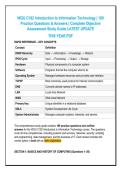
WGU C182 Introduction to Information Technology | 189
Practice Questions & Answers | Complete Objective
Assessment Study Guide LATEST UPDATE
THIS YEAR.PDF
RAPID REFERENCE – KEY CONCEPTS
Concept Definition
DIKW Hierarchy Data → Information → Knowledge → Wisdom
IPOS Cycle Input → Processing → Output → Storage
Hardware Physical components of a computer system
Software Programs that tell the computer what to do
Operating System Manages hardware resources and provides user interface
TCP/IP Most commonly used protocol for Internet communication
DNS Converts domain names to IP addresses
LAN Local Area Network
WAN Wide Area Network
Primary Key Unique identifier in a relational database
SDLC System Development Life Cycle
System Administrator Manages computer systems, networks, and servers
This comprehensive study guide contains 189 practice questions and verified
answers for the WGU C182 Introduction to Information Technology course. The questions
cover all nine competencies, including systems and services, networks, security, scripting
and programming, data management, and the business of IT. Each answer includes the
correct option in bold with an italic explanation.
SECTION 1: BASICS AND HISTORY OF COMPUTING (Questions 1–20)
,1. Which generation of computing is associated with microprocessors?
A) First generation
B) Second generation
C) Third generation
D) Fourth generation
Answer: D
Microprocessors (thousands of integrated circuits on a single silicon chip) were introduced
in the fourth generation of computing. This generation also saw the introduction of personal
computers and handheld devices.
2. Which computing generation is associated with the exclusive use of machine
languages and punch cards?
A) First generation
B) Second generation
C) Third generation
D) Fourth generation
Answer: A
First-generation computers used machine language exclusively and relied on punch cards
for input. These computers were massive, used vacuum tubes, and were programmed by
engineers who built and operated them.
3. Which computing generation is associated with the replacement of machine
languages by assembly languages?
A) First generation
B) Second generation
C) Third generation
D) Fourth generation
Answer: B
,Second-generation computers introduced assembly languages to replace machine
language. These computers used transistors instead of vacuum tubes, were smaller, and
featured magnetic core memory and disk drives.
4. Which computing generation is associated with the first use of thousands of
integrated circuits on a single silicon chip?
A) First generation
B) Second generation
C) Third generation
D) Fourth generation
Answer: D
Fourth-generation computers introduced large-scale integration (LSI)—thousands of
integrated circuits on a single silicon chip. This is the generation of microprocessors and
personal computers.
5. Which generation of computing is known for the introduction of handheld devices?
A) First generation
B) Second generation
C) Third generation
D) Fourth generation
Answer: D
Fourth-generation computing brought handheld devices such as smartphones and tablets.
This generation also saw the development of personal computers and the widespread
availability of computing power.
6. Silicon chips were first used in computers in which generation?
A) First generation
B) Second generation
C) Third generation
D) Fourth generation
, Answer: C
Third-generation computers used silicon chips (integrated circuits) for the first time. These
computers were smaller and less expensive, called "mini computers," and networks were
introduced via dumb terminals.
7. Which type of programming language corresponds one-to-one with assembly?
A) High-level language
B) Scripting language
C) Machine language
D) Interpreted language
Answer: C
Machine language corresponds one-to-one with assembly language. Machine language is
the lowest-level programming language and can be directly understood by the computer's
CPU.
8. Assembly and machine language are examples of which type of programming
language?
A) High-level languages
B) Scripting languages
C) Low-level programming languages
D) Interpreted languages
Answer: C
Assembly and machine language are both low-level programming languages. They are
written specifically for a particular machine and are closely tied to the computer's hardware
architecture.
9. JavaScript, Python, PHP, and JSP are examples of which type of programming
language?
A) High-level languages
B) Scripting languages
Practice Questions & Answers | Complete Objective
Assessment Study Guide LATEST UPDATE
THIS YEAR.PDF
RAPID REFERENCE – KEY CONCEPTS
Concept Definition
DIKW Hierarchy Data → Information → Knowledge → Wisdom
IPOS Cycle Input → Processing → Output → Storage
Hardware Physical components of a computer system
Software Programs that tell the computer what to do
Operating System Manages hardware resources and provides user interface
TCP/IP Most commonly used protocol for Internet communication
DNS Converts domain names to IP addresses
LAN Local Area Network
WAN Wide Area Network
Primary Key Unique identifier in a relational database
SDLC System Development Life Cycle
System Administrator Manages computer systems, networks, and servers
This comprehensive study guide contains 189 practice questions and verified
answers for the WGU C182 Introduction to Information Technology course. The questions
cover all nine competencies, including systems and services, networks, security, scripting
and programming, data management, and the business of IT. Each answer includes the
correct option in bold with an italic explanation.
SECTION 1: BASICS AND HISTORY OF COMPUTING (Questions 1–20)
,1. Which generation of computing is associated with microprocessors?
A) First generation
B) Second generation
C) Third generation
D) Fourth generation
Answer: D
Microprocessors (thousands of integrated circuits on a single silicon chip) were introduced
in the fourth generation of computing. This generation also saw the introduction of personal
computers and handheld devices.
2. Which computing generation is associated with the exclusive use of machine
languages and punch cards?
A) First generation
B) Second generation
C) Third generation
D) Fourth generation
Answer: A
First-generation computers used machine language exclusively and relied on punch cards
for input. These computers were massive, used vacuum tubes, and were programmed by
engineers who built and operated them.
3. Which computing generation is associated with the replacement of machine
languages by assembly languages?
A) First generation
B) Second generation
C) Third generation
D) Fourth generation
Answer: B
,Second-generation computers introduced assembly languages to replace machine
language. These computers used transistors instead of vacuum tubes, were smaller, and
featured magnetic core memory and disk drives.
4. Which computing generation is associated with the first use of thousands of
integrated circuits on a single silicon chip?
A) First generation
B) Second generation
C) Third generation
D) Fourth generation
Answer: D
Fourth-generation computers introduced large-scale integration (LSI)—thousands of
integrated circuits on a single silicon chip. This is the generation of microprocessors and
personal computers.
5. Which generation of computing is known for the introduction of handheld devices?
A) First generation
B) Second generation
C) Third generation
D) Fourth generation
Answer: D
Fourth-generation computing brought handheld devices such as smartphones and tablets.
This generation also saw the development of personal computers and the widespread
availability of computing power.
6. Silicon chips were first used in computers in which generation?
A) First generation
B) Second generation
C) Third generation
D) Fourth generation
, Answer: C
Third-generation computers used silicon chips (integrated circuits) for the first time. These
computers were smaller and less expensive, called "mini computers," and networks were
introduced via dumb terminals.
7. Which type of programming language corresponds one-to-one with assembly?
A) High-level language
B) Scripting language
C) Machine language
D) Interpreted language
Answer: C
Machine language corresponds one-to-one with assembly language. Machine language is
the lowest-level programming language and can be directly understood by the computer's
CPU.
8. Assembly and machine language are examples of which type of programming
language?
A) High-level languages
B) Scripting languages
C) Low-level programming languages
D) Interpreted languages
Answer: C
Assembly and machine language are both low-level programming languages. They are
written specifically for a particular machine and are closely tied to the computer's hardware
architecture.
9. JavaScript, Python, PHP, and JSP are examples of which type of programming
language?
A) High-level languages
B) Scripting languages