
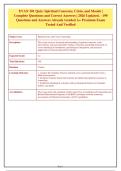
EVAN 101 Quiz: Spiritual Concerns, Crisis, and Moods |
Complete Questions and Correct Answers | 2026 Updated. - 190
Questions and Answers Already Graded A+ Premium Exam
Tested And Verified
Subject Area Spiritual Care and Crisis Counseling
Description This exam assesses advanced understanding of spiritual concerns, crisis
intervention, and mood disorders within a Christian counseling framework. It
covers theological foundations, psychological integration, and practical
application in clinical and pastoral settings.
Expected Grade A+
Total Questions 190
Duration 3 hours
Learning Outcomes 1. Analyze the interplay between spiritual crises and mood disorders from a
biblical perspective.
2. Evaluate evidence-based interventions for addressing spiritual concerns in
counseling.
3. Synthesize theological concepts with psychological theories to formulate
holistic care plans.
Accreditation This exam meets the standards of the Council for Accreditation of Counseling and
Related Educational Programs (CACREP) and aligns with the American
Association of Christian Counselors (AACC) guidelines.
Page 1
,1. A client reports feeling abandoned by God after a prolonged period of suffering,
yet continues to attend church and pray. Which theological framework best explains
this paradoxical combination of doubt and continued religious practice?
A. Lament as a form of protest that maintains relationship with God
B. Cognitive dissonance reduction via selective exposure to supportive messages
C. Spiritual bypass as a defense mechanism against existential anxiety
D. Scrupulosity as a manifestation of obsessive-compulsive religiosity
Answer: A. Lament as a form of protest that maintains relationship with God
Lament, as modeled in the Psalms, allows believers to express anguish while still
addressing God, thereby preserving the relationship. Option B describes a
psychological mechanism but does not capture the theological depth. Option C implies
avoidance, not engagement. Option D pathologizes a normative spiritual struggle.
2. In a crisis counseling session, a client states, 'I know God forgives me, but I cannot
forgive myself.' Which intervention aligns best with a narrative therapy approach
integrated with Christian theology?
A. Challenge the client to identify cognitive distortions about self-worth
B. Explore the client's story of failure and re-author it with themes of redemption
C. Assign Scripture memorization on God's forgiveness to reinforce truth
D. Use a genogram to trace family patterns of unforgiveness
Answer: B. Explore the client's story of failure and re-author it with themes of
redemption
Narrative therapy focuses on deconstructing problem-saturated stories and co-creating
alternative narratives. Re-authoring with redemption aligns with both the method and
Christian theology. Option A is cognitive-behavioral, C is prescriptive, D is
systemic-none directly address the client's internal narrative.
Page 2
,3. A pastor observes that a congregant's depressive symptoms worsen significantly
each year during Lent. Which differential diagnosis should be considered most
strongly?
A. Seasonal affective disorder with winter pattern
B. Recurrent major depressive disorder with seasonal pattern
C. Religious or spiritual problem (V-code) with exacerbation during a liturgical season
D. Adjustment disorder with depressed mood related to religious guilt
Answer: C. Religious or spiritual problem (V-code) with exacerbation during a
liturgical season
The V-code 'Religious or Spiritual Problem' (V62.89) is appropriate when a religious
observance triggers distress without meeting criteria for a full mood disorder. Lent
focuses on penance, which may intensify guilt. Options A and B require a consistent
seasonal pattern tied to light exposure, not liturgical calendar. Option D implies a
specific identifiable stressor, but Lent is a predictable event.
4. Which of the following best distinguishes 'spiritual crisis' from 'mood disorder
with religious content' in a clinical assessment?
A. Spiritual crisis involves doubt about God's existence; mood disorder involves guilt over
sin
B. Spiritual crisis is triggered by a sacred loss; mood disorder has a biological etiology
C. Spiritual crisis responds to pastoral care; mood disorder requires medication
D. Spiritual crisis is time-limited and linked to a meaning-making challenge; mood disorder
is pervasive and includes neurovegetative symptoms
Answer: D. Spiritual crisis is time-limited and linked to a meaning-making
challenge; mood disorder is pervasive and includes neurovegetative symptoms
Spiritual crises are typically acute, meaning-oriented, and resolve with support, while
mood disorders are enduring and involve biological markers (sleep, appetite, energy).
Option A oversimplifies; both can include doubt or guilt. Option B denies psychosocial
triggers in mood disorders. Option C is false-mood disorders often benefit from
psychotherapy and pastoral care as adjuncts.
Page 3
, 5. A client with a history of bipolar I disorder reports feeling 'spiritually attacked'
during a manic episode, stating that demons are communicating through the
television. Which intervention is most appropriate initially?
A. Perform a deliverance prayer session to address spiritual warfare
B. Validate the distress while gently reality-testing the television content
C. Increase antipsychotic medication and monitor for treatment adherence
D. Refer to a psychiatrist for evaluation of psychotic features and medication adjustment
Answer: D. Refer to a psychiatrist for evaluation of psychotic features and
medication adjustment
The client's symptoms suggest mood-congruent psychotic features (delusions) requiring
psychiatric evaluation. Option A could reinforce delusions. Option B may be premature
without stabilization. Option C is beyond the counselor's scope. The priority is safety
and appropriate medical referral.
6. Which of the following best integrates the concept of 'theodicy' into a counseling
intervention for a client experiencing a major depressive episode after a tragic loss?
A. Encourage the client to focus on God's sovereignty and accept the loss as part of His plan
B. Help the client construct a personal narrative that acknowledges the loss while
maintaining a sense of divine purpose
C. Challenge the client's belief that God is responsible for the loss as a cognitive distortion
D. Refer the client to a support group for bereaved individuals without addressing
theological questions
Answer: B. Help the client construct a personal narrative that acknowledges the
loss while maintaining a sense of divine purpose
Theodicy addresses the problem of evil and suffering in light of God's goodness. Option
B allows the client to wrestle with meaning-making in a way that preserves faith.
Option A may bypass the client's grief. Option C dismisses a legitimate theological
struggle. Option D avoids the spiritual dimension entirely.
Page 4
Complete Questions and Correct Answers | 2026 Updated. - 190
Questions and Answers Already Graded A+ Premium Exam
Tested And Verified
Subject Area Spiritual Care and Crisis Counseling
Description This exam assesses advanced understanding of spiritual concerns, crisis
intervention, and mood disorders within a Christian counseling framework. It
covers theological foundations, psychological integration, and practical
application in clinical and pastoral settings.
Expected Grade A+
Total Questions 190
Duration 3 hours
Learning Outcomes 1. Analyze the interplay between spiritual crises and mood disorders from a
biblical perspective.
2. Evaluate evidence-based interventions for addressing spiritual concerns in
counseling.
3. Synthesize theological concepts with psychological theories to formulate
holistic care plans.
Accreditation This exam meets the standards of the Council for Accreditation of Counseling and
Related Educational Programs (CACREP) and aligns with the American
Association of Christian Counselors (AACC) guidelines.
Page 1
,1. A client reports feeling abandoned by God after a prolonged period of suffering,
yet continues to attend church and pray. Which theological framework best explains
this paradoxical combination of doubt and continued religious practice?
A. Lament as a form of protest that maintains relationship with God
B. Cognitive dissonance reduction via selective exposure to supportive messages
C. Spiritual bypass as a defense mechanism against existential anxiety
D. Scrupulosity as a manifestation of obsessive-compulsive religiosity
Answer: A. Lament as a form of protest that maintains relationship with God
Lament, as modeled in the Psalms, allows believers to express anguish while still
addressing God, thereby preserving the relationship. Option B describes a
psychological mechanism but does not capture the theological depth. Option C implies
avoidance, not engagement. Option D pathologizes a normative spiritual struggle.
2. In a crisis counseling session, a client states, 'I know God forgives me, but I cannot
forgive myself.' Which intervention aligns best with a narrative therapy approach
integrated with Christian theology?
A. Challenge the client to identify cognitive distortions about self-worth
B. Explore the client's story of failure and re-author it with themes of redemption
C. Assign Scripture memorization on God's forgiveness to reinforce truth
D. Use a genogram to trace family patterns of unforgiveness
Answer: B. Explore the client's story of failure and re-author it with themes of
redemption
Narrative therapy focuses on deconstructing problem-saturated stories and co-creating
alternative narratives. Re-authoring with redemption aligns with both the method and
Christian theology. Option A is cognitive-behavioral, C is prescriptive, D is
systemic-none directly address the client's internal narrative.
Page 2
,3. A pastor observes that a congregant's depressive symptoms worsen significantly
each year during Lent. Which differential diagnosis should be considered most
strongly?
A. Seasonal affective disorder with winter pattern
B. Recurrent major depressive disorder with seasonal pattern
C. Religious or spiritual problem (V-code) with exacerbation during a liturgical season
D. Adjustment disorder with depressed mood related to religious guilt
Answer: C. Religious or spiritual problem (V-code) with exacerbation during a
liturgical season
The V-code 'Religious or Spiritual Problem' (V62.89) is appropriate when a religious
observance triggers distress without meeting criteria for a full mood disorder. Lent
focuses on penance, which may intensify guilt. Options A and B require a consistent
seasonal pattern tied to light exposure, not liturgical calendar. Option D implies a
specific identifiable stressor, but Lent is a predictable event.
4. Which of the following best distinguishes 'spiritual crisis' from 'mood disorder
with religious content' in a clinical assessment?
A. Spiritual crisis involves doubt about God's existence; mood disorder involves guilt over
sin
B. Spiritual crisis is triggered by a sacred loss; mood disorder has a biological etiology
C. Spiritual crisis responds to pastoral care; mood disorder requires medication
D. Spiritual crisis is time-limited and linked to a meaning-making challenge; mood disorder
is pervasive and includes neurovegetative symptoms
Answer: D. Spiritual crisis is time-limited and linked to a meaning-making
challenge; mood disorder is pervasive and includes neurovegetative symptoms
Spiritual crises are typically acute, meaning-oriented, and resolve with support, while
mood disorders are enduring and involve biological markers (sleep, appetite, energy).
Option A oversimplifies; both can include doubt or guilt. Option B denies psychosocial
triggers in mood disorders. Option C is false-mood disorders often benefit from
psychotherapy and pastoral care as adjuncts.
Page 3
, 5. A client with a history of bipolar I disorder reports feeling 'spiritually attacked'
during a manic episode, stating that demons are communicating through the
television. Which intervention is most appropriate initially?
A. Perform a deliverance prayer session to address spiritual warfare
B. Validate the distress while gently reality-testing the television content
C. Increase antipsychotic medication and monitor for treatment adherence
D. Refer to a psychiatrist for evaluation of psychotic features and medication adjustment
Answer: D. Refer to a psychiatrist for evaluation of psychotic features and
medication adjustment
The client's symptoms suggest mood-congruent psychotic features (delusions) requiring
psychiatric evaluation. Option A could reinforce delusions. Option B may be premature
without stabilization. Option C is beyond the counselor's scope. The priority is safety
and appropriate medical referral.
6. Which of the following best integrates the concept of 'theodicy' into a counseling
intervention for a client experiencing a major depressive episode after a tragic loss?
A. Encourage the client to focus on God's sovereignty and accept the loss as part of His plan
B. Help the client construct a personal narrative that acknowledges the loss while
maintaining a sense of divine purpose
C. Challenge the client's belief that God is responsible for the loss as a cognitive distortion
D. Refer the client to a support group for bereaved individuals without addressing
theological questions
Answer: B. Help the client construct a personal narrative that acknowledges the
loss while maintaining a sense of divine purpose
Theodicy addresses the problem of evil and suffering in light of God's goodness. Option
B allows the client to wrestle with meaning-making in a way that preserves faith.
Option A may bypass the client's grief. Option C dismisses a legitimate theological
struggle. Option D avoids the spiritual dimension entirely.
Page 4


