

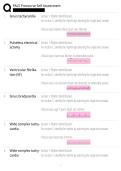
PALS Precourse Self Assessment
1. Sinus tachycardia Section 1: Rhythm Identification
For section 1, identify the rhythm byt selecting the single best answer.
Clinical clues: febrile infant; heart rate 188/min
2. Pulseless electrical Section 1: Rhythm Identification
activity For section 1, identify the rhythm byt selecting the single best answer.
Clinical clues: heart rate 44/min; no detectable pulses
3. Ventricular fibrilla- Section 1: Rhythm Identification
tion (VF) For section 1, identify the rhythm byt selecting the single best answer.
Clinical clues: no consistent heart rate detected; no detectable pulses
4. Sinus bradycardia Section 1: Rhythm Identification
For section 1, identify the rhythm by selecting the single best answer.
Clinical clues: age 7 years; heart rate 38/min
5. Wide complex tachy- Section 1: Rhythm Identification
cardia For section 1, identify the rhythm by selecting the single best answer.
Clinical clue: heart rate 214/min
6. Wide complex tachy- Section 1: Rhythm Identification
cardia For section 1, identify the rhythm by selecting the single best answer.
, PALS Precourse Self Assessment
Clinical clues: heart rate 150/min
7. Torsades de Pointes Section 1: Rhythm Identification
For section 1, identify the rhythm by selecting the single best answer.
Clinical clues: heart rate 200/min; no detectable pulses
8. Normal sinus Section 1: Rhythm Identification
rhythm For section 1, identify the rhythm by selecting the single best answer.
Clinical clues: age 8 years; heart rate 78/min
9. Supraventricular Section 1: Rhythm Identification
tachycardia (SVT) For section 1, identify the rhythm by selecting the single best answer.
Clinical clue: heart rate 300/min
10. SVT converting to Section 1: Rhythm Identification
sinus rhythm after For section 1, identify the rhythm by selecting the single best answer.
adenosine adminis-
tration Clinical clues: initial rhythm associated with heart rate 300/min
11. VF with successful Section 1: Rhythm Identification
defibrillation and re- For section 1, identify the rhythm by selecting the single best answer.
sumption of orga-
nized rhythm Clinical clues: initial rhythm associated with no detectable pulses
, PALS Precourse Self Assessment
12. Asystole Section 1: Rhythm Identification
For section 1, identify the rhythm by selecting the single best answer.
Clinical clues: no detectable pulses
13. Section 1: Rhythm Identification
For section 1, identify the rhythm by selecting the single best answer.
Clinical clues: age 3 months; heart rate 65/min
14. B. Amiodarone 5 Section 2: Pharmacology
mg/kg IO You are part of a team attempting to resuscitate a child with ventricular fibril-
lation cardiac arrest. You delivered 2 unsynchronized shocks. A team member
established I access, so you give a dose of epinephrine, 0.01 mg/kg IO. At the
next rhythm check, persistent ventricular fibrillation is present. You administer
a 4-J/kg shock and resume CPR. Which drug and dose should be administered
next?
A. Magnesium sulfate 25 to 50 mg/kg IO
B. Amiodarone 5 mg/kg IO
C. Epinephrine 0.1 mg/kg IO
D. Atropine 0.02 mg/kg IO
15. C. Rapid bolus of Section 2: Pharmacology
20 mL/kg of isotonic Paramedics are called to the home of a 1-year-old child. Their initial assess-
crystalloid ment reveals a child who responds only to painful stimuli and has irregular
breathing, faint central pulses, bruises over the abdomen, abdominal disten-
tion, and cyanosis. Bag-mask ventilation with 100% oxygen is initiated. The
child's heart rate is 36/min. Peripheral pulses cannot be palpated, and central
pulses are barely palpable. The cardiac monitor shows sinus bradycardia.
1. Sinus tachycardia Section 1: Rhythm Identification
For section 1, identify the rhythm byt selecting the single best answer.
Clinical clues: febrile infant; heart rate 188/min
2. Pulseless electrical Section 1: Rhythm Identification
activity For section 1, identify the rhythm byt selecting the single best answer.
Clinical clues: heart rate 44/min; no detectable pulses
3. Ventricular fibrilla- Section 1: Rhythm Identification
tion (VF) For section 1, identify the rhythm byt selecting the single best answer.
Clinical clues: no consistent heart rate detected; no detectable pulses
4. Sinus bradycardia Section 1: Rhythm Identification
For section 1, identify the rhythm by selecting the single best answer.
Clinical clues: age 7 years; heart rate 38/min
5. Wide complex tachy- Section 1: Rhythm Identification
cardia For section 1, identify the rhythm by selecting the single best answer.
Clinical clue: heart rate 214/min
6. Wide complex tachy- Section 1: Rhythm Identification
cardia For section 1, identify the rhythm by selecting the single best answer.
, PALS Precourse Self Assessment
Clinical clues: heart rate 150/min
7. Torsades de Pointes Section 1: Rhythm Identification
For section 1, identify the rhythm by selecting the single best answer.
Clinical clues: heart rate 200/min; no detectable pulses
8. Normal sinus Section 1: Rhythm Identification
rhythm For section 1, identify the rhythm by selecting the single best answer.
Clinical clues: age 8 years; heart rate 78/min
9. Supraventricular Section 1: Rhythm Identification
tachycardia (SVT) For section 1, identify the rhythm by selecting the single best answer.
Clinical clue: heart rate 300/min
10. SVT converting to Section 1: Rhythm Identification
sinus rhythm after For section 1, identify the rhythm by selecting the single best answer.
adenosine adminis-
tration Clinical clues: initial rhythm associated with heart rate 300/min
11. VF with successful Section 1: Rhythm Identification
defibrillation and re- For section 1, identify the rhythm by selecting the single best answer.
sumption of orga-
nized rhythm Clinical clues: initial rhythm associated with no detectable pulses
, PALS Precourse Self Assessment
12. Asystole Section 1: Rhythm Identification
For section 1, identify the rhythm by selecting the single best answer.
Clinical clues: no detectable pulses
13. Section 1: Rhythm Identification
For section 1, identify the rhythm by selecting the single best answer.
Clinical clues: age 3 months; heart rate 65/min
14. B. Amiodarone 5 Section 2: Pharmacology
mg/kg IO You are part of a team attempting to resuscitate a child with ventricular fibril-
lation cardiac arrest. You delivered 2 unsynchronized shocks. A team member
established I access, so you give a dose of epinephrine, 0.01 mg/kg IO. At the
next rhythm check, persistent ventricular fibrillation is present. You administer
a 4-J/kg shock and resume CPR. Which drug and dose should be administered
next?
A. Magnesium sulfate 25 to 50 mg/kg IO
B. Amiodarone 5 mg/kg IO
C. Epinephrine 0.1 mg/kg IO
D. Atropine 0.02 mg/kg IO
15. C. Rapid bolus of Section 2: Pharmacology
20 mL/kg of isotonic Paramedics are called to the home of a 1-year-old child. Their initial assess-
crystalloid ment reveals a child who responds only to painful stimuli and has irregular
breathing, faint central pulses, bruises over the abdomen, abdominal disten-
tion, and cyanosis. Bag-mask ventilation with 100% oxygen is initiated. The
child's heart rate is 36/min. Peripheral pulses cannot be palpated, and central
pulses are barely palpable. The cardiac monitor shows sinus bradycardia.


