

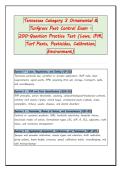
Tennessee Category 3 Ornamental &
Turfgrass Pest Control Exam –
200-Question Practice Test (Laws, IPM,
Turf Pests, Pesticides, Calibration,
Environment)
Section 1 – Laws, Regulations, and Safety (Q1–25)
Tennessee pesticide law, certified vs. private applicators, RUP rules, label
requirements, signal words, PPE, poisoning first aid, storage, transport, spills,
and recordkeeping.
Section 2 – IPM and Pest Identification (Q26–50)
IPM principles, action thresholds, scouting, cultural/biological/mechanical controls,
common turf insects (grubs, chinch bugs), ornamental pests (aphids, scales,
caterpillars, mites), weeds, diseases, and abiotic disorders.
Section 3 – Pesticides, Modes of Action, and Formulations (Q51–80)
Contact vs. systemic products, IGRs, herbicide selectivity, fungicide classes,
insecticide modes of action, formulation types (EC, WP, G, SC), adjuvants, tank
mixes, and resistance management.
Section 4 – Application Equipment, Calibration, and Techniques (Q81–Q115)
Sprayer and spreader calibration, nozzle types and selection, drift reduction,
spray volume, boom height, pressure, speed, calibration math, recordkeeping, and
safe mixing/cleanup.
,Section 5 – Environmental Fate, Non-Target Impacts, and Turf/Ornamental
Specifics (Q116–Q150)
Drift, runoff, leaching, soil and site factors, pollinator protection, aquatic
buffers, wellhead protection, phytotoxicity, thatch, timing for grubs and
diseases, container vs. field plantings, and endangered species considerations.
Section 6 – Integrated Scenarios and Calculations (Q151–Q200)
Rate calculations (per 1,000 ft² and per acre), calibration adjustments, timing
decisions, IPM case studies, drift/runoff scenarios, resistance management, REI
interpretations, and real-world ornamental/turf problem solving.
SECTION 1 – Laws, Regulations, and Safety (Q1–25)
Q1. In Tennessee, who regulates pesticide certification and enforcement?
A. Tennessee Department of Health
B. Tennessee Department of Agriculture (TDA)
C. University of Tennessee Extension only
D. EPA Region 4 only
B. Tennessee Department of Agriculture (TDA)
TDA administers the state pesticide program under state and federal law.
Q2. To legally purchase a restricted-use pesticide (RUP) in Tennessee, an
individual must be:
A. At least 16 years old
B. At least 18 years old and certified or working under a certified applicator
,C. Any age if supervised
D. A homeowner with a garden
B. At least 18 years old and certified or working under a certified applicator
RUPs require certified applicators or direct supervision, and buyers must be 18+.
Q3. A “private applicator” is someone who applies RUPs to:
A. Any property for hire
B. Land they own or rent for production of agricultural commodities
C. Public parks only
D. Golf courses only
B. Land they own or rent for production of agricultural commodities
Private applicators treat their own agricultural land; commercial applicators treat
others’ property for hire.
Q4. Which document legally defines how a pesticide may be used?
A. Sales receipt
B. Pesticide label
C. Advertisement
D. Extension fact sheet
B. Pesticide label
The label is the law; use must follow label directions.
, Q5. “Misuse” of a pesticide includes:
A. Following all label directions
B. Using a pesticide at a higher rate than the label allows
C. Wearing required PPE
D. Keeping records as required
B. Using a pesticide at a higher rate than the label allows
Any use inconsistent with the label is misuse and illegal.
Q6. Which signal word indicates the highest acute toxicity (oral/dermal)?
A. CAUTION
B. WARNING
C. DANGER
D. NOTICE
C. DANGER
“DANGER” (often with “POISON” and skull/crossbones) indicates very high
toxicity.
Q7. A pesticide with the signal word “CAUTION” generally indicates:
A. Highly toxic
B. Moderately toxic
C. Slightly toxic or relatively non-toxic
D. Non-registrable
Turfgrass Pest Control Exam –
200-Question Practice Test (Laws, IPM,
Turf Pests, Pesticides, Calibration,
Environment)
Section 1 – Laws, Regulations, and Safety (Q1–25)
Tennessee pesticide law, certified vs. private applicators, RUP rules, label
requirements, signal words, PPE, poisoning first aid, storage, transport, spills,
and recordkeeping.
Section 2 – IPM and Pest Identification (Q26–50)
IPM principles, action thresholds, scouting, cultural/biological/mechanical controls,
common turf insects (grubs, chinch bugs), ornamental pests (aphids, scales,
caterpillars, mites), weeds, diseases, and abiotic disorders.
Section 3 – Pesticides, Modes of Action, and Formulations (Q51–80)
Contact vs. systemic products, IGRs, herbicide selectivity, fungicide classes,
insecticide modes of action, formulation types (EC, WP, G, SC), adjuvants, tank
mixes, and resistance management.
Section 4 – Application Equipment, Calibration, and Techniques (Q81–Q115)
Sprayer and spreader calibration, nozzle types and selection, drift reduction,
spray volume, boom height, pressure, speed, calibration math, recordkeeping, and
safe mixing/cleanup.
,Section 5 – Environmental Fate, Non-Target Impacts, and Turf/Ornamental
Specifics (Q116–Q150)
Drift, runoff, leaching, soil and site factors, pollinator protection, aquatic
buffers, wellhead protection, phytotoxicity, thatch, timing for grubs and
diseases, container vs. field plantings, and endangered species considerations.
Section 6 – Integrated Scenarios and Calculations (Q151–Q200)
Rate calculations (per 1,000 ft² and per acre), calibration adjustments, timing
decisions, IPM case studies, drift/runoff scenarios, resistance management, REI
interpretations, and real-world ornamental/turf problem solving.
SECTION 1 – Laws, Regulations, and Safety (Q1–25)
Q1. In Tennessee, who regulates pesticide certification and enforcement?
A. Tennessee Department of Health
B. Tennessee Department of Agriculture (TDA)
C. University of Tennessee Extension only
D. EPA Region 4 only
B. Tennessee Department of Agriculture (TDA)
TDA administers the state pesticide program under state and federal law.
Q2. To legally purchase a restricted-use pesticide (RUP) in Tennessee, an
individual must be:
A. At least 16 years old
B. At least 18 years old and certified or working under a certified applicator
,C. Any age if supervised
D. A homeowner with a garden
B. At least 18 years old and certified or working under a certified applicator
RUPs require certified applicators or direct supervision, and buyers must be 18+.
Q3. A “private applicator” is someone who applies RUPs to:
A. Any property for hire
B. Land they own or rent for production of agricultural commodities
C. Public parks only
D. Golf courses only
B. Land they own or rent for production of agricultural commodities
Private applicators treat their own agricultural land; commercial applicators treat
others’ property for hire.
Q4. Which document legally defines how a pesticide may be used?
A. Sales receipt
B. Pesticide label
C. Advertisement
D. Extension fact sheet
B. Pesticide label
The label is the law; use must follow label directions.
, Q5. “Misuse” of a pesticide includes:
A. Following all label directions
B. Using a pesticide at a higher rate than the label allows
C. Wearing required PPE
D. Keeping records as required
B. Using a pesticide at a higher rate than the label allows
Any use inconsistent with the label is misuse and illegal.
Q6. Which signal word indicates the highest acute toxicity (oral/dermal)?
A. CAUTION
B. WARNING
C. DANGER
D. NOTICE
C. DANGER
“DANGER” (often with “POISON” and skull/crossbones) indicates very high
toxicity.
Q7. A pesticide with the signal word “CAUTION” generally indicates:
A. Highly toxic
B. Moderately toxic
C. Slightly toxic or relatively non-toxic
D. Non-registrable


