

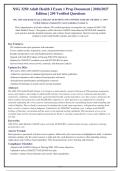
NSG 3250 Adult Health I Exam 1 Prep Document | 2026/2027
Edition | 250 Verified Questions
NSG 3250 Adult Health I Exam 1 2026-2027 QUESTIONS AND ANSWERS ALREADY GRADED A+. 100%
Verified Solutions | Updated Per Latest Guidelines | Graded A+
This comprehensive test bank contains 250 verified questions covering the core content of NSG 3250
Adult Health I Exam 1. Designed to reflect the latest GALEN curriculum and NCLEX-RN standards,
each question includes detailed rationales and evidence-based explanations. Ideal for nursing students
seeking to master adult health concepts and achieve a top score.
Key Features:
250 verified exam-style questions with rationales
Covers cardiovascular, respiratory, renal, and gastrointestinal systems
Includes perioperative care and fluid/electrolyte imbalances
Aligned with GALEN College of Nursing NSG 3250 objectives
Updated for 2026/2027 academic year and NCLEX-RN test plan
Answer format with correct answer, rationale, and distractor analysis
Updates for 2026:
- Revised to reflect 2026 GALEN curriculum changes
- Added new questions on updated hypertension and heart failure guidelines
- Enhanced rationales with evidence-based practice references
- Included more prioritization and delegation scenarios
- Updated terminology to match current nursing standards
Abstract:
The NSG 3250 Adult Health I Exam 1 test bank is a meticulously curated collection of 250 questions designed to
assess and reinforce knowledge in adult health nursing. Covering key areas such as cardiovascular disorders,
respiratory conditions, renal function, gastrointestinal health, and perioperative care, this resource integrates the
latest evidence-based practices and NCLEX-RN competencies. Each question is accompanied by a detailed
rationale explaining the correct answer and analyzing common distractors, facilitating deeper understanding and
critical thinking. The test bank is structured to simulate the actual exam experience, with questions ranging from
basic recall to complex clinical judgment. Updated for the 2026/2027 academic year, it aligns with GALEN
College of Nursing's curriculum and the most recent national nursing standards. This document serves as an
essential study tool for nursing students preparing for Exam 1, ensuring comprehensive review and confidence on
test day.
Keywords:
NSG 3250, Adult Health I, GALEN exam, test bank, NCLEX-RN, cardiovascular nursing, respiratory nursing,
perioperative care
Answer Format:
Each question is presented with four answer options, followed by the correct answer highlighted in bold. A detailed
rationale explains why the correct answer is right and why each distractor is incorrect, often including nursing
implications and evidence-based guidelines. This format promotes active learning and retention.
Compliance Checklist:
Aligned with GALEN College of Nursing NSG 3250 course objectives
Updated to reflect 2026/2027 NCLEX-RN test plan
Includes evidence-based rationales and current clinical guidelines
Page 1
, Covers all major content areas weighted per exam blueprint
Questions reviewed by subject matter experts for accuracy
Suitable for self-assessment and group study
Content Area Overview:
Content Area Questions Key Topics Weight
Cardiovascular Disorders 1-60 Hypertension, heart failure, coronary artery 24%
disease, dysrhythmias, cardiac medications
Respiratory Disorders 61-110 COPD, asthma, pneumonia, pulmonary 20%
embolism, chest tubes, oxygen therapy
Renal and Urinary Disorders 111-150 Acute kidney injury, chronic kidney disease, 16%
urinary tract infections, dialysis,
fluid/electrolyte imbalances
Gastrointestinal Disorders 151-190 Peptic ulcer disease, bowel obstruction, 16%
pancreatitis, liver disease, nutrition
Perioperative Care 191-220 Preoperative assessment, intraoperative 12%
nursing, postoperative complications, wound
care
Fluid, Electrolyte, and 221-250 Sodium/potassium imbalances, acid-base 12%
Acid-Base Balance disorders, IV therapy, blood transfusions
Page 2
,Q1. A patient receiving intravenous heparin for acute pulmonary embolism develops a sudden drop
in blood pressure and hematochezia. Which laboratory value is most critical to assess immediately?
A. Activated partial thromboplastin time (aPTT)
B. International normalized ratio (INR)
C. Platelet count
D. D-dimer
Correct Answer: A. Activated partial thromboplastin time (aPTT)
Rationale: Heparin therapy is monitored by aPTT. A prolonged aPTT indicates excessive
anticoagulation, which can cause bleeding. While platelet count and INR are relevant, aPTT is the direct
measure of heparin effect. D-dimer is elevated in thrombosis but not for monitoring heparin.
Why Wrong:
B - INR is used to monitor warfarin, not heparin.
C - Platelet count is important for heparin-induced thrombocytopenia but not the first value to assess
in acute bleeding on heparin.
D - D-dimer is used to diagnose thromboembolic events, not to monitor anticoagulation therapy.
Reference: Lehne, R.A. (2026). Pharmacology for Nursing Care, 12th Ed., Ch. 34
Q2. In a patient with hyperkalemia (6.8 mEq/L) and ECG showing widened QRS complexes, which
sequence of interventions is most appropriate?
A. Administer calcium gluconate, then insulin with dextrose, then sodium polystyrene sulfonate
B. Administer insulin with dextrose, then sodium bicarbonate, then calcium gluconate
C. Administer sodium polystyrene sulfonate, then furosemide, then calcium gluconate
D. Administer albuterol nebulized, then insulin with dextrose, then sodium polystyrene sulfonate
Correct Answer: A. Administer calcium gluconate, then insulin with dextrose, then sodium
polystyrene sulfonate
Rationale: Calcium gluconate is given first to stabilize cardiac membranes. Then insulin with dextrose
shifts potassium into cells. Sodium polystyrene sulfonate removes potassium from the body. The other
options either delay membrane stabilization or use less effective agents first.
Why Wrong:
B - Sodium bicarbonate is not first-line for acute hyperkalemia with ECG changes; calcium must be
given first.
C - Sodium polystyrene sulfonate works slowly and is not for acute cardiac stabilization.
D - Albuterol is an adjunct but not the priority; calcium must be first.
Reference: Lewis, S. et al. (2026). Medical-Surgical Nursing, 12th Ed., Ch. 16
Page 3
, Q3. A patient with acute heart failure has pulmonary crackles, an S3 heart sound, and jugular
venous distention. Which hemodynamic profile best describes this patient?
A. Warm and dry
B. Warm and wet
C. Cold and dry
D. Cold and wet
Correct Answer: D. Cold and wet
Rationale: The patient has signs of congestion (wet: crackles, JVD) and low cardiac output (cold: S3,
possibly hypotension). The 'cold and wet' profile indicates both congestion and hypoperfusion, requiring
inotropes and diuretics. 'Warm and wet' would have congestion but adequate perfusion.
Why Wrong:
A - Warm and dry indicates no congestion and adequate perfusion.
B - Warm and wet would have congestion but warm extremities and adequate perfusion.
C - Cold and dry indicates hypoperfusion without congestion.
Reference: Yancy, C.W. et al. (2026). ACC/AHA Heart Failure Guidelines, Circulation
Q4. A patient with type 2 diabetes mellitus is started on metformin. Which finding would necessitate
immediate discontinuation of the drug?
A. Serum creatinine 1.1 mg/dL
B. eGFR 38 mL/min/1.73 m²
C. Hemoglobin A1c 7.2%
D. Fasting blood glucose 130 mg/dL
Correct Answer: B. eGFR 38 mL/min/1.73 m²
Rationale: Metformin is contraindicated when eGFR is less than 30-45 mL/min due to risk of lactic
acidosis. eGFR 38 is below the threshold for continued use (usually <45). Creatinine 1.1 may be
acceptable depending on age, but eGFR is more precise. A1c and glucose levels are not
contraindications.
Why Wrong:
A - Serum creatinine 1.1 mg/dL is within normal range for many adults.
C - A1c 7.2% indicates good glycemic control, not a contraindication.
D - Fasting glucose 130 mg/dL is above target but not a reason to stop metformin.
Reference: American Diabetes Association (2026). Standards of Medical Care in Diabetes, Diabetes
Care
Page 4
Edition | 250 Verified Questions
NSG 3250 Adult Health I Exam 1 2026-2027 QUESTIONS AND ANSWERS ALREADY GRADED A+. 100%
Verified Solutions | Updated Per Latest Guidelines | Graded A+
This comprehensive test bank contains 250 verified questions covering the core content of NSG 3250
Adult Health I Exam 1. Designed to reflect the latest GALEN curriculum and NCLEX-RN standards,
each question includes detailed rationales and evidence-based explanations. Ideal for nursing students
seeking to master adult health concepts and achieve a top score.
Key Features:
250 verified exam-style questions with rationales
Covers cardiovascular, respiratory, renal, and gastrointestinal systems
Includes perioperative care and fluid/electrolyte imbalances
Aligned with GALEN College of Nursing NSG 3250 objectives
Updated for 2026/2027 academic year and NCLEX-RN test plan
Answer format with correct answer, rationale, and distractor analysis
Updates for 2026:
- Revised to reflect 2026 GALEN curriculum changes
- Added new questions on updated hypertension and heart failure guidelines
- Enhanced rationales with evidence-based practice references
- Included more prioritization and delegation scenarios
- Updated terminology to match current nursing standards
Abstract:
The NSG 3250 Adult Health I Exam 1 test bank is a meticulously curated collection of 250 questions designed to
assess and reinforce knowledge in adult health nursing. Covering key areas such as cardiovascular disorders,
respiratory conditions, renal function, gastrointestinal health, and perioperative care, this resource integrates the
latest evidence-based practices and NCLEX-RN competencies. Each question is accompanied by a detailed
rationale explaining the correct answer and analyzing common distractors, facilitating deeper understanding and
critical thinking. The test bank is structured to simulate the actual exam experience, with questions ranging from
basic recall to complex clinical judgment. Updated for the 2026/2027 academic year, it aligns with GALEN
College of Nursing's curriculum and the most recent national nursing standards. This document serves as an
essential study tool for nursing students preparing for Exam 1, ensuring comprehensive review and confidence on
test day.
Keywords:
NSG 3250, Adult Health I, GALEN exam, test bank, NCLEX-RN, cardiovascular nursing, respiratory nursing,
perioperative care
Answer Format:
Each question is presented with four answer options, followed by the correct answer highlighted in bold. A detailed
rationale explains why the correct answer is right and why each distractor is incorrect, often including nursing
implications and evidence-based guidelines. This format promotes active learning and retention.
Compliance Checklist:
Aligned with GALEN College of Nursing NSG 3250 course objectives
Updated to reflect 2026/2027 NCLEX-RN test plan
Includes evidence-based rationales and current clinical guidelines
Page 1
, Covers all major content areas weighted per exam blueprint
Questions reviewed by subject matter experts for accuracy
Suitable for self-assessment and group study
Content Area Overview:
Content Area Questions Key Topics Weight
Cardiovascular Disorders 1-60 Hypertension, heart failure, coronary artery 24%
disease, dysrhythmias, cardiac medications
Respiratory Disorders 61-110 COPD, asthma, pneumonia, pulmonary 20%
embolism, chest tubes, oxygen therapy
Renal and Urinary Disorders 111-150 Acute kidney injury, chronic kidney disease, 16%
urinary tract infections, dialysis,
fluid/electrolyte imbalances
Gastrointestinal Disorders 151-190 Peptic ulcer disease, bowel obstruction, 16%
pancreatitis, liver disease, nutrition
Perioperative Care 191-220 Preoperative assessment, intraoperative 12%
nursing, postoperative complications, wound
care
Fluid, Electrolyte, and 221-250 Sodium/potassium imbalances, acid-base 12%
Acid-Base Balance disorders, IV therapy, blood transfusions
Page 2
,Q1. A patient receiving intravenous heparin for acute pulmonary embolism develops a sudden drop
in blood pressure and hematochezia. Which laboratory value is most critical to assess immediately?
A. Activated partial thromboplastin time (aPTT)
B. International normalized ratio (INR)
C. Platelet count
D. D-dimer
Correct Answer: A. Activated partial thromboplastin time (aPTT)
Rationale: Heparin therapy is monitored by aPTT. A prolonged aPTT indicates excessive
anticoagulation, which can cause bleeding. While platelet count and INR are relevant, aPTT is the direct
measure of heparin effect. D-dimer is elevated in thrombosis but not for monitoring heparin.
Why Wrong:
B - INR is used to monitor warfarin, not heparin.
C - Platelet count is important for heparin-induced thrombocytopenia but not the first value to assess
in acute bleeding on heparin.
D - D-dimer is used to diagnose thromboembolic events, not to monitor anticoagulation therapy.
Reference: Lehne, R.A. (2026). Pharmacology for Nursing Care, 12th Ed., Ch. 34
Q2. In a patient with hyperkalemia (6.8 mEq/L) and ECG showing widened QRS complexes, which
sequence of interventions is most appropriate?
A. Administer calcium gluconate, then insulin with dextrose, then sodium polystyrene sulfonate
B. Administer insulin with dextrose, then sodium bicarbonate, then calcium gluconate
C. Administer sodium polystyrene sulfonate, then furosemide, then calcium gluconate
D. Administer albuterol nebulized, then insulin with dextrose, then sodium polystyrene sulfonate
Correct Answer: A. Administer calcium gluconate, then insulin with dextrose, then sodium
polystyrene sulfonate
Rationale: Calcium gluconate is given first to stabilize cardiac membranes. Then insulin with dextrose
shifts potassium into cells. Sodium polystyrene sulfonate removes potassium from the body. The other
options either delay membrane stabilization or use less effective agents first.
Why Wrong:
B - Sodium bicarbonate is not first-line for acute hyperkalemia with ECG changes; calcium must be
given first.
C - Sodium polystyrene sulfonate works slowly and is not for acute cardiac stabilization.
D - Albuterol is an adjunct but not the priority; calcium must be first.
Reference: Lewis, S. et al. (2026). Medical-Surgical Nursing, 12th Ed., Ch. 16
Page 3
, Q3. A patient with acute heart failure has pulmonary crackles, an S3 heart sound, and jugular
venous distention. Which hemodynamic profile best describes this patient?
A. Warm and dry
B. Warm and wet
C. Cold and dry
D. Cold and wet
Correct Answer: D. Cold and wet
Rationale: The patient has signs of congestion (wet: crackles, JVD) and low cardiac output (cold: S3,
possibly hypotension). The 'cold and wet' profile indicates both congestion and hypoperfusion, requiring
inotropes and diuretics. 'Warm and wet' would have congestion but adequate perfusion.
Why Wrong:
A - Warm and dry indicates no congestion and adequate perfusion.
B - Warm and wet would have congestion but warm extremities and adequate perfusion.
C - Cold and dry indicates hypoperfusion without congestion.
Reference: Yancy, C.W. et al. (2026). ACC/AHA Heart Failure Guidelines, Circulation
Q4. A patient with type 2 diabetes mellitus is started on metformin. Which finding would necessitate
immediate discontinuation of the drug?
A. Serum creatinine 1.1 mg/dL
B. eGFR 38 mL/min/1.73 m²
C. Hemoglobin A1c 7.2%
D. Fasting blood glucose 130 mg/dL
Correct Answer: B. eGFR 38 mL/min/1.73 m²
Rationale: Metformin is contraindicated when eGFR is less than 30-45 mL/min due to risk of lactic
acidosis. eGFR 38 is below the threshold for continued use (usually <45). Creatinine 1.1 may be
acceptable depending on age, but eGFR is more precise. A1c and glucose levels are not
contraindications.
Why Wrong:
A - Serum creatinine 1.1 mg/dL is within normal range for many adults.
C - A1c 7.2% indicates good glycemic control, not a contraindication.
D - Fasting glucose 130 mg/dL is above target but not a reason to stop metformin.
Reference: American Diabetes Association (2026). Standards of Medical Care in Diabetes, Diabetes
Care
Page 4


