
CPNP-PC Test Questions with all Correct & 100% Verified Answers |Actual
Complete Exam |Already Graded A+
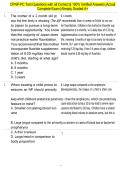
1. The mother of a 2 month old pt B. 6 months
says that their family is relocating (The AAP recommends that in areas w/little to no wa-
to Japan to pursue a long-term ter fluoridation, children s/be started on fluoride sup-
business opportunity. You know plementation @ 6 months, w/a daily dose of 0.25 mg.
that the majority of Japan does Supplementation is not required for the 1st 6 months of
not practice water fluoridation. life, meaning 3 months of age is too early to introduce
You recommend that the mother fluoride. By 1 year of age, the patient should already be
incorporate fluoride supplemen- receiving 0.25 mg/day. From 3-6 years of age, children
tation of 0.25 mg/day into her should receive 0.50 mg/day of fluoride.)
child's diet, starting at what age?
A. 3 months
B. 6 months
C. 1 year
D. 3 years
2. When treating a child prone to B. Large tongue compared to the oropharynx
seizures an NP should primarily (Developmentally, the tongue of a child is often com-
keep which childhood anatomical paratively > than the oropharynx, which can protectively
feature in mind? cause obstruction during a SZ & may lead to severe reper-
A. Smaller circulating blood vol- cussions attributed to O2 loss. Children have a smaller
ume circulating blood volume in absolute terms, but this is
B. Large tongue compared to the primarily a concern in cases of blood loss or bacterial
oropharynx
C. A thin cranium 3.
D. Large head in comparison to
body proportion
, CPNP-PC Test Questions with all Correct & 100% Verified Answers |Actual
Complete Exam |Already Graded A+
infection no SZ. Children have thinner craniums,
which would place them @ > risk of head injury if
the skill is pen-etrated' this may present a
concern during convulsions, but is < of a concern
that the risk of obstruction. Lastly,
a child's large head, in comparison to the child's
body, accounts for a smaller body surface area
when compared w/an adult, but this doesn't
greatly influence potential complications from
SZ)
, CPNP-PC Test Questions with all Correct & 100% Verified Answers |Actual
Complete Exam |Already Graded A+
A newborn is born weighing 9lb. C. Nine lb
After 2 weeks, what would be (The normal weight game progression of an infant indi-
the expected weight of the new- cates that, @ 1-2 weeks mark, the weight will be approx
born? the same as birth. The infant will typically lose 10% of the
A. Eight lb BW in the days after birth, weighing a little over 8 lb, &
B. Eight lb 5 oz then gain that weight back w/in 7-14 days. By 5 months,
C. Nine lb will double, & by 1 year triple, by 2 years quadruple.)
D. Nine lb 10 oz
4. The Denver II assessment test D. Intelligence
commonly measures a child for (Although the Denver II assessment test measures several
all of the following except: aspects of child development, it is NOT an intelligence
A. Personal-social development test. It measures language, personal-social dev, fine mo-
B. Language tor, & gross motor dev.)
C. Fine motor development
D. Intelligence
5. Kasey, age 7 months, is bought A. Supports weight on feet
to the clinic by her concerned (A child exhibiting the milestones of a 6-9 month old, as
parents. They have been talking evidenced by crawling, babbling, picking up objects, &
to other parents in their parent- responding to her name, is likely to be able to support
ing group & need reassurance her weight on her feet. The ability to hold her head
that Kasey is keeping up develop- steady by 2-5 months; play independently & exhibit equal
mentally. As you observe Kasey, her name, consistently babbles,
you notice that she responds to
, CPNP-PC Test Questions with all Correct & 100% Verified Answers |Actual
Complete Exam |Already Graded A+
coordination in her hands by 10-12 months.)
Complete Exam |Already Graded A+
1. The mother of a 2 month old pt B. 6 months
says that their family is relocating (The AAP recommends that in areas w/little to no wa-
to Japan to pursue a long-term ter fluoridation, children s/be started on fluoride sup-
business opportunity. You know plementation @ 6 months, w/a daily dose of 0.25 mg.
that the majority of Japan does Supplementation is not required for the 1st 6 months of
not practice water fluoridation. life, meaning 3 months of age is too early to introduce
You recommend that the mother fluoride. By 1 year of age, the patient should already be
incorporate fluoride supplemen- receiving 0.25 mg/day. From 3-6 years of age, children
tation of 0.25 mg/day into her should receive 0.50 mg/day of fluoride.)
child's diet, starting at what age?
A. 3 months
B. 6 months
C. 1 year
D. 3 years
2. When treating a child prone to B. Large tongue compared to the oropharynx
seizures an NP should primarily (Developmentally, the tongue of a child is often com-
keep which childhood anatomical paratively > than the oropharynx, which can protectively
feature in mind? cause obstruction during a SZ & may lead to severe reper-
A. Smaller circulating blood vol- cussions attributed to O2 loss. Children have a smaller
ume circulating blood volume in absolute terms, but this is
B. Large tongue compared to the primarily a concern in cases of blood loss or bacterial
oropharynx
C. A thin cranium 3.
D. Large head in comparison to
body proportion
, CPNP-PC Test Questions with all Correct & 100% Verified Answers |Actual
Complete Exam |Already Graded A+
infection no SZ. Children have thinner craniums,
which would place them @ > risk of head injury if
the skill is pen-etrated' this may present a
concern during convulsions, but is < of a concern
that the risk of obstruction. Lastly,
a child's large head, in comparison to the child's
body, accounts for a smaller body surface area
when compared w/an adult, but this doesn't
greatly influence potential complications from
SZ)
, CPNP-PC Test Questions with all Correct & 100% Verified Answers |Actual
Complete Exam |Already Graded A+
A newborn is born weighing 9lb. C. Nine lb
After 2 weeks, what would be (The normal weight game progression of an infant indi-
the expected weight of the new- cates that, @ 1-2 weeks mark, the weight will be approx
born? the same as birth. The infant will typically lose 10% of the
A. Eight lb BW in the days after birth, weighing a little over 8 lb, &
B. Eight lb 5 oz then gain that weight back w/in 7-14 days. By 5 months,
C. Nine lb will double, & by 1 year triple, by 2 years quadruple.)
D. Nine lb 10 oz
4. The Denver II assessment test D. Intelligence
commonly measures a child for (Although the Denver II assessment test measures several
all of the following except: aspects of child development, it is NOT an intelligence
A. Personal-social development test. It measures language, personal-social dev, fine mo-
B. Language tor, & gross motor dev.)
C. Fine motor development
D. Intelligence
5. Kasey, age 7 months, is bought A. Supports weight on feet
to the clinic by her concerned (A child exhibiting the milestones of a 6-9 month old, as
parents. They have been talking evidenced by crawling, babbling, picking up objects, &
to other parents in their parent- responding to her name, is likely to be able to support
ing group & need reassurance her weight on her feet. The ability to hold her head
that Kasey is keeping up develop- steady by 2-5 months; play independently & exhibit equal
mentally. As you observe Kasey, her name, consistently babbles,
you notice that she responds to
, CPNP-PC Test Questions with all Correct & 100% Verified Answers |Actual
Complete Exam |Already Graded A+
coordination in her hands by 10-12 months.)


