
THE ELITE UNIVERSAL TEST BANK:
England COUNCIL HOUSING ESTATE
SERVICES MANAGER
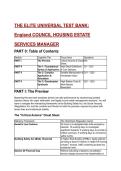
PART 0: Table of Contents
Section Cognitive Tier Focus Area Questions
PART I The Preview Critical Axioms & Cheat N/A
Sheet
PART II Tier 1: Foundational Hard Deck Definitions Q1 – Q10
Syntax & Application & Core Statutes
PART II Tier 2: Complex Variable Manipulation & Q11 – Q20
Application & Immediate Action
Simulation
PART II Tier 3: Grandmaster High-Stakes Crisis & Q21 – Q30
Synthesis Multi-Statute
Resolution
PART I: The Preview
Mastering this test bank translates directly into elite performance by transforming isolated
statutory theory into rapid, defensible, and legally sound estate management decisions. You will
learn to navigate the intersecting frameworks of the Building Safety Act, the Social Housing
(Regulation) Act, and the Landlord and Tenant Act with the precision required to protect both
tenant lives and institutional viability.
The "Critical Axioms" Cheat Sheet
Statutory Framework The Hard-Deck Regulatory Axiom
Awaab's Law Cadence 24 hours to investigate/make safe emergency
hazards; 10 working days to investigate
significant hazards; 3 working days to provide a
written summary; 5 working days to commence
safety works.
Building Safety Act (BSA) Threshold A Higher-Risk Building (HRB) is rigidly defined
as being at least 18 metres in height OR having
at least 7 storeys, AND containing at least two
residential units.
Section 20 Financial Cap Without executing a statutory consultation,
service charge recovery from leaseholders is
,Statutory Framework The Hard-Deck Regulatory Axiom
strictly capped at £250 per unit for major works,
and £100 per year for Qualifying Long-Term
Agreements (QLTAs).
Right to Buy (RTB) Perimeter Current protections mandate a 10-year
minimum eligibility period, a 30-year cost floor
to secure council capital investment, and an
absolute 35-year exemption for new builds.
Ombudsman Handling Code Complaints mandate logging within 5 working
days, a full Stage 1 response within 10 working
days, and a Stage 2 response within 20
working days. Informal "Stage 0" steps are
strictly prohibited.
Proactive Consumer Regulation The Social Housing (Regulation) Act 2023
removes the legacy "serious detriment" test,
granting the Regulator of Social Housing (RSH)
power to act proactively and levy unlimited fines
for consumer standard failures.
PART II: THE ELITE TEST BANK
Tier 1: Foundational Syntax & Application
Q1: A tenant in a council-owned property files a formal complaint regarding black mould
appearing in a poorly ventilated bathroom. Under the mandated timeframes of Awaab's Law,
what is the MAXIMUM time allowed for the council to investigate this potential significant
hazard? A) 14 calendar days from the date the hazard was first noticed by the tenant. B) 24
hours, regardless of the severity, to conduct a full structural survey. C) 10 working days from the
moment the council is made aware of the hazard. D) 5 working days to both investigate and
complete the remedial safety works.
● The Answer: C (10 working days from the moment the council is made aware of the
hazard.)
● Distractor Analysis:
○ A is incorrect: The timeframe of 14 calendar days is a common novice
misconception derived from outdated draft proposals; the enacted legislation strictly
enforces the use of working days.
○ B is incorrect: The 24-hour mandate applies exclusively to emergency hazards that
pose an immediate, severe risk to life or safety, not as the baseline for investigating
standard significant hazards like early-stage mould.
○ D is incorrect: The 5-working-day deadline dictates when safety works must
commence after the investigation has formally concluded, it does not represent the
timeframe for the initial investigation itself.
The Mentor's Analysis: Awaab's Law establishes a strict, statutory clock the moment a
landlord is made aware of a hazard through any channel. When facing reports of damp and
mould, the immediate priority is triage and rapid investigation. By utilizing the 10-working-day
investigation mandate, you bypass the common trap of treating all damp complaints as
non-urgent repairs subject to standard 28-day maintenance cycles. Professional/Academic
Intuition: The statutory clock starts at awareness, not confirmation; investigate
, significant hazards within 10 working days, and initiate repairs within 5.
\n\n
Q2: Following the implementation of the Social Housing (Regulation) Act 2023, the Regulator of
Social Housing (RSH) assesses a provider exhibiting systemic failures in damp management
and tenant communication. Based on the principles of the new regulatory framework, which
action or conclusion is the MOST ACCURATE? A) The RSH must wait until evidence shows
that tenants have suffered a "serious detriment" before intervening. B) The RSH can proactively
intervene and impose unlimited fines without waiting for tenant harm to occur. C) The RSH is
limited to capping the provider's rent increases until the systemic consumer failures are
resolved. D) The RSH must refer the provider to the Housing Ombudsman before initiating any
direct regulatory enforcement.
● The Answer: B (The RSH can proactively intervene and impose unlimited fines without
waiting for tenant harm to occur.)
● Distractor Analysis:
○ A is incorrect: The 2023 Act explicitly abolished the legacy "serious detriment" test,
which historically prevented the regulator from acting proactively to protect tenants.
○ C is incorrect: While economic sanctions exist, the Act specifically grants the RSH
the power to levy unlimited fines and enforce performance improvement plans,
establishing consumer standards on par with economic standards.
○ D is incorrect: The Housing Ombudsman handles individual maladministration
complaints, whereas the RSH regulates systemic compliance. The RSH does not
require the Ombudsman's permission or a referral to execute its regulatory powers.
The Mentor's Analysis: The 2023 Act represents a paradigm shift from reactive to proactive
consumer regulation in social housing. When facing systemic non-compliance, the immediate
priority is recognizing the RSH's vastly expanded authority. By utilizing proactive compliance
frameworks, you bypass the common trap of relying on outdated reactive triggers that expose
the council to catastrophic regulatory failure. Professional/Academic Intuition: Consumer
standards now carry the exact same proactive regulatory weight and punitive threat as
economic standards.
\n\n
Q3: An Estate Services Manager is auditing a diverse portfolio of residential blocks. According
to the rigid criteria set by the Building Safety Act 2022, which of the following structures
STRICTLY meets the definition of a Higher-Risk Building (HRB) requiring registration with the
Building Safety Regulator? A) A 15-metre building with 8 storeys containing a single commercial
unit and one residential flat. B) A 19-metre building with 5 storeys containing exclusively military
barracks. C) A 17-metre building with 7 storeys containing 12 residential flats. D) A 20-metre
building with 6 storeys operating entirely as a secure residential institution.
● The Answer: C (A 17-metre building with 7 storeys containing 12 residential flats.)
● Distractor Analysis:
○ A is incorrect: An HRB must contain at least two residential units; a single flat fails
this critical statutory requirement regardless of the storey count.
○ B is incorrect: Military barracks and accommodations provided by the Ministry of
Defence are explicitly excluded from the HRB definition under the Act.
○ D is incorrect: Secure residential institutions (such as prisons or secure hospitals)
are explicitly excluded from the HRB scope, regardless of their height or storey
count.
The Mentor's Analysis: The definition of an HRB is mathematically rigid and dictates intense
statutory duties for the Accountable Person. When classifying a portfolio, the immediate priority
England COUNCIL HOUSING ESTATE
SERVICES MANAGER
PART 0: Table of Contents
Section Cognitive Tier Focus Area Questions
PART I The Preview Critical Axioms & Cheat N/A
Sheet
PART II Tier 1: Foundational Hard Deck Definitions Q1 – Q10
Syntax & Application & Core Statutes
PART II Tier 2: Complex Variable Manipulation & Q11 – Q20
Application & Immediate Action
Simulation
PART II Tier 3: Grandmaster High-Stakes Crisis & Q21 – Q30
Synthesis Multi-Statute
Resolution
PART I: The Preview
Mastering this test bank translates directly into elite performance by transforming isolated
statutory theory into rapid, defensible, and legally sound estate management decisions. You will
learn to navigate the intersecting frameworks of the Building Safety Act, the Social Housing
(Regulation) Act, and the Landlord and Tenant Act with the precision required to protect both
tenant lives and institutional viability.
The "Critical Axioms" Cheat Sheet
Statutory Framework The Hard-Deck Regulatory Axiom
Awaab's Law Cadence 24 hours to investigate/make safe emergency
hazards; 10 working days to investigate
significant hazards; 3 working days to provide a
written summary; 5 working days to commence
safety works.
Building Safety Act (BSA) Threshold A Higher-Risk Building (HRB) is rigidly defined
as being at least 18 metres in height OR having
at least 7 storeys, AND containing at least two
residential units.
Section 20 Financial Cap Without executing a statutory consultation,
service charge recovery from leaseholders is
,Statutory Framework The Hard-Deck Regulatory Axiom
strictly capped at £250 per unit for major works,
and £100 per year for Qualifying Long-Term
Agreements (QLTAs).
Right to Buy (RTB) Perimeter Current protections mandate a 10-year
minimum eligibility period, a 30-year cost floor
to secure council capital investment, and an
absolute 35-year exemption for new builds.
Ombudsman Handling Code Complaints mandate logging within 5 working
days, a full Stage 1 response within 10 working
days, and a Stage 2 response within 20
working days. Informal "Stage 0" steps are
strictly prohibited.
Proactive Consumer Regulation The Social Housing (Regulation) Act 2023
removes the legacy "serious detriment" test,
granting the Regulator of Social Housing (RSH)
power to act proactively and levy unlimited fines
for consumer standard failures.
PART II: THE ELITE TEST BANK
Tier 1: Foundational Syntax & Application
Q1: A tenant in a council-owned property files a formal complaint regarding black mould
appearing in a poorly ventilated bathroom. Under the mandated timeframes of Awaab's Law,
what is the MAXIMUM time allowed for the council to investigate this potential significant
hazard? A) 14 calendar days from the date the hazard was first noticed by the tenant. B) 24
hours, regardless of the severity, to conduct a full structural survey. C) 10 working days from the
moment the council is made aware of the hazard. D) 5 working days to both investigate and
complete the remedial safety works.
● The Answer: C (10 working days from the moment the council is made aware of the
hazard.)
● Distractor Analysis:
○ A is incorrect: The timeframe of 14 calendar days is a common novice
misconception derived from outdated draft proposals; the enacted legislation strictly
enforces the use of working days.
○ B is incorrect: The 24-hour mandate applies exclusively to emergency hazards that
pose an immediate, severe risk to life or safety, not as the baseline for investigating
standard significant hazards like early-stage mould.
○ D is incorrect: The 5-working-day deadline dictates when safety works must
commence after the investigation has formally concluded, it does not represent the
timeframe for the initial investigation itself.
The Mentor's Analysis: Awaab's Law establishes a strict, statutory clock the moment a
landlord is made aware of a hazard through any channel. When facing reports of damp and
mould, the immediate priority is triage and rapid investigation. By utilizing the 10-working-day
investigation mandate, you bypass the common trap of treating all damp complaints as
non-urgent repairs subject to standard 28-day maintenance cycles. Professional/Academic
Intuition: The statutory clock starts at awareness, not confirmation; investigate
, significant hazards within 10 working days, and initiate repairs within 5.
\n\n
Q2: Following the implementation of the Social Housing (Regulation) Act 2023, the Regulator of
Social Housing (RSH) assesses a provider exhibiting systemic failures in damp management
and tenant communication. Based on the principles of the new regulatory framework, which
action or conclusion is the MOST ACCURATE? A) The RSH must wait until evidence shows
that tenants have suffered a "serious detriment" before intervening. B) The RSH can proactively
intervene and impose unlimited fines without waiting for tenant harm to occur. C) The RSH is
limited to capping the provider's rent increases until the systemic consumer failures are
resolved. D) The RSH must refer the provider to the Housing Ombudsman before initiating any
direct regulatory enforcement.
● The Answer: B (The RSH can proactively intervene and impose unlimited fines without
waiting for tenant harm to occur.)
● Distractor Analysis:
○ A is incorrect: The 2023 Act explicitly abolished the legacy "serious detriment" test,
which historically prevented the regulator from acting proactively to protect tenants.
○ C is incorrect: While economic sanctions exist, the Act specifically grants the RSH
the power to levy unlimited fines and enforce performance improvement plans,
establishing consumer standards on par with economic standards.
○ D is incorrect: The Housing Ombudsman handles individual maladministration
complaints, whereas the RSH regulates systemic compliance. The RSH does not
require the Ombudsman's permission or a referral to execute its regulatory powers.
The Mentor's Analysis: The 2023 Act represents a paradigm shift from reactive to proactive
consumer regulation in social housing. When facing systemic non-compliance, the immediate
priority is recognizing the RSH's vastly expanded authority. By utilizing proactive compliance
frameworks, you bypass the common trap of relying on outdated reactive triggers that expose
the council to catastrophic regulatory failure. Professional/Academic Intuition: Consumer
standards now carry the exact same proactive regulatory weight and punitive threat as
economic standards.
\n\n
Q3: An Estate Services Manager is auditing a diverse portfolio of residential blocks. According
to the rigid criteria set by the Building Safety Act 2022, which of the following structures
STRICTLY meets the definition of a Higher-Risk Building (HRB) requiring registration with the
Building Safety Regulator? A) A 15-metre building with 8 storeys containing a single commercial
unit and one residential flat. B) A 19-metre building with 5 storeys containing exclusively military
barracks. C) A 17-metre building with 7 storeys containing 12 residential flats. D) A 20-metre
building with 6 storeys operating entirely as a secure residential institution.
● The Answer: C (A 17-metre building with 7 storeys containing 12 residential flats.)
● Distractor Analysis:
○ A is incorrect: An HRB must contain at least two residential units; a single flat fails
this critical statutory requirement regardless of the storey count.
○ B is incorrect: Military barracks and accommodations provided by the Ministry of
Defence are explicitly excluded from the HRB definition under the Act.
○ D is incorrect: Secure residential institutions (such as prisons or secure hospitals)
are explicitly excluded from the HRB scope, regardless of their height or storey
count.
The Mentor's Analysis: The definition of an HRB is mathematically rigid and dictates intense
statutory duties for the Accountable Person. When classifying a portfolio, the immediate priority


