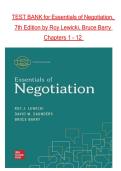
TEST BANK for Essentials of Negotiation,
7th Edition by Roy Lewicki, Bruce Barry
Chapters 1 - 12
,Table of Contents
\ \
1. The\ \ Nature\ \ of\ \ Negotiation
2. Strategy\ \ and\ \ Tactics\ \ of\ \ Distributive\ \ Bargaining
3. Strategy\ \ and\ \ Tactics\ \ of\ \ Integrative\ \ Negotiation
4. Negotiation:\ \ Strategy\ \ and\ \ Planning
5. Ethics\ \ in\ \ Negotiation
6. Perception,\ \ Cognition,\ \ and\ \ Emotion
7. Communication
8. Finding\ \ and\ \ Using\ \ Negotiation\ \ Power
9. Relationships\ \ in\ \ Negotiation
10. Multiple\ \ Parties,\ \ Groups,\ \ and\ \ Teams\ \ in\ \ Negotiation
11. International\ \ and\ Cross-Cultural\ \ Negotiation
12. Best\ \ Practices\ \ in\ \ Negotiations
, Chapter\1
Student:
1. People all\ the\ time.
2. The\ term is\ used\ to\ describe\ the\ competitive,\ win-
lose\ situations\ such\ as\ hagglingover\ price\ that\happens\ at\ yard\ sale,\ flea\ market,\ or\ used\ car\ lot.
3. Negotiating\ parties\ always\ negotiate\ by .
4. There\ are\ times\ when\ you\ should negotiate.
5. Successful\ negotiation\ involves\ the\ management\of\ _
(e.g.,\ the\ price\ or\ the\ terms\ ofagreement)\ and\ also\ the\ resolution\ of.
6. Independent\parties\are\able\to\meet\their\o
wn\without\the\help\and\assistance\ofot\hers.
, 7. The\ mix\ of\ convergent\ and\ conflicting\ goals\ characterizes\ many relationships.
8. The of\ people's\ goals,\ and\ the
of\ the\ situation\ in\ which\ they\ aregoing\ to\ negotiate,\ strongly\ shapes\ negotiation\ p\roces
ses\ and\ outcomes.
9. Whether\ you\ should\ or\ should\ not\ agree\ on\ something\ in\ a\ negotiation\ depends\ entir\el
y\ upon\ th\ eattractiveness\ to\ you\ of\ the\ best\ available .
10. When\ parties\ are\ interdependent,\ they\ have\ to\ find\ a\ way\ to their\ differences.
11. Negotiation\ is\ a that\ transforms\ over\ time.
12. Negotiations\ often\ begin\ with\ statements\ of\ opening .
13. When\ one\ party\ accepts\ \ a\ change\ in\ his\ or\ her\ position,\ a has\ been\ made.
7th Edition by Roy Lewicki, Bruce Barry
Chapters 1 - 12
,Table of Contents
\ \
1. The\ \ Nature\ \ of\ \ Negotiation
2. Strategy\ \ and\ \ Tactics\ \ of\ \ Distributive\ \ Bargaining
3. Strategy\ \ and\ \ Tactics\ \ of\ \ Integrative\ \ Negotiation
4. Negotiation:\ \ Strategy\ \ and\ \ Planning
5. Ethics\ \ in\ \ Negotiation
6. Perception,\ \ Cognition,\ \ and\ \ Emotion
7. Communication
8. Finding\ \ and\ \ Using\ \ Negotiation\ \ Power
9. Relationships\ \ in\ \ Negotiation
10. Multiple\ \ Parties,\ \ Groups,\ \ and\ \ Teams\ \ in\ \ Negotiation
11. International\ \ and\ Cross-Cultural\ \ Negotiation
12. Best\ \ Practices\ \ in\ \ Negotiations
, Chapter\1
Student:
1. People all\ the\ time.
2. The\ term is\ used\ to\ describe\ the\ competitive,\ win-
lose\ situations\ such\ as\ hagglingover\ price\ that\happens\ at\ yard\ sale,\ flea\ market,\ or\ used\ car\ lot.
3. Negotiating\ parties\ always\ negotiate\ by .
4. There\ are\ times\ when\ you\ should negotiate.
5. Successful\ negotiation\ involves\ the\ management\of\ _
(e.g.,\ the\ price\ or\ the\ terms\ ofagreement)\ and\ also\ the\ resolution\ of.
6. Independent\parties\are\able\to\meet\their\o
wn\without\the\help\and\assistance\ofot\hers.
, 7. The\ mix\ of\ convergent\ and\ conflicting\ goals\ characterizes\ many relationships.
8. The of\ people's\ goals,\ and\ the
of\ the\ situation\ in\ which\ they\ aregoing\ to\ negotiate,\ strongly\ shapes\ negotiation\ p\roces
ses\ and\ outcomes.
9. Whether\ you\ should\ or\ should\ not\ agree\ on\ something\ in\ a\ negotiation\ depends\ entir\el
y\ upon\ th\ eattractiveness\ to\ you\ of\ the\ best\ available .
10. When\ parties\ are\ interdependent,\ they\ have\ to\ find\ a\ way\ to their\ differences.
11. Negotiation\ is\ a that\ transforms\ over\ time.
12. Negotiations\ often\ begin\ with\ statements\ of\ opening .
13. When\ one\ party\ accepts\ \ a\ change\ in\ his\ or\ her\ position,\ a has\ been\ made.