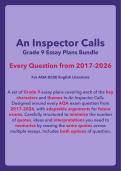
An Inspector Calls
Grade 9 Essay Plans Bundle
Every Question from 2017-2026
For AQA GCSE English Literature
A set of Grade 9 essay plans covering each of the key
characters and themes in An Inspector Calls.
Designed around every AQA exam question from
2017–2026, with adaptable arguments for future
exams. Carefully structured to minimise the number
of quotes, ideas and interpretations you need to
memorise by reusing the same quotes across
multiple essays. Includes both options of question.
, The Inspector/Collective responsibility
• uses dramatic irony and omniscient abilities to warn Birlings and audience
• “if men will not learn that lesson, then they will be taught in fire and blood and anguish”
o “fire and blood and aguish” – triplet nouns, metaphor, evokes emotion in the
audience as they just recovered from WW2 → whole speech is dramatic irony
▪ “blood” – war imagery forces audience to reflect on their own ideals
▪ “men” “they” – vaguer pronouns widen this message to audience, not just
Birlings, contrasts previous “we” → directed at the upper-middle class (Bs)
▪ “learn that lesson” – feels condescending, emphasises Inspector’s role in the
play as a powerful omniscient voice, undermines Mr B’s arrogance
▪ used together to reveal Priestley’s intention to force audience to
acknowledge how ‘they’ didn’t ‘learn that lesson’ and the war happened as
a consequence → evokes fear as they’ve already seen it happen once
o entire speech encapsulates Priestley’s purpose as Goole becomes the playwright’s
mouthpiece and articulates his socialist vision to the audience
• uses setting to reflect the Birling’s warped view on society & how Inspector reveals it
• “pink and intimate” → “brighter and harder” ACT ONE
o “pink” – adjective references idiom ‘through rose coloured glasses’ → audience sees
Birlings at beginning as overly positive and not provided a realistic view of the family
o “intimate” – reflects the closeness of the family, contrasted later once Inspector
arrives (“not the sort of father a chap could go to”) & exposes false nature of this
o “brighter” – directly symbolises the exposing nature of Inspector, lighting used a
motif to represent the audience’s view on the family → pink = loving and perfect,
brighter = exposed realities
o “harder” – reflects firm unmoving nature of inspector, fight for his beliefs
▪ priestly using inspector to voice his socialist values to a targeted upper-
middle class audience → all characters in scene are microcosm for society
(Birlings = stubborn middle class, Inspector = socialist voice of reason)
▪ possibly acknowledges how he cannot address society directly so instead
uses a play to encourage them to listen and understand
• targets audience and quotes socialist message
• “we are members of one body. we are responsible for each other.” ACT THREE
o “we” – collective pronoun highlights importance of collective responsibility as it
addresses both speaker, other characters and the audience → his physical presence
on stage & middle class appearance develop his respectability at a time when these
qualities were wanted in a leading politician, so shows audience that even the most
respectable wealthy people need to play a role in responsibility
Grade 9 Essay Plans Bundle
Every Question from 2017-2026
For AQA GCSE English Literature
A set of Grade 9 essay plans covering each of the key
characters and themes in An Inspector Calls.
Designed around every AQA exam question from
2017–2026, with adaptable arguments for future
exams. Carefully structured to minimise the number
of quotes, ideas and interpretations you need to
memorise by reusing the same quotes across
multiple essays. Includes both options of question.
, The Inspector/Collective responsibility
• uses dramatic irony and omniscient abilities to warn Birlings and audience
• “if men will not learn that lesson, then they will be taught in fire and blood and anguish”
o “fire and blood and aguish” – triplet nouns, metaphor, evokes emotion in the
audience as they just recovered from WW2 → whole speech is dramatic irony
▪ “blood” – war imagery forces audience to reflect on their own ideals
▪ “men” “they” – vaguer pronouns widen this message to audience, not just
Birlings, contrasts previous “we” → directed at the upper-middle class (Bs)
▪ “learn that lesson” – feels condescending, emphasises Inspector’s role in the
play as a powerful omniscient voice, undermines Mr B’s arrogance
▪ used together to reveal Priestley’s intention to force audience to
acknowledge how ‘they’ didn’t ‘learn that lesson’ and the war happened as
a consequence → evokes fear as they’ve already seen it happen once
o entire speech encapsulates Priestley’s purpose as Goole becomes the playwright’s
mouthpiece and articulates his socialist vision to the audience
• uses setting to reflect the Birling’s warped view on society & how Inspector reveals it
• “pink and intimate” → “brighter and harder” ACT ONE
o “pink” – adjective references idiom ‘through rose coloured glasses’ → audience sees
Birlings at beginning as overly positive and not provided a realistic view of the family
o “intimate” – reflects the closeness of the family, contrasted later once Inspector
arrives (“not the sort of father a chap could go to”) & exposes false nature of this
o “brighter” – directly symbolises the exposing nature of Inspector, lighting used a
motif to represent the audience’s view on the family → pink = loving and perfect,
brighter = exposed realities
o “harder” – reflects firm unmoving nature of inspector, fight for his beliefs
▪ priestly using inspector to voice his socialist values to a targeted upper-
middle class audience → all characters in scene are microcosm for society
(Birlings = stubborn middle class, Inspector = socialist voice of reason)
▪ possibly acknowledges how he cannot address society directly so instead
uses a play to encourage them to listen and understand
• targets audience and quotes socialist message
• “we are members of one body. we are responsible for each other.” ACT THREE
o “we” – collective pronoun highlights importance of collective responsibility as it
addresses both speaker, other characters and the audience → his physical presence
on stage & middle class appearance develop his respectability at a time when these
qualities were wanted in a leading politician, so shows audience that even the most
respectable wealthy people need to play a role in responsibility