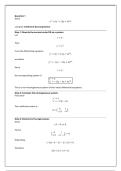
Question 1
Solve
y ′′ + 6y ′ + 13y = 4e2x
using the method of decomposition.
Step 1: Rewrite the second-order DE as a system
Let
z = y′.
Then
z ′ = y ′′ .
From the differential equation,
y ′′ + 6y ′ + 13y = 4e2x ,
we obtain
y ′′ = −6y ′ − 13y + 4e2x .
Since
z = y′,
the corresponding system is
y ′ = z,
z ′ = −13y − 6z + 4e2x .
This is a non-homogeneous system of first-order differential equations.
Step 2: Consider the homogeneous system
First solve
y ′ = z,
z ′ = −13y − 6z.
The coefficient matrix is
0 1
A=( ).
−13 −6
Step 3: Determine the eigenvalues
Solve
∣ A − λI ∣= 0.
Hence
∣∣ −λ 1 ∣
∣−13 −6 − λ∣∣ = 0.
Expanding,
(−λ)(−6 − λ) − 1(−13) = 0.
Therefore
λ(6 + λ) + 13 = 0,
, or
λ2 + 6λ + 13 = 0.
Using the quadratic formula,
−6 ± √36 − 52 −6 ± √−16
λ= = = −3 ± 2i.
2 2
Hence
λ1 = −3 + 2i, λ2 = −3 − 2i.
Step 4: Determine the eigenvectors
Eigenvector corresponding to
λ1 = −3 + 2i
Solve
(A − λI)v = 0.
Thus
3 − 2i 1 v1
( ) (v ) = 0.
−13 −3 − 2i 2
The first row gives
(3 − 2i)v1 + v2 = 0,
so
v2 = −(3 − 2i)v1 .
Choose
v1 = 1.
Then
v2 = −3 + 2i.
Hence
1
v1 = ( ).
−3 + 2i
Eigenvector corresponding to
λ2 = −3 − 2i
Similarly,
1
v2 = ( ).
−3 − 2i
Step 5: Form the complementary solution
The complex solution is
1 1
X = c1 ( ) e(−3+2i)x + c2 ( ) e(−3−2i)x .
−3 + 2i −3 − 2i
Solve
y ′′ + 6y ′ + 13y = 4e2x
using the method of decomposition.
Step 1: Rewrite the second-order DE as a system
Let
z = y′.
Then
z ′ = y ′′ .
From the differential equation,
y ′′ + 6y ′ + 13y = 4e2x ,
we obtain
y ′′ = −6y ′ − 13y + 4e2x .
Since
z = y′,
the corresponding system is
y ′ = z,
z ′ = −13y − 6z + 4e2x .
This is a non-homogeneous system of first-order differential equations.
Step 2: Consider the homogeneous system
First solve
y ′ = z,
z ′ = −13y − 6z.
The coefficient matrix is
0 1
A=( ).
−13 −6
Step 3: Determine the eigenvalues
Solve
∣ A − λI ∣= 0.
Hence
∣∣ −λ 1 ∣
∣−13 −6 − λ∣∣ = 0.
Expanding,
(−λ)(−6 − λ) − 1(−13) = 0.
Therefore
λ(6 + λ) + 13 = 0,
, or
λ2 + 6λ + 13 = 0.
Using the quadratic formula,
−6 ± √36 − 52 −6 ± √−16
λ= = = −3 ± 2i.
2 2
Hence
λ1 = −3 + 2i, λ2 = −3 − 2i.
Step 4: Determine the eigenvectors
Eigenvector corresponding to
λ1 = −3 + 2i
Solve
(A − λI)v = 0.
Thus
3 − 2i 1 v1
( ) (v ) = 0.
−13 −3 − 2i 2
The first row gives
(3 − 2i)v1 + v2 = 0,
so
v2 = −(3 − 2i)v1 .
Choose
v1 = 1.
Then
v2 = −3 + 2i.
Hence
1
v1 = ( ).
−3 + 2i
Eigenvector corresponding to
λ2 = −3 − 2i
Similarly,
1
v2 = ( ).
−3 − 2i
Step 5: Form the complementary solution
The complex solution is
1 1
X = c1 ( ) e(−3+2i)x + c2 ( ) e(−3−2i)x .
−3 + 2i −3 − 2i