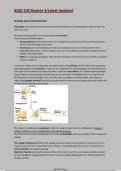
BIOD 102 Module 3/Latest Updated
NEURONS AND ACTION POTENTIALS
Physiology is the branch of science that deals with the functions of a living organism and the "way" the
processes occur.
The communicating cells in the nervous system are neurons.
There are several different kinds:
• Sensory Neurons receive information from an organism's external and internal environment and
transmit the information to the brain
• Interneurons are connecting neurons that are usually part of a circuit. They have the role of
integrating information so that a response can occur. They affect communication between neurons
located in the same region.
• Motor are outgoing messengers. They transmit messages from the brain to muscle fibers or glands
to elicit a response.
A neuron is a nerve cell, the organelles are located within the cell body, which has branched extensions
extending outward called dendrites. These two are responsible for receiving signals from other neurons.
The region of the cell body that meets the axon is called the axon hillock, this is where action potentials
are generated. Once generated, they will travel along the length of the axon, which is an extension for
the transport of action potentials. The end of the axon is arranged in many branches, extending to a
node called synaptic terminal, they form a junction with the next neuron or target tissue and contain the
NT that will be released at the synapse.
The neuron's membranes are polarized, it refers to a state in which there is a difference in charge (or
voltage) inside the neuron (negative) from the outside (positive).
This allows them to communicated with each other via potentials, which are changes to the membrane's
voltage.
The resting membrane potential is the voltage measured inside a neuron when the neuron is at rest, it
measures around -70 mV. Information about stimuli is transmitted along the neuron in the form of an
action potential, via synaptic signaling.
Gated ion channels are closed and prevent flow of ions into or out of the cell, when a stimuli is present
(certain voltage for voltage-gated channels) or a particular ligand (ligand-gated ion channels) they open
to allow ion flow.
BIOD102 Page 1
, 1. A neuron's potassium (K+) channels are closed at rest (at -70mV).
2. Positive (Na+, Ca2+ or K+) enters the cell and becomes more positive. Depolarization.
3. If the depolarization is large enough (in neurons it needs to be around +62mV), it will generate the
action potential along the axon.
4. Channels open and K+ flows out of the cell - membrane's potential changes, becomes more
negative (to about -90mV). Hyperpolarization.
Graded Potentials are electrical shifts within a cell membrane that result in small changes. They can
occur in a depolarization (positive) or hyperpolarization (negative). They are proportional to the
magnitude of the stimuli. They may not cause the cell to fire, since as they travel along the membrane,
they dissipate and eventually expire.
1) The neuron is at resting state, membrane potential is -70mV. The channels are closed.
2) Depolarization: A large stimulus is received, there's a shift in the membrane potential over the
threshold, it causes an action potential to fire. The threshold, which is usually -55mV, voltagegated
sodium channels open, sodium flows down their gradient (from high to low concentration).
3) Rising phase: Sodium continues to flow into the cell causing a greater shift in the positive charge,
causing even more sodium channels to open. The massive influx of sodium initiates the action
potential with a peak magnitude, not dependent of the size of the stimulus, they happen at an
allor-none response.
4) Falling phase or repolarization: Occurs as the sodium channels begin to close and inactivate. At the
same time sodium stops flowing into the cell, the membrane potential begins to shift toward the
negative resting value, causing the potassium channels to open and to leave the cell.
5) Undershoot or hyperpolarization: The calcium channels are slow to close, so more potassium exits
the neuron. The cell is slightly more negative than the resting membrane of -70mV. If another
stimulus were to arrive, it wouldn't be able to put it past the threshold.
This inhibitory state is called refractory period. Due to the inactivation of the sodium channels and the
hyperpolarized state of the neuron. It prevents overstimulation and to keep the action potential moving
down the axon.
BIOD102 Page 2
NEURONS AND ACTION POTENTIALS
Physiology is the branch of science that deals with the functions of a living organism and the "way" the
processes occur.
The communicating cells in the nervous system are neurons.
There are several different kinds:
• Sensory Neurons receive information from an organism's external and internal environment and
transmit the information to the brain
• Interneurons are connecting neurons that are usually part of a circuit. They have the role of
integrating information so that a response can occur. They affect communication between neurons
located in the same region.
• Motor are outgoing messengers. They transmit messages from the brain to muscle fibers or glands
to elicit a response.
A neuron is a nerve cell, the organelles are located within the cell body, which has branched extensions
extending outward called dendrites. These two are responsible for receiving signals from other neurons.
The region of the cell body that meets the axon is called the axon hillock, this is where action potentials
are generated. Once generated, they will travel along the length of the axon, which is an extension for
the transport of action potentials. The end of the axon is arranged in many branches, extending to a
node called synaptic terminal, they form a junction with the next neuron or target tissue and contain the
NT that will be released at the synapse.
The neuron's membranes are polarized, it refers to a state in which there is a difference in charge (or
voltage) inside the neuron (negative) from the outside (positive).
This allows them to communicated with each other via potentials, which are changes to the membrane's
voltage.
The resting membrane potential is the voltage measured inside a neuron when the neuron is at rest, it
measures around -70 mV. Information about stimuli is transmitted along the neuron in the form of an
action potential, via synaptic signaling.
Gated ion channels are closed and prevent flow of ions into or out of the cell, when a stimuli is present
(certain voltage for voltage-gated channels) or a particular ligand (ligand-gated ion channels) they open
to allow ion flow.
BIOD102 Page 1
, 1. A neuron's potassium (K+) channels are closed at rest (at -70mV).
2. Positive (Na+, Ca2+ or K+) enters the cell and becomes more positive. Depolarization.
3. If the depolarization is large enough (in neurons it needs to be around +62mV), it will generate the
action potential along the axon.
4. Channels open and K+ flows out of the cell - membrane's potential changes, becomes more
negative (to about -90mV). Hyperpolarization.
Graded Potentials are electrical shifts within a cell membrane that result in small changes. They can
occur in a depolarization (positive) or hyperpolarization (negative). They are proportional to the
magnitude of the stimuli. They may not cause the cell to fire, since as they travel along the membrane,
they dissipate and eventually expire.
1) The neuron is at resting state, membrane potential is -70mV. The channels are closed.
2) Depolarization: A large stimulus is received, there's a shift in the membrane potential over the
threshold, it causes an action potential to fire. The threshold, which is usually -55mV, voltagegated
sodium channels open, sodium flows down their gradient (from high to low concentration).
3) Rising phase: Sodium continues to flow into the cell causing a greater shift in the positive charge,
causing even more sodium channels to open. The massive influx of sodium initiates the action
potential with a peak magnitude, not dependent of the size of the stimulus, they happen at an
allor-none response.
4) Falling phase or repolarization: Occurs as the sodium channels begin to close and inactivate. At the
same time sodium stops flowing into the cell, the membrane potential begins to shift toward the
negative resting value, causing the potassium channels to open and to leave the cell.
5) Undershoot or hyperpolarization: The calcium channels are slow to close, so more potassium exits
the neuron. The cell is slightly more negative than the resting membrane of -70mV. If another
stimulus were to arrive, it wouldn't be able to put it past the threshold.
This inhibitory state is called refractory period. Due to the inactivation of the sodium channels and the
hyperpolarized state of the neuron. It prevents overstimulation and to keep the action potential moving
down the axon.
BIOD102 Page 2