

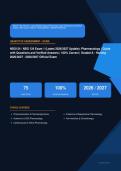
NSG124 / NSG 124 Exam 1 (Latest 2026/2027 Update): Pharmacology | Guide with Questions and Verified
Answers | 100% Correct | Graded A - Herzing 2026/2027 - 2026/2027 Official Exam
OBJECTIVE ASSESSMENT - EXAM
NSG124 / NSG 124 Exam 1 (Latest 2026/2027 Update): Pharmacology | Guide
with Questions and Verified Answers | 100% Correct | Graded A - Herzing
2026/2027 - 2026/2027 Official Exam
75 100%
QUESTIONS VERIFIED ANSWERS EDITION
TOPICS COVERED
Pharmacokinetics & Pharmacodynamics Endocrine & Reproductive Pharmacology
Autonomic & CNS Pharmacology Anti-infectives & Chemotherapy
Cardiovascular & Renal Pharmacology
COVER PAGE - 1
, SECTION 1 | Pharmacokinetics & Pharmacodynamics | Q1-Q15 | NSG124 / NSG 124 Exam 1 (Latest 2026/2027 Update): Pharmacology | Guide with Questions and Verified Answers | 100%
Q1 Question 1 of 75
A 68-year-old male with atrial fibrillation takes oral warfarin 5 mg daily. He is newly
prescribed oral amiodarone 200 mg daily for rhythm control. One week later his INR is
6.2 with no bleeding. Which pharmacokinetic mechanism most directly explains this
interaction?
A. Amiodarone induces CYP2C9 and accelerates warfarin metabolism
B. Amiodarone inhibits CYP2C9, reducing warfarin clearance
C. Amiodarone increases gastric pH and warfarin absorption
D. Amiodarone displaces warfarin from plasma protein binding only
Correct Answer: A
Rationale:
Amiodarone is a potent inhibitor of CYP2C9, the primary enzyme that metabolizes S-warfarin (the more
active enantiomer). This inhibition markedly reduces warfarin clearance and elevates INR, requiring a 25
to 50 percent warfarin dose reduction when amiodarone is added. The effect can persist for months after
amiodarone discontinuation due to its long half-life and tissue accumulation. Induction, pH changes, and
protein-binding displacement alone do not explain the magnitude or duration of this interaction.
Q2 Question 2 of 75
A 55-year-old female takes oral levothyroxine 100 mcg each morning on an empty
stomach for hypothyroidism. She recently began taking calcium carbonate 600 mg with
her levothyroxine and now reports fatigue and a rising TSH. Which pharmacokinetic
process is most directly affected by this interaction?
A. Distribution into thyroid tissue
B. Absorption from the gastrointestinal lumen
C. Hepatic conjugation
D. Renal tubular secretion
Correct Answer: B
Rationale:
Calcium carbonate complexes with levothyroxine in the intestinal lumen, reducing drug absorption and
lowering serum thyroxine, which produces a compensatory rise in TSH. Levothyroxine should be taken
on an empty stomach and separated from calcium, iron, and other binders by at least 4 hours. The
interaction does not affect distribution, hepatic metabolism, or renal excretion. Choice A is incorrect
because tissue distribution is not the rate-limiting step here.
NSG124 / NSG 124 Exam 1 (Latest 2026/2027 Update): Pharmacology | Guide with Questions and -- 2026/2027 | Passing Score: 80% | Page 2 of 41
, Q3 Question 3 of 75
A 62-year-old male with hypertension is prescribed oral propranolol 40 mg twice daily.
The provider notes that bioavailability is only about 25 percent despite nearly complete
gastrointestinal absorption. Which pharmacokinetic phenomenon best explains the
reduced bioavailability of propranolol?
A. Renal tubular reabsorption
B. P-glycoprotein efflux in the gut
C. Extensive first-pass hepatic metabolism
D. High plasma protein binding
Correct Answer: C
Rationale:
Propranolol is highly lipophilic and almost completely absorbed, but it undergoes extensive first-pass
metabolism in the liver, leaving only about 25 percent of the dose reaching systemic circulation. This is
why oral doses are much higher than intravenous doses for the same effect. Renal reabsorption,
P-glycoprotein efflux, and protein binding do not account for the magnitude of the loss. Choice D would
affect free drug concentration, not total bioavailability.
Q4 Question 4 of 75
A 47-year-old female with generalized tonic-clonic seizures is started on oral phenytoin
300 mg daily. After 10 days her level is 22 mcg/mL (therapeutic 10 to 20). The provider
explains that small dose increases are likely to produce disproportionate rises in level.
Which pharmacokinetic property best explains this behavior?
A. Linear first-order elimination
B. Saturable renal tubular secretion
C. Prolonged half-life
D. Saturable (Michaelis-Menten) hepatic metabolism
Correct Answer: D
Rationale:
Phenytoin follows Michaelis-Menten kinetics: at therapeutic doses the hepatic enzymes that hydroxylate
phenytoin become saturated, so small dose increases produce disproportionate rises in serum
concentration. This narrow therapeutic window requires level monitoring and cautious dose titration.
First-order kinetics would produce proportional increases, and renal secretion is not the rate-limiting
step. Choice C is a consequence, not the mechanism.
NSG124 / NSG 124 Exam 1 (Latest 2026/2027 Update): Pharmacology | Guide with Questions and -- 2026/2027 | Passing Score: 80% | Page 3 of 41
, Q5 Question 5 of 75
A 71-year-old male with chronic kidney disease has an eGFR of 28 mL/min. He is
prescribed oral gabapentin 300 mg three times daily for neuropathic pain. Two weeks
later he presents with somnolence and ataxia. Which pharmacokinetic change in older
adults with renal impairment most contributes to gabapentin toxicity?
A. Reduced renal excretion of unchanged drug
B. Increased hepatic CYP3A4 metabolism
C. Enhanced blood-brain barrier permeability
D. Increased gastric absorption
Correct Answer: A
Rationale:
Gabapentin is not metabolized and is eliminated unchanged by the kidneys, so declining renal function
in older adults causes drug accumulation, somnolence, ataxia, and falls. Dose reduction based on
creatinine clearance is required. Hepatic metabolism, blood-brain barrier permeability, and absorption
are not clinically relevant factors for gabapentin accumulation. Choice C is plausible but not the primary
driver in renal impairment.
Q6 Question 6 of 75
A 59-year-old male with type 2 diabetes takes oral metformin 1000 mg twice daily. He is
hospitalized with acute kidney injury from dehydration and a lactate level of 6 mmol/L with
pH 7.25. Which pharmacokinetic property of metformin most directly contributes to this
presentation?
A. Hepatic enzyme inhibition
B. Renal clearance dependence with lactic acid buildup
C. Plasma protein binding displacement
D. First-pass metabolism saturation
Correct Answer: B
Rationale:
Metformin is eliminated unchanged by the kidneys and inhibits mitochondrial complex I, reducing hepatic
gluconeogenesis and increasing lactate production. When renal function declines acutely, metformin
accumulates and lactic acidosis can develop, particularly with hypoperfusion or sepsis. Metformin should
be held during acute kidney injury and around iodinated contrast. Hepatic inhibition and protein binding
are not relevant to this mechanism.
NSG124 / NSG 124 Exam 1 (Latest 2026/2027 Update): Pharmacology | Guide with Questions and -- 2026/2027 | Passing Score: 80% | Page 4 of 41
Answers | 100% Correct | Graded A - Herzing 2026/2027 - 2026/2027 Official Exam
OBJECTIVE ASSESSMENT - EXAM
NSG124 / NSG 124 Exam 1 (Latest 2026/2027 Update): Pharmacology | Guide
with Questions and Verified Answers | 100% Correct | Graded A - Herzing
2026/2027 - 2026/2027 Official Exam
75 100%
QUESTIONS VERIFIED ANSWERS EDITION
TOPICS COVERED
Pharmacokinetics & Pharmacodynamics Endocrine & Reproductive Pharmacology
Autonomic & CNS Pharmacology Anti-infectives & Chemotherapy
Cardiovascular & Renal Pharmacology
COVER PAGE - 1
, SECTION 1 | Pharmacokinetics & Pharmacodynamics | Q1-Q15 | NSG124 / NSG 124 Exam 1 (Latest 2026/2027 Update): Pharmacology | Guide with Questions and Verified Answers | 100%
Q1 Question 1 of 75
A 68-year-old male with atrial fibrillation takes oral warfarin 5 mg daily. He is newly
prescribed oral amiodarone 200 mg daily for rhythm control. One week later his INR is
6.2 with no bleeding. Which pharmacokinetic mechanism most directly explains this
interaction?
A. Amiodarone induces CYP2C9 and accelerates warfarin metabolism
B. Amiodarone inhibits CYP2C9, reducing warfarin clearance
C. Amiodarone increases gastric pH and warfarin absorption
D. Amiodarone displaces warfarin from plasma protein binding only
Correct Answer: A
Rationale:
Amiodarone is a potent inhibitor of CYP2C9, the primary enzyme that metabolizes S-warfarin (the more
active enantiomer). This inhibition markedly reduces warfarin clearance and elevates INR, requiring a 25
to 50 percent warfarin dose reduction when amiodarone is added. The effect can persist for months after
amiodarone discontinuation due to its long half-life and tissue accumulation. Induction, pH changes, and
protein-binding displacement alone do not explain the magnitude or duration of this interaction.
Q2 Question 2 of 75
A 55-year-old female takes oral levothyroxine 100 mcg each morning on an empty
stomach for hypothyroidism. She recently began taking calcium carbonate 600 mg with
her levothyroxine and now reports fatigue and a rising TSH. Which pharmacokinetic
process is most directly affected by this interaction?
A. Distribution into thyroid tissue
B. Absorption from the gastrointestinal lumen
C. Hepatic conjugation
D. Renal tubular secretion
Correct Answer: B
Rationale:
Calcium carbonate complexes with levothyroxine in the intestinal lumen, reducing drug absorption and
lowering serum thyroxine, which produces a compensatory rise in TSH. Levothyroxine should be taken
on an empty stomach and separated from calcium, iron, and other binders by at least 4 hours. The
interaction does not affect distribution, hepatic metabolism, or renal excretion. Choice A is incorrect
because tissue distribution is not the rate-limiting step here.
NSG124 / NSG 124 Exam 1 (Latest 2026/2027 Update): Pharmacology | Guide with Questions and -- 2026/2027 | Passing Score: 80% | Page 2 of 41
, Q3 Question 3 of 75
A 62-year-old male with hypertension is prescribed oral propranolol 40 mg twice daily.
The provider notes that bioavailability is only about 25 percent despite nearly complete
gastrointestinal absorption. Which pharmacokinetic phenomenon best explains the
reduced bioavailability of propranolol?
A. Renal tubular reabsorption
B. P-glycoprotein efflux in the gut
C. Extensive first-pass hepatic metabolism
D. High plasma protein binding
Correct Answer: C
Rationale:
Propranolol is highly lipophilic and almost completely absorbed, but it undergoes extensive first-pass
metabolism in the liver, leaving only about 25 percent of the dose reaching systemic circulation. This is
why oral doses are much higher than intravenous doses for the same effect. Renal reabsorption,
P-glycoprotein efflux, and protein binding do not account for the magnitude of the loss. Choice D would
affect free drug concentration, not total bioavailability.
Q4 Question 4 of 75
A 47-year-old female with generalized tonic-clonic seizures is started on oral phenytoin
300 mg daily. After 10 days her level is 22 mcg/mL (therapeutic 10 to 20). The provider
explains that small dose increases are likely to produce disproportionate rises in level.
Which pharmacokinetic property best explains this behavior?
A. Linear first-order elimination
B. Saturable renal tubular secretion
C. Prolonged half-life
D. Saturable (Michaelis-Menten) hepatic metabolism
Correct Answer: D
Rationale:
Phenytoin follows Michaelis-Menten kinetics: at therapeutic doses the hepatic enzymes that hydroxylate
phenytoin become saturated, so small dose increases produce disproportionate rises in serum
concentration. This narrow therapeutic window requires level monitoring and cautious dose titration.
First-order kinetics would produce proportional increases, and renal secretion is not the rate-limiting
step. Choice C is a consequence, not the mechanism.
NSG124 / NSG 124 Exam 1 (Latest 2026/2027 Update): Pharmacology | Guide with Questions and -- 2026/2027 | Passing Score: 80% | Page 3 of 41
, Q5 Question 5 of 75
A 71-year-old male with chronic kidney disease has an eGFR of 28 mL/min. He is
prescribed oral gabapentin 300 mg three times daily for neuropathic pain. Two weeks
later he presents with somnolence and ataxia. Which pharmacokinetic change in older
adults with renal impairment most contributes to gabapentin toxicity?
A. Reduced renal excretion of unchanged drug
B. Increased hepatic CYP3A4 metabolism
C. Enhanced blood-brain barrier permeability
D. Increased gastric absorption
Correct Answer: A
Rationale:
Gabapentin is not metabolized and is eliminated unchanged by the kidneys, so declining renal function
in older adults causes drug accumulation, somnolence, ataxia, and falls. Dose reduction based on
creatinine clearance is required. Hepatic metabolism, blood-brain barrier permeability, and absorption
are not clinically relevant factors for gabapentin accumulation. Choice C is plausible but not the primary
driver in renal impairment.
Q6 Question 6 of 75
A 59-year-old male with type 2 diabetes takes oral metformin 1000 mg twice daily. He is
hospitalized with acute kidney injury from dehydration and a lactate level of 6 mmol/L with
pH 7.25. Which pharmacokinetic property of metformin most directly contributes to this
presentation?
A. Hepatic enzyme inhibition
B. Renal clearance dependence with lactic acid buildup
C. Plasma protein binding displacement
D. First-pass metabolism saturation
Correct Answer: B
Rationale:
Metformin is eliminated unchanged by the kidneys and inhibits mitochondrial complex I, reducing hepatic
gluconeogenesis and increasing lactate production. When renal function declines acutely, metformin
accumulates and lactic acidosis can develop, particularly with hypoperfusion or sepsis. Metformin should
be held during acute kidney injury and around iodinated contrast. Hepatic inhibition and protein binding
are not relevant to this mechanism.
NSG124 / NSG 124 Exam 1 (Latest 2026/2027 Update): Pharmacology | Guide with Questions and -- 2026/2027 | Passing Score: 80% | Page 4 of 41


