

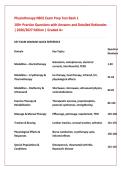
Physiotherapy NBCE Exam Prep Test Bank 1
100+ Practice Questions with Answers and Detailed Rationales
| 2026/2027 Edition | Graded A+
KEY EXAM DOMAINS QUICK REFERENCE
Question
Domain Key Topics
Numbers
Galvanism, iontophoresis, electrical
Modalities – Electrotherapy 1-50
currents, interferential, TENS
Modalities – Cryotherapy & Ice therapy, heat therapy, infrared, UV,
51-63
Thermotherapy physiological effects
Modalities – Diathermy & Shortwave, microwave, ultrasound physics,
64-81
Ultrasound contraindications
Exercise Therapy & Therapeutic exercise, proprioception,
82-124
Rehabilitation postural syndromes, strengthening
Massage & Manual Therapy Effleurage, petrissage, tapotement, TFM 125-130
Traction & Bracing Lumbar traction, cervical traction, orthotics 131-135
Physiological Effects & Nerve conduction, cryotherapy cycle,
136-140
Responses infrared effects
Special Populations & Osteoporosis, rheumatoid arthritis,
141-145
Conditions Raynaud's disease
,SECTION 1: MODALITIES – ELECTROTHERAPY
Questions 1-50
Q1. What is the dosage for low volt galvanism?
A) 0.5 milliamperes per square inch of electrode
B) 1 milliampere per square inch of electrode
C) 2 milliamperes per square inch of electrode
D) 5 milliamperes per square inch of electrode
Answer: B) 1 milliampere per square inch of electrode
Rationale: The standard dosage for low volt galvanism is 1 milliampere per square
inch of electrode surface area . This ensures safe and effective current delivery
without tissue damage.
Q2. Which substance would be used with negative iontophoresis?
A) Calcium
B) Iodine
C) Lidocaine
D) Zinc
Answer: B) Iodine
Rationale: Iodine is a negatively charged ion and is therefore used with negative
iontophoresis. Potassium iodide (KI) is used at the negative pole to break
adhesions . Lidocaine is a positive ion used with positive iontophoresis .
Q3. Why is luminous infrared better than hot moist packs when you want to
relax a muscle spasm?
A) It penetrates deeper into tissues
B) It can be applied over the patient's clothing
C) It provides more heat
D) It is safer for all patients
,Answer: B) It can be applied over the patient's clothing
Rationale: Luminous infrared can be applied over the patient's clothing, making it
more convenient and allowing for continuous treatment without direct skin
contact . Hot moist packs require direct skin contact with multiple towel layers.
Q4. Which body tissue absorbs ultrasound most readily?
A) Bone
B) Muscle
C) Blood vessel
D) Nerve
Answer: C) Blood vessel
Rationale: Blood vessels and connective tissues absorb ultrasound most readily .
Muscle and bone absorb it less efficiently. Ultrasound is absorbed most in
protein-rich tissues like tendons, ligaments, and scar tissue.
Q5. What is the maximum tissue penetration depth of infrared heat therapy?
A) 1 cm
B) 2 cm
C) 5 cm
D) 10 cm
Answer: A) 1 cm
Rationale: Infrared heat therapy penetrates tissue to a maximum of
approximately 1 cm . It is a superficial heating modality. The depth of infrared is
8-10 mm (vascular) .
Q6. When heat is applied to a nerve, the conductivity of the nerve is:
A) Decreased
B) Increased
, C) Unchanged
D) Temporarily blocked
Answer: B) Increased
Rationale: When heat is applied to a nerve, the conductivity of the nerve is
increased . This can contribute to the therapeutic effects of thermotherapy but
also explains why heat can sometimes increase inflammation.
Q7. Which of the following pairs is NOT similar?
A) Short-wave diathermy and microwave diathermy
B) Galvanism and sinusoidal current
C) Ultrasound and active exercise
D) Short-wave diathermy and ultrasound
Answer: C) Ultrasound and active exercise
Rationale: Ultrasound and active exercise are not similar modalities . Ultrasound
is a passive modality; active exercise is active therapy. Galvanism and sinusoidal
current are both electrical modalities.
Q8. What is the functional response of the human body to positive galvanism
(the positive pole)?
A) Stimulation
B) Sedation
C) Contraction
D) Vasodilation
Answer: B) Sedation
Rationale: The positive pole of galvanism causes sedation . The negative pole
causes stimulation. Positive galvanic current produces hyperemia and softened
tissue .
Q9. Galvanism has its most direct effect upon which tissue?
100+ Practice Questions with Answers and Detailed Rationales
| 2026/2027 Edition | Graded A+
KEY EXAM DOMAINS QUICK REFERENCE
Question
Domain Key Topics
Numbers
Galvanism, iontophoresis, electrical
Modalities – Electrotherapy 1-50
currents, interferential, TENS
Modalities – Cryotherapy & Ice therapy, heat therapy, infrared, UV,
51-63
Thermotherapy physiological effects
Modalities – Diathermy & Shortwave, microwave, ultrasound physics,
64-81
Ultrasound contraindications
Exercise Therapy & Therapeutic exercise, proprioception,
82-124
Rehabilitation postural syndromes, strengthening
Massage & Manual Therapy Effleurage, petrissage, tapotement, TFM 125-130
Traction & Bracing Lumbar traction, cervical traction, orthotics 131-135
Physiological Effects & Nerve conduction, cryotherapy cycle,
136-140
Responses infrared effects
Special Populations & Osteoporosis, rheumatoid arthritis,
141-145
Conditions Raynaud's disease
,SECTION 1: MODALITIES – ELECTROTHERAPY
Questions 1-50
Q1. What is the dosage for low volt galvanism?
A) 0.5 milliamperes per square inch of electrode
B) 1 milliampere per square inch of electrode
C) 2 milliamperes per square inch of electrode
D) 5 milliamperes per square inch of electrode
Answer: B) 1 milliampere per square inch of electrode
Rationale: The standard dosage for low volt galvanism is 1 milliampere per square
inch of electrode surface area . This ensures safe and effective current delivery
without tissue damage.
Q2. Which substance would be used with negative iontophoresis?
A) Calcium
B) Iodine
C) Lidocaine
D) Zinc
Answer: B) Iodine
Rationale: Iodine is a negatively charged ion and is therefore used with negative
iontophoresis. Potassium iodide (KI) is used at the negative pole to break
adhesions . Lidocaine is a positive ion used with positive iontophoresis .
Q3. Why is luminous infrared better than hot moist packs when you want to
relax a muscle spasm?
A) It penetrates deeper into tissues
B) It can be applied over the patient's clothing
C) It provides more heat
D) It is safer for all patients
,Answer: B) It can be applied over the patient's clothing
Rationale: Luminous infrared can be applied over the patient's clothing, making it
more convenient and allowing for continuous treatment without direct skin
contact . Hot moist packs require direct skin contact with multiple towel layers.
Q4. Which body tissue absorbs ultrasound most readily?
A) Bone
B) Muscle
C) Blood vessel
D) Nerve
Answer: C) Blood vessel
Rationale: Blood vessels and connective tissues absorb ultrasound most readily .
Muscle and bone absorb it less efficiently. Ultrasound is absorbed most in
protein-rich tissues like tendons, ligaments, and scar tissue.
Q5. What is the maximum tissue penetration depth of infrared heat therapy?
A) 1 cm
B) 2 cm
C) 5 cm
D) 10 cm
Answer: A) 1 cm
Rationale: Infrared heat therapy penetrates tissue to a maximum of
approximately 1 cm . It is a superficial heating modality. The depth of infrared is
8-10 mm (vascular) .
Q6. When heat is applied to a nerve, the conductivity of the nerve is:
A) Decreased
B) Increased
, C) Unchanged
D) Temporarily blocked
Answer: B) Increased
Rationale: When heat is applied to a nerve, the conductivity of the nerve is
increased . This can contribute to the therapeutic effects of thermotherapy but
also explains why heat can sometimes increase inflammation.
Q7. Which of the following pairs is NOT similar?
A) Short-wave diathermy and microwave diathermy
B) Galvanism and sinusoidal current
C) Ultrasound and active exercise
D) Short-wave diathermy and ultrasound
Answer: C) Ultrasound and active exercise
Rationale: Ultrasound and active exercise are not similar modalities . Ultrasound
is a passive modality; active exercise is active therapy. Galvanism and sinusoidal
current are both electrical modalities.
Q8. What is the functional response of the human body to positive galvanism
(the positive pole)?
A) Stimulation
B) Sedation
C) Contraction
D) Vasodilation
Answer: B) Sedation
Rationale: The positive pole of galvanism causes sedation . The negative pole
causes stimulation. Positive galvanic current produces hyperemia and softened
tissue .
Q9. Galvanism has its most direct effect upon which tissue?


