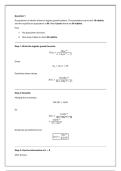
Question 1
A population of rabbits follows a logistic growth pattern. The population starts with 18 rabbits
and the equilibrium population is 90. After 8 years there are 54 rabbits.
Find
1. The population function.
2. How long it takes to reach 85 rabbits.
Step 1: Write the logistic growth formula
𝑘𝑁0 𝑒 𝑟𝑡
𝑁(𝑡) =
𝑘 + 𝑁0 (𝑒 𝑟𝑡 − 1)
Given
𝑁0 = 18, 𝑘 = 90
Substitute these values.
90(18)𝑒 𝑟𝑡
𝑁(𝑡) =
90 + 18(𝑒 𝑟𝑡 − 1)
Step 2: Simplify
Multiply the numerator.
90(18) = 1620
So
1620𝑒 𝑟𝑡
𝑁(𝑡) =
90 + 18𝑒 𝑟𝑡 − 18
1620𝑒 𝑟𝑡
=
72 + 18𝑒 𝑟𝑡
Divide top and bottom by 18.
90𝑒 𝑟𝑡
𝑁(𝑡) =
4 + 𝑒 𝑟𝑡
Step 3: Use the information at 𝒕 = 𝟖
After 8 years,
, 𝑁(8) = 54
Substitute.
90𝑒 8𝑟
54 =
4 + 𝑒 8𝑟
Step 4: Solve for 𝒓
Multiply both sides.
54(4 + 𝑒 8𝑟 ) = 90𝑒 8𝑟
Expand.
216 + 54𝑒 8𝑟 = 90𝑒 8𝑟
Move terms.
216 = 36𝑒 8𝑟
Divide.
𝑒 8𝑟 = 6
Take logarithms.
8𝑟 = ln 6
ln 6
𝑟=
8
𝑟 = 0.22397
Step 5: Population function
Substitute into the model.
90𝑒 0.22397𝑡
𝑁(𝑡) =
4 + 𝑒 0.22397𝑡
Step 6: Find when 𝑵 = 𝟖𝟓
Substitute.
A population of rabbits follows a logistic growth pattern. The population starts with 18 rabbits
and the equilibrium population is 90. After 8 years there are 54 rabbits.
Find
1. The population function.
2. How long it takes to reach 85 rabbits.
Step 1: Write the logistic growth formula
𝑘𝑁0 𝑒 𝑟𝑡
𝑁(𝑡) =
𝑘 + 𝑁0 (𝑒 𝑟𝑡 − 1)
Given
𝑁0 = 18, 𝑘 = 90
Substitute these values.
90(18)𝑒 𝑟𝑡
𝑁(𝑡) =
90 + 18(𝑒 𝑟𝑡 − 1)
Step 2: Simplify
Multiply the numerator.
90(18) = 1620
So
1620𝑒 𝑟𝑡
𝑁(𝑡) =
90 + 18𝑒 𝑟𝑡 − 18
1620𝑒 𝑟𝑡
=
72 + 18𝑒 𝑟𝑡
Divide top and bottom by 18.
90𝑒 𝑟𝑡
𝑁(𝑡) =
4 + 𝑒 𝑟𝑡
Step 3: Use the information at 𝒕 = 𝟖
After 8 years,
, 𝑁(8) = 54
Substitute.
90𝑒 8𝑟
54 =
4 + 𝑒 8𝑟
Step 4: Solve for 𝒓
Multiply both sides.
54(4 + 𝑒 8𝑟 ) = 90𝑒 8𝑟
Expand.
216 + 54𝑒 8𝑟 = 90𝑒 8𝑟
Move terms.
216 = 36𝑒 8𝑟
Divide.
𝑒 8𝑟 = 6
Take logarithms.
8𝑟 = ln 6
ln 6
𝑟=
8
𝑟 = 0.22397
Step 5: Population function
Substitute into the model.
90𝑒 0.22397𝑡
𝑁(𝑡) =
4 + 𝑒 0.22397𝑡
Step 6: Find when 𝑵 = 𝟖𝟓
Substitute.