

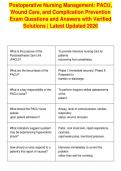
Postoperative Nursing Management: PACU,
Wound Care, and Complication Prevention
Exam Questions and Answers with Verified
Solutions | Latest Updated 2026
What is the purpose of the To provide intensive nursing care for
Postanesthesia Care Unit patients
(PACU)? recovering from anesthesia.
What are the two phases of the Phase I: Immediate recovery; Phase II:
PACU? Prepared for
transfer or discharge.
What is a key responsibility of the To perform frequent skilled assessments
PACU nurse? of the
patient.
What should the PACU nurse Airway, level of consciousness, cardiac,
assess respiratory
upon patient admission? status, wound, and pain.
What indicators suggest a patient Pallor, cool moist skin, rapid respirations,
may be experiencing hypovolemic cyanosis,
shock? rapid weak pulse, low blood pressure.
How should a nurse respond to a Intervene immediately to control the
patient's first report of nausea? problem
rather than wait for vomiting.
Wound Care, and Complication Prevention
Exam Questions and Answers with Verified
Solutions | Latest Updated 2026
What is the purpose of the To provide intensive nursing care for
Postanesthesia Care Unit patients
(PACU)? recovering from anesthesia.
What are the two phases of the Phase I: Immediate recovery; Phase II:
PACU? Prepared for
transfer or discharge.
What is a key responsibility of the To perform frequent skilled assessments
PACU nurse? of the
patient.
What should the PACU nurse Airway, level of consciousness, cardiac,
assess respiratory
upon patient admission? status, wound, and pain.
What indicators suggest a patient Pallor, cool moist skin, rapid respirations,
may be experiencing hypovolemic cyanosis,
shock? rapid weak pulse, low blood pressure.
How should a nurse respond to a Intervene immediately to control the
patient's first report of nausea? problem
rather than wait for vomiting.


