

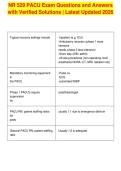
NR 529 PACU Exam Questions and Answers
with Verified Solutions | Latest Updated 2026
Typical recovery settings include -Inpatient (e.g. ICU)
-Ambulatory recovery (phase 1 more
intensive
needs, phase 2 less intensive)
-Short stay (23hr admit)
-off-site procedures (non-operating room
anesthesia NORA- CT, MRI, radiation etc)
Mandatory monitoring equipment -Pulse ox
in -ECG
the PACU -automated NIBP
Phase 1 PACU's require anesthesiologist
supervision
by
PACU RN: patient staffing ratios usually 1:1 due to emergence delirium
for
peds
General PACU RN: patient staffing Usually 1:2 is adequate
ratio
,ASA post-anesthesia care ALL PATIENTS WHO HAVE RECEIVED
standard 1 GENERAL
ANESTHESIA, REGIONAL ANESTHESIA
OR
MONITORED ANESTHESIA CARE
SHALL RECEIVE
APPROPRIATE POSTANESTHESIA
MANAGEMENT.
ASA post-anesthesia care A PATIENT TRANSPORTED TO THE
standard 2 PACU SHALL
BE ACCOMPANIED BY A MEMBER OF
THE
ANESTHESIA CARE TEAM WHO IS
KNOWLEDGEABLE ABOUT THE
PATIENT'S
CONDITION.
THE PATIENT SHALL BE CONTINUALLY
EVALUATED AND TREATED DURING
TRANSPORT
WITH MONITORING AND SUPPORT
APPROPRIATE TO THE PATIENT'S
CONDITION.
ASA post-anesthesia care UPON ARRIVAL IN THE PACU, THE
standard 3 PATIENT SHALL
BE RE-EVALUATED AND A VERBAL
REPORT
PROVIDED TO THE RESPONSIBLE
PACU NURSE
BY THE MEMBER OF THE ANESTHESIA
CARE
TEAM WHO ACCOMPANIES THE
PATIENT.
, ASA standard 4 post-anesthesia THE PATIENT'S CONDITION SHALL BE
care EVALUATED CONTINUALLY IN THE
PACU
ASA standard 5 A PHYSICIAN IS RESPONSIBLE FOR
THE
DISCHARGE OF THE PATIENT FROM
THE
POSTANESTHESIA CARE UNIT.
Positions patients should be Trendelenberg, or back-up
placed
during transport to PACU
Trendelenberg position useful for hypovolemic patients
Head-up position useful for patients with underlying pulmonary
dysfunction
Elevating the HOB before the airway obstruction (put an oral/nasal
patient airway until
is responsive can lead to the pt can maintain airway)
Patients at risk of vomiting or Lateral; helps prevent airway obstruction
upper and
airway bleeding should be promotes the drainage of secretions
transported in which position?
with Verified Solutions | Latest Updated 2026
Typical recovery settings include -Inpatient (e.g. ICU)
-Ambulatory recovery (phase 1 more
intensive
needs, phase 2 less intensive)
-Short stay (23hr admit)
-off-site procedures (non-operating room
anesthesia NORA- CT, MRI, radiation etc)
Mandatory monitoring equipment -Pulse ox
in -ECG
the PACU -automated NIBP
Phase 1 PACU's require anesthesiologist
supervision
by
PACU RN: patient staffing ratios usually 1:1 due to emergence delirium
for
peds
General PACU RN: patient staffing Usually 1:2 is adequate
ratio
,ASA post-anesthesia care ALL PATIENTS WHO HAVE RECEIVED
standard 1 GENERAL
ANESTHESIA, REGIONAL ANESTHESIA
OR
MONITORED ANESTHESIA CARE
SHALL RECEIVE
APPROPRIATE POSTANESTHESIA
MANAGEMENT.
ASA post-anesthesia care A PATIENT TRANSPORTED TO THE
standard 2 PACU SHALL
BE ACCOMPANIED BY A MEMBER OF
THE
ANESTHESIA CARE TEAM WHO IS
KNOWLEDGEABLE ABOUT THE
PATIENT'S
CONDITION.
THE PATIENT SHALL BE CONTINUALLY
EVALUATED AND TREATED DURING
TRANSPORT
WITH MONITORING AND SUPPORT
APPROPRIATE TO THE PATIENT'S
CONDITION.
ASA post-anesthesia care UPON ARRIVAL IN THE PACU, THE
standard 3 PATIENT SHALL
BE RE-EVALUATED AND A VERBAL
REPORT
PROVIDED TO THE RESPONSIBLE
PACU NURSE
BY THE MEMBER OF THE ANESTHESIA
CARE
TEAM WHO ACCOMPANIES THE
PATIENT.
, ASA standard 4 post-anesthesia THE PATIENT'S CONDITION SHALL BE
care EVALUATED CONTINUALLY IN THE
PACU
ASA standard 5 A PHYSICIAN IS RESPONSIBLE FOR
THE
DISCHARGE OF THE PATIENT FROM
THE
POSTANESTHESIA CARE UNIT.
Positions patients should be Trendelenberg, or back-up
placed
during transport to PACU
Trendelenberg position useful for hypovolemic patients
Head-up position useful for patients with underlying pulmonary
dysfunction
Elevating the HOB before the airway obstruction (put an oral/nasal
patient airway until
is responsive can lead to the pt can maintain airway)
Patients at risk of vomiting or Lateral; helps prevent airway obstruction
upper and
airway bleeding should be promotes the drainage of secretions
transported in which position?


