

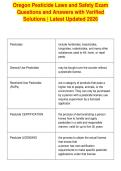
Oregon Pesticide Laws and Safety Exam
Questions and Answers with Verified
Solutions | Latest Updated 2026
Pesticides include herbicides, insecticides,
fungicides, rodenticides, and many other
substances used to kill, harm, or repel
pests.
General Use Pesticides may be bought over the counter without
a pesticide license.
Restricted Use Pesticides are a category of products that pose a
(RUPs) higher risk to people, animals, or the
environment. They can only be purchased
by a person with a pesticide license; use
requires supervision by a licensed
applicator.
Pesticide CERTIFICATION the process of demonstrating a person
knows how to handle and apply
pesticides in a safe and responsible
manner. valid for up to five (5) years
Pesticide LICENSING the process to obtain the actual license
that shows that
a person has met certification
requirements to make specific pesticide
applications under that license.
,PRIVATE PESTICIDE needed to purchase, apply, or supervise
APPLICATOR LICENSE the use of restricted-use pesticides
(RUPs) on land in agricultural production
that a person, or their employer owns,
leases, or rents. This includes farmland,
rangeland, forests, greenhouses,
nurseries, orchards, etc.
IMMEDIATELY SUPERVISED for individuals who work under the
Pesticide TRAINEE LICENSE supervision of a Commercial or Public
Pesticide Applicator.
• Must be on-site at all times with the
trainee when making pesticide
applications, and
• Be able to reach the trainee's location
within five minutes.
• No required exam
Trainees may only make applications
within their supervisor's categories.
• The supervising applicator is
responsible for training the Immediately
Supervised Trainee
, PESTICIDE APPRENTICE individuals who work under the
LICENSE supervision of a Commercial or Public
Pesticide Applicator.
• The supervising applicator does not
need to be onsite when the apprentice is
making pesticide applications, BUT the
apprentice must be able to reach the
supervising applicator at all times.
• The Pesticide Apprentice is not a
certified applicator. In order to renew this
license, beyond the first year, the
apprentice will need to attend eight (8)
hours of approved continuing education
classes. The eight hours must consist of at
least four (4) hours of CORE credits. If the
apprentice does not accrue the required
credit hours, they will need to retake the
Laws & Safety exam to re-license.
• Required exam: Laws & Safety
Apprentices may only make applications
within their supervisor's categories. The
supervising applicator is responsible for
training the apprentice.
Questions and Answers with Verified
Solutions | Latest Updated 2026
Pesticides include herbicides, insecticides,
fungicides, rodenticides, and many other
substances used to kill, harm, or repel
pests.
General Use Pesticides may be bought over the counter without
a pesticide license.
Restricted Use Pesticides are a category of products that pose a
(RUPs) higher risk to people, animals, or the
environment. They can only be purchased
by a person with a pesticide license; use
requires supervision by a licensed
applicator.
Pesticide CERTIFICATION the process of demonstrating a person
knows how to handle and apply
pesticides in a safe and responsible
manner. valid for up to five (5) years
Pesticide LICENSING the process to obtain the actual license
that shows that
a person has met certification
requirements to make specific pesticide
applications under that license.
,PRIVATE PESTICIDE needed to purchase, apply, or supervise
APPLICATOR LICENSE the use of restricted-use pesticides
(RUPs) on land in agricultural production
that a person, or their employer owns,
leases, or rents. This includes farmland,
rangeland, forests, greenhouses,
nurseries, orchards, etc.
IMMEDIATELY SUPERVISED for individuals who work under the
Pesticide TRAINEE LICENSE supervision of a Commercial or Public
Pesticide Applicator.
• Must be on-site at all times with the
trainee when making pesticide
applications, and
• Be able to reach the trainee's location
within five minutes.
• No required exam
Trainees may only make applications
within their supervisor's categories.
• The supervising applicator is
responsible for training the Immediately
Supervised Trainee
, PESTICIDE APPRENTICE individuals who work under the
LICENSE supervision of a Commercial or Public
Pesticide Applicator.
• The supervising applicator does not
need to be onsite when the apprentice is
making pesticide applications, BUT the
apprentice must be able to reach the
supervising applicator at all times.
• The Pesticide Apprentice is not a
certified applicator. In order to renew this
license, beyond the first year, the
apprentice will need to attend eight (8)
hours of approved continuing education
classes. The eight hours must consist of at
least four (4) hours of CORE credits. If the
apprentice does not accrue the required
credit hours, they will need to retake the
Laws & Safety exam to re-license.
• Required exam: Laws & Safety
Apprentices may only make applications
within their supervisor's categories. The
supervising applicator is responsible for
training the apprentice.


